Crypto Debit Cards Explained: How They Work and What They Really Cost
A crypto debit card lets you pay at a normal shop or website while the money behind it sits in crypto. The card reader sees a regular Visa or Mastercard, but underneath, your tokens get turned into dollars or euros at the moment you tap. That conversion step is where all the interesting details live, and it is also where most people get caught out.
What actually happens when you tap
The merchant terminal does not understand Bitcoin or USDC. It only understands card networks. So a crypto card is really a normal Visa or Mastercard glued to a piece of software that produces fiat the instant you pay.
Picture the flow. You buy a coffee for four dollars. The terminal asks the card network for four dollars. The card program then has to come up with four dollars right then, in the local currency, from whatever you funded the card with. If you funded it with a stablecoin, the swap is tiny. If you funded it with a volatile coin, the program sells just enough of that coin to cover the bill, plus its own cut. Either way, the shop gets paid in regular money and never touches crypto.
That settlement happens in well under a second, which is why these cards feel like any other tap-to-pay card at the till. The crypto part is invisible to the cashier and, honestly, mostly invisible to you too. That is the appeal and the trap.
The three ways a card turns crypto into a payment
Almost every card on the market uses one of three funding models. Knowing which one you are holding tells you most of what you need about cost, tax, and risk.
- Preloaded stablecoin. You move a stablecoin like USDC onto the card account ahead of time. Each tap spends from that pegged balance. Because a stablecoin tracks the dollar, there is little or no price swing between loading and spending, so the conversion cost is small and the tax picture is simple.
- Auto-convert at purchase. You hold a volatile coin, and the card sells the exact slice it needs at the moment you pay. Convenient, but every single tap is a sale of crypto.
- Borrow against collateral. You keep your crypto and the provider lends you fiat against it as a credit line. You spend the loan, not your coins, so you are not selling. The catch is a loan that can be called if the market drops.
Some cards blend these. Bybit's card, for example, spends a fiat balance first and only auto-converts a chosen coin if the fiat runs short. Read the funding page before you decide, because the model decides your costs.
The fee you cannot see: the spread
Cards love to advertise zero fees. Sometimes there genuinely is no line-item fee on a domestic purchase. But there is almost always a spread, and the spread is a real cost even when nothing shows up on your statement.
The spread is the gap between the true market price of a coin and the price the card program gives you when it sells it for you. If the market says one dollar and the program sells your stablecoin at 99.7 cents, that 0.3 percent is money you paid, even though no fee appeared anywhere. On volatile coins the spread is wider, because the program is taking on price risk in the second it holds your sale.
Coinbase is open about this. Its card carries a spread on the underlying crypto sale, and historically a separate liquidation fee around 2.49 percent applies when you convert crypto to spend. Spend a stablecoin or a plain USD balance instead and that conversion fee drops away, leaving only a small spread. So the cheapest way to use a card is often to fund it with a stablecoin and never let it touch a volatile coin at the till.
Cashback and staking, and what they really pay
Cashback is the loudest part of every card pitch, and the part that needs the most squinting.
Crypto.com runs a tiered Visa program. The entry card pays around 1 percent with no stake. Higher cashback needs you to lock the platform's CRO token for 180 days: roughly 2 percent at the Ruby Steel tier, 3 percent higher up, and 5 percent at tiers that ask you to stake tens or hundreds of thousands of dollars of CRO. The rewards pay out in CRO, so your reward is itself a volatile asset, and the stake is locked while it earns.
Coinbase's card offers rotating monthly cashback. The headline 4 percent rate tends to sit on smaller, more volatile tokens, while Bitcoin or Ethereum rewards land closer to 1 percent. In the US the rewards program exists; in the EU and UK you often get the spending function without the cashback. Bybit advertises up to 10 percent, but that top rate is for high-spend VIP tiers, with ordinary users earning closer to 2 percent under a monthly points cap. MetaMask's card pays 1 percent on its free tier and up to 3 percent on the paid Metal tier for the first chunk of yearly spend.
Do the simple math. A 1 percent reward paid in a volatile token, after a 2 percent-ish conversion cost, can be a net loss. Cashback only beats the cost when you spend a stablecoin and the reward rate clears the spread.
MetaMask Card and the self-custody approach
Most cards make you move crypto onto an exchange first. MetaMask's card, run with Mastercard, works differently. Your funds stay in your own MetaMask wallet, on chains like Linea, Base, and Solana, and they only convert at the moment you authorize a payment. You hold the keys right up until the tap.
It supports a range of tokens including USDC, USDT, and the mUSD stablecoin. The free Virtual tier gives 1 percent cashback with a 1 percent cross-border fee; the Metal tier costs 199 dollars a year and offers 3 percent on early spend with no FX markup. MetaMask says it adds no fee of its own on the conversion and uses Mastercard's rate, though you still pay network gas to settle on chain.
One honest note on availability: as of early June 2026, US sign-ups and Metal card orders were temporarily paused. Check the current status on the official site before you plan around it, because these programs open and close by region.
Every auto-convert tap is a taxable sale
This is the part that surprises people, and it is worth being blunt about. In the US, the IRS treats spending crypto as selling it. So if your card auto-converts a volatile coin to pay, every tap is a disposal, and every disposal can create a capital gain or loss based on how the coin moved since you bought it.
Buy a coffee with Bitcoin that has risen since you acquired it, and you owe tax on that little slice of gain. Do it forty times a month and you have forty taxable events to track. The IRS has said this applies even to tiny transactions. There has been talk of a small everyday exemption, but do not assume one exists until it is law.
From 2026, US exchanges issue Form 1099-DA, so these transactions are increasingly visible to the tax authority. A preloaded stablecoin sidesteps most of this pain, because a coin pegged to the dollar barely moves, so the gain or loss on each spend rounds to nothing. If you spend volatile coins through a card, use software that imports your card history and computes the gains, or you will face an ugly reconstruction job at filing time. Rules differ by country, so confirm your own.
Borrow-against-collateral, and the liquidation trap
The borrow model sounds like the best of both worlds. You keep your Bitcoin, you spend a credit line backed by it, and you never trigger a sale, so there is no taxable disposal at the tap. Nexo's card offers a credit mode that works this way.
The risk is the loan itself. The provider tracks your loan-to-value ratio, meaning how big your loan is against the value of your collateral. If your crypto falls, that ratio gets worse even if you stop spending entirely. Cross the provider's threshold and you may be asked to add collateral or repay, and if you cannot, part of your crypto gets sold off to bring the ratio back. With Nexo, liquidation can begin as the ratio climbs toward the low-to-mid 80s percent range, and in a fast drop that can happen quickly.
So borrowing to spend means you are running a leveraged position on your own coffee. Keep the loan small against your collateral, leave a wide buffer, and watch the market. Use this mode only if you actually want a crypto-backed credit line and are willing to babysit it. If you are not, the preloaded stablecoin route is far calmer.
How to pick one without regret
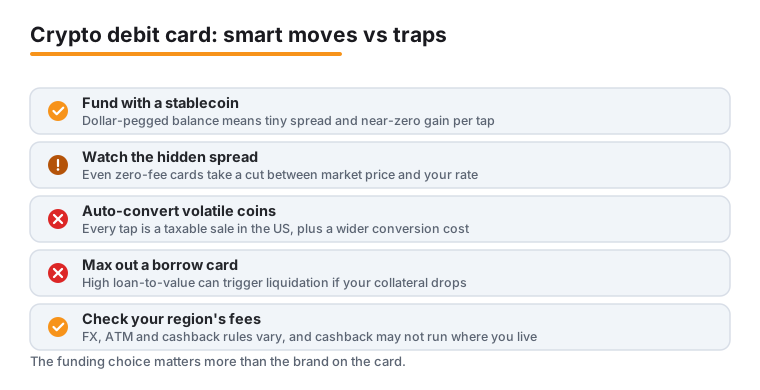
Start with how you intend to fund it, not the cashback number. If you want simple and cheap, load a stablecoin and spend that; you dodge most of the spread, most of the tax mess, and all of the liquidation risk. If you want self-custody, MetaMask's model keeps your keys until you pay. If you genuinely want a credit line against your holdings, the borrow model exists, but treat it like the leverage it is.
Then check the boring details for your country: foreign transaction fees, ATM fees, monthly free withdrawal limits, and whether the cashback program even runs where you live. A card that pays 2 percent but charges 2.49 percent to convert your volatile coin is paying you nothing. The same card, fed a stablecoin, can be genuinely cheap to use. The funding choice matters more than the brand on the front.
Frequently asked questions
Are crypto debit cards really free to use?
Rarely fully free. A domestic purchase may have no line-item fee, but there is almost always a spread, the small gap between the market price and the price the card gives you when it converts your crypto. Some cards also add a conversion or liquidation fee on volatile coins. Spending a stablecoin keeps the cost lowest, often just a fraction of a percent.
Do I owe tax every time I pay with crypto?
In the US, yes, if the card sells crypto to pay. The IRS treats spending crypto as a sale, so each auto-convert tap is a taxable event with a gain or loss based on how the coin moved since you bought it. Spending a dollar-pegged stablecoin makes the gain on each tap essentially zero. From 2026, US exchanges report card activity on Form 1099-DA. Rules vary by country, so check yours.
What is the difference between preloaded, auto-convert, and borrow cards?
Preloaded means you move a stablecoin onto the card and spend that pegged balance, which is cheap and simple. Auto-convert means the card sells a volatile coin at the moment you pay, which is convenient but taxable every tap. Borrow means you keep your crypto and spend a fiat credit line backed by it, which avoids a sale but carries liquidation risk if the market drops.
Can I lose my crypto with a borrow-against-collateral card?
Yes, that is the main risk. Your loan-to-value ratio worsens if your collateral falls in price, even if you stop spending. If it crosses the provider's threshold, part of your crypto can be sold to repay the loan. With Nexo this can begin as the ratio climbs into the low-to-mid 80s percent. Keep the loan small and leave a wide buffer.
Which card gives the best cashback in 2026?
It depends on what you spend and where you live. Crypto.com pays up to 5 percent but needs a large locked CRO stake; its base card is around 1 percent. Coinbase rotates rewards, with the high rate usually on volatile tokens. Bybit advertises up to 10 percent but that is for VIP tiers, with most users near 2 percent. MetaMask pays 1 to 3 percent. Always weigh the reward against the conversion cost.
Is MetaMask Card different from exchange cards?
Yes. It is self-custodial, run with Mastercard. Your crypto stays in your own MetaMask wallet on chains like Linea, Base, and Solana, and only converts when you authorize a payment, so you hold the keys until you tap. Exchange cards usually require you to move funds onto the exchange first. Note that availability changes by region, and US sign-ups were paused in early June 2026, so check the official site.
Last updated: 2026-06-24.