Home › Crypto Regulation › Burkina Faso
Bitcoin & Cryptocurrency Regulation in Burkina Faso
Quick answer — Burkina Faso, 2026
- Legal: Tolerated but unregulated, not legal tender
- Tax: No crypto-specific tax, general rules may apply
- Buying: No local licensed exchanges, use international or P2P via mobile money
Burkina Faso has no dedicated national law that defines, licenses, or bans cryptocurrency. In practice, owning, buying, and selling Bitcoin or other digital assets is tolerated rather than formally regulated, and crypto is not legal tender. Only the West African CFA franc (XOF) is legal tender, and no merchant is obliged to accept crypto. The country belongs to the West African Economic and Monetary Union (WAEMU, in French UEMOA) and shares a single central bank, the Central Bank of West African States (BCEAO, Banque Centrale des Etats de l'Afrique de l'Ouest). That regional structure is decisive: most rules touching crypto here, from anti-money-laundering obligations to foreign-exchange controls, are set at the WAEMU level rather than purely nationally.
This guide explains the current legal status, who regulates what, the regional frameworks that already capture crypto activity, how exchange access and tax work in practice, and recent 2025 to 2026 developments. It is general information as of 2026 and is not legal, tax, or financial advice; rules across West Africa are evolving quickly, so verify anything important with the BCEAO and a qualified Burkinabe professional before acting. For broader background see our guide to crypto regulation and the wider country regulation hub.
On this page: Legal status · Who regulates it · Taxes · How to buy · Mining
Legal status: is crypto legal in Burkina Faso?
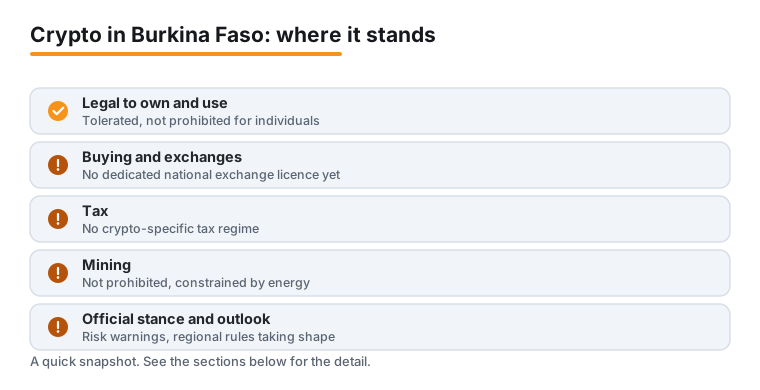
Crypto is legal in the narrow sense that no statute prohibits individuals from buying, holding, or selling Bitcoin and other cryptocurrencies. Equally, no law grants crypto official recognition as money or as a regulated financial instrument. The result is a legal grey zone: digital assets are neither outlawed nor licensed at the national level, and they are not legal tender. Only the West African CFA franc has legal-tender status in Burkina Faso.
The BCEAO and regional bodies have repeatedly cautioned the public about the risks of crypto-assets, including extreme volatility, fraud, scams, and the absence of consumer protection. These warnings are not, by themselves, a ban, but because the domestic environment is undefined, users carry more responsibility than in a country with a licensing regime, and they have limited formal recourse if a platform fails or funds are lost.
The regulator: BCEAO and the WAEMU institutions
There is no national crypto regulator in Burkina Faso. Monetary policy, currency issuance, and the payments system are handled regionally by the Central Bank of West African States (BCEAO), an international public institution headquartered in Dakar, Senegal. The BCEAO is the common central bank for the eight WAEMU member states: Benin, Burkina Faso, Cote d'Ivoire, Guinea-Bissau, Mali, Niger, Senegal, and Togo.
Banking and financial-institution supervision is carried out through the WAMU Banking Commission (Commission Bancaire de l'UMOA). Broader economic and legal harmonisation across the union is coordinated by the WAEMU Commission (UEMOA). Because these institutions set rules union-wide, the crypto framework that reaches Burkinabe users is largely regional, then transposed into national law. Nationally, ordinary business, consumer-protection, and tax authorities still apply to anyone operating a crypto activity.
Key laws and frameworks that touch crypto
Burkina Faso has no stand-alone crypto statute. Instead, several regional layers already capture digital-asset activity:
- WAEMU uniform AML/CFT law (2023). On 31 March 2023 the WAEMU Council of Ministers adopted a uniform law against money laundering, terrorist financing, and the financing of proliferation. It introduced legal definitions of virtual assets and virtual-asset service providers (VASPs, in French PSAV) and subjects those providers to prior authorisation or registration, in line with FATF Recommendation 15. Burkina Faso has now transposed it. On 30 December 2024 the Assemblee Legislative de Transition adopted Loi n. 046-2024/ALT, which carries the virtual-asset and VASP provisions into Burkinabe law and repeals the previous Loi n. 016-2016/AN of 3 May 2016.
- Uniform banking law (2023). A revised banking law adopted on 16 June 2023 broadened the supervised perimeter to include fintechs and electronic-money institutions, tightening oversight of the wider digital-finance sector.
- Foreign-exchange regulation (2024). A new WAEMU foreign-exchange regulation adopted on 20 December 2024 replaced the 2010 rules and reinforced BCEAO control over cross-border flows. Because crypto can move value across borders outside traditional channels, exchange-control rules are part of the legal backdrop.
- General law. Company registration, consumer-protection, and tax obligations apply to crypto businesses like any other.
The direction of travel across the union is regulation and supervision, not blanket prohibition. Verify the latest position on the official BCEAO and WAEMU sites linked at the end of this page.
Licensing and registration of exchanges and VASPs
There is no dedicated national licence for a crypto exchange in Burkina Faso today. However, the 2023 WAEMU uniform AML/CFT law places virtual-asset service providers, which include exchanges, brokers, and custodians, within the regulated perimeter: in principle they must obtain prior authorisation or register with the competent authority before operating, and they are treated as obligated entities for AML/CFT purposes.
The practical gap is no longer transposition but implementation. Article 58 of Loi n. 046-2024/ALT already bars anyone from working as a virtual-asset service provider without the prior licence or authorisation of the competent authority. But the law does not name that authority, Article 59 leaves the specific requirements and the sanctions to be set later by the competent authorities, and Article 205 leaves the detail to implementing texts that have not been published. Until those exist, no operator can actually obtain a Burkinabe crypto licence, and the BCEAO is separately still drafting the union-wide framework. The result is that platforms serving Burkinabe users generally operate without a specific local crypto licence. Treat any service claiming to be fully licensed in Burkina Faso with caution and verify its status before depositing funds.
Crypto and Bitcoin taxation
Burkina Faso has not published a tax regime written specifically for cryptocurrency, but that does not make crypto activity automatically tax-free. General tax principles can apply: income earned through crypto, for example from trading as a business, mining, or being paid in crypto, may be treated as taxable income, and businesses dealing in digital assets remain subject to ordinary corporate and indirect-tax rules.
The General Tax Code, Loi n. 058-2017/AN, contains no occurrence of cryptocurrency, bitcoin or virtual assets, and the 2026 finance law added none. The ordinary rates therefore apply: VAT is fixed at 18% by Art.317, companies are taxed at a flat 27.5% under Art.87, and a business run by a natural person is taxed on the progressive scale in Art.13 and Art.39, namely 10% up to 500,000 CFA francs, 20% from 501,000 to 1,000,000 CFA francs, and 27.5% above 1,000,000 CFA francs. The 2026 finance law also raised VAT withholding at source from 20% to 30%. For an individual making a one-off disposal, the Direction Generale des Impots has published no ruling on which head of charge applies, so no crypto capital-gains rate can honestly be quoted. If you trade actively, mine, or accept crypto in a business, keep detailed records of transactions, dates, and CFA-franc values, and seek advice from a qualified Burkinabe tax professional. For general background see our crypto tax guide. Do not assume crypto is invisible to the authorities.
AML, KYC, and counter-terrorist-financing rules
Anti-money-laundering and counter-terrorist-financing (AML/CFT) is the area where crypto is most clearly captured. The WAEMU uniform AML/CFT law adopted on 31 March 2023 brings virtual-asset service providers into the same obligated-entity regime as financial institutions. In practice that means reputable services handling crypto are expected to apply customer due diligence and identity verification (KYC), monitor transactions, and report suspicious activity, even though crypto itself is not separately licensed at the national level.
Regional authorities have been vocal on this front. The BCEAO has warned about the cross-border nature of crypto-assets, cybersecurity, consumer protection, and heightened money-laundering and terrorist-financing risk, citing international (FATF) concerns about the role of stablecoins in illicit finance. For users this means international platforms will typically require ID checks before allowing fiat deposits, withdrawals, or larger trades, and that informal or anonymous channels carry elevated legal and security risk.
Buying and using crypto in practice
With no domestic licensing regime, residents generally access digital assets through international platforms and peer-to-peer (P2P) marketplaces rather than locally supervised exchanges. In practice that means:
- Global exchanges and broker apps that accept users from Burkina Faso, subject to each platform's own KYC checks and country availability.
- Peer-to-peer trading, where buyers and sellers match directly and settle through local payment rails.
- Mobile-money funding. Mobile money underpins everyday payments in Burkina Faso, with services such as Orange Money and Moov Money widely used. P2P traders frequently fund or cash out through mobile wallets.
The regional payment rails that P2P users rely on are also modernising. On 30 September 2025 the BCEAO launched the Interoperable Instant Payment System Platform (PI-SPI, Plateforme Interoperable du Systeme de Paiement Instantane), which lets banks, electronic-money issuers, microfinance institutions, and payment firms across the WAEMU send and receive funds instantly, around the clock. This is a fiat mobile-money and bank rail rather than a crypto system, but it can make the local funding and cash-out step for P2P trades faster and cheaper. The BCEAO has extended the connection deadline on 25 June 2026, to 30 September 2026 for banks and electronic-money and payment institutions, and to 30 June 2027 for microfinance institutions supervised by the WAMU Banking Commission. As at 24 June 2026, 80 participants were connected and 74 institutions were in live testing ahead of opening services to the public, so coverage is still rolling out.
Crypto can also shorten and cheapen cross-border remittances, an important use case in the region, often using stablecoins to avoid Bitcoin's volatility before a mobile-money cash-out. Because these platforms are not nationally licensed, do your own due diligence: confirm the service genuinely supports Burkina Faso, enable strong security, understand fees and FX spreads, keep records, and never send funds to unverified counterparties. Local protection is limited if something goes wrong, and dedicated crypto ATMs are essentially absent in the country.
Bitcoin mining
No law specifically prohibits cryptocurrency mining in Burkina Faso. As with trading, mining sits in an unregulated rather than a licensed space, and any operation would still be subject to ordinary rules on electricity supply, business registration, and taxation.
The binding constraint is practical: energy. Burkina Faso has constrained generation capacity, periodic power shortages, and relatively high electricity costs, and the grid serves essential needs in homes, healthcare, and education. Large-scale, energy-intensive proof-of-work mining is hard to justify in that context and could compete with priority demand. Renewable sources such as solar are the most credible route to limit grid strain. Anyone evaluating mining should model real, all-in electricity costs and confirm the legality of their power arrangement before investing in hardware.
Recent developments (2025 to 2026)
The regional framework is moving, even if Burkina Faso has passed no crypto-specific national law. Notable recent steps include:
- VASP rules taking shape. Following the 2023 uniform AML/CFT law, member states have been transposing the virtual-asset and VASP provisions into national law, gradually giving the registration and authorisation requirement legal teeth across the union.
- C-CRYPTO committee. The BCEAO announced the C-CRYPTO committee at its Dakar conference of 8 May 2026 to develop crypto-asset regulation for the union, working with the UMOA Financial Markets Authority (AMF-UMOA), the regional securities regulator. That conference produced no immediate normative announcement, and as at 24 July 2026 no draft text had been published and the BCEAO had communicated no publication deadline.
- Dakar conference, May 2026. The BCEAO convened an international conference on crypto-assets and digital innovations on 8 May 2026 at the Terrou-Bi in Dakar, stating that the aim is to strengthen understanding of the economic, monetary, prudential, regulatory, and technological issues raised by crypto-assets, and to formulate recommendations toward a harmonised WAEMU regulatory framework.
- Instant payment platform. On 30 September 2025 the BCEAO launched the Interoperable Instant Payment System Platform (PI-SPI) for real-time transfers across banks, mobile money, and microfinance in the union, with a phased connection deadline running into 2026. This is fiat infrastructure, not crypto, but it reshapes the payment rails that P2P crypto users rely on.
- Central bank digital currency under study. The BCEAO has said it is considering whether to issue its own central bank digital currency (a digital CFA franc), part of a wider effort to modernise payments while protecting monetary sovereignty. This is distinct from private crypto-assets and remains at the study stage.
- Tighter FX and AML posture. The 2024 foreign-exchange regulation and ongoing FATF-aligned vigilance reflect a stance of supervising, not banning, crypto while protecting monetary sovereignty.
Expect incremental, supervised regulation on an open timetable. On 22 July 2026, presenting the BCEAO 2025 annual report in Dakar, Governor Jean-Claude Kassi Brou restated the position on crypto-assets: it is not a currency, it is not regulated, so be careful. With no draft text and no adoption date published, the practical position for the rest of 2026 is unchanged.
Consumer risks and protection
The defining feature of crypto in Burkina Faso is regulatory uncertainty, and that translates into limited consumer protection. There is no national crypto licence, no compensation or deposit-guarantee scheme for crypto, and unclear tax treatment, so if an offshore platform fails, freezes funds, or turns out to be fraudulent, formal recourse is limited. On top of this sit the universal risks: high price volatility, scams and impersonation, phishing, and platform failure.
Sensible precautions include using only well-established services that complete proper KYC, enabling two-factor authentication, considering self-custody (ideally a hardware wallet) for meaningful amounts, never committing money you cannot afford to lose, and treating any promise of guaranteed returns as a warning sign. Keep records of amounts, dates, and CFA-franc values. Follow official BCEAO communications, since the rules and any public warnings can change with little notice.
Official sources and how to verify
Crypto rules in Burkina Faso are regional and evolving, so always check primary sources rather than relying on summaries. The most authoritative are:
- BCEAO (Central Bank of West African States) for monetary policy, payment rules, foreign-exchange regulation, and public communiques and warnings on crypto-assets.
- WAMU Banking Commission (Commission Bancaire de l'UMOA) for supervision of banks, fintechs, and obligated entities, including AML/CFT matters.
- WAEMU Commission (UEMOA) for the uniform laws and directives adopted at union level and their official texts.
For national matters, consult Burkina Faso's tax administration (Direction Generale des Impots) and a licensed local lawyer or accountant. This page is general information as of 2026, not legal, tax, or financial advice; verify the current position with the BCEAO and a qualified Burkinabe professional before acting. See also our crypto regulation overview.
What is changing, and when: the pipeline as at August 2026
Nothing crypto-specific was adopted in Burkina Faso or the WAEMU between 30 June and 3 August 2026. What has moved is the regional signalling, and it points to a longer wait than the phrase "rules are being prepared" suggests. On 22 July 2026, presenting the BCEAO 2025 annual report in Dakar, Governor Jean-Claude Kassi Brou restated the central bank's line on crypto-assets: "Ce n'est pas une monnaie. Ce n'est pas réglementé. Donc soyez prudents", which translates as it is not a currency, it is not regulated, so be careful. He named three risks: high volatility exposing investors to capital losses, the anonymity and frequently cross-border nature of transactions, and exposure to cyberattacks in a market that remains insufficiently regulated (Togo First, 24 July 2026). On the same occasion he said a central bank digital currency "ne se met pas en place du jour au lendemain", and that the e-CFA remains a study with no decision to deploy (Financial Afrik, 23 July 2026).
The drafting work is real but open-ended. The BCEAO says it has established a committee "responsible for developing the regulatory framework relating to crypto-assets in the UMOA, to anticipate technological changes and their implications for the financial sector" (BCEAO, Dakar conference of 8 May 2026). Togo First names it C-CRYPTO, reports that the work is conducted with the Autorité des marchés financiers de l'UMOA (AMF-UMOA), and records that the conference produced no immediate normative announcement and that as at 24 July 2026 "Aucune échéance de publication n'a été communiquée" (Togo First). Plan on the current position holding through 2026.
| Measure | Stage on 3 August 2026 | Timing |
|---|---|---|
| Loi n° 046-2024/ALT, national AML law covering virtual-asset service providers | Adopted and operative | Adopted 30 December 2024 |
| Designation of the competent authority and implementing texts for the VASP licence | Not published | No date announced |
| WAEMU crypto-asset framework (C-CRYPTO with AMF-UMOA) | Committee announced, no draft text, no normative announcement | No publication deadline announced |
| Digital CFA franc (e-CFA) | Study only, no decision to issue | No date announced |
| PI-SPI instant payment connection, fiat rails only | Rolling out | 30 September 2026 for banks and e-money and payment institutions, 30 June 2027 for microfinance |
| Certified electronic invoicing (FEC), applies to any business including a crypto business | Launched, obligation phased in | Mandatory for large enterprises from 1 July 2026 |
The reader's takeaway: the thing most likely to change your position is not a WAEMU crypto law, which has no date, but a Burkinabè implementing text naming the authority that can actually issue the licence already required by statute.
The crypto law Burkina Faso already has: Loi n° 046-2024/ALT
Burkina Faso is often described as having no legislation touching crypto at all. That is not accurate. On 30 December 2024 the Assemblée Législative de Transition adopted Loi n° 046-2024/ALT on money laundering, terrorist financing and the financing of proliferation, the national transposition of the WAEMU uniform law adopted by the UMOA Council of Ministers on 31 March 2023. It carries virtual assets into Burkinabè law directly. The provisions that matter:
- Article 58. "Nul ne peut se livrer à l'activité professionnelle de prestataire de services d'actifs virtuels s'il n'a pas obtenu l'agrément ou l'autorisation préalable de l'autorité compétente." No one may carry on the professional activity of a virtual-asset service provider without first obtaining the licence or prior authorisation of the competent authority. The law does not say which body that is.
- Definitions. A virtual asset is a digital representation of value that can be exchanged or transferred by digital means, excluding digital representations of fiat currencies, securities and other separately regulated financial assets. A virtual-asset service provider is any natural or legal person carrying on commercially, on behalf of or for a client, one or more of five listed activities, beginning with exchange between virtual assets and fiat currency and including transfer, custody and administration.
- Article 59. Persons carrying on VASP activities must comply with the relevant provisions of the law, including its preventive measures. The specific requirements and the sanctions applicable to VASPs "sont précisées par les autorités compétentes", that is, they are left to be set later.
- Article 60. Suspicious transactions are reported to CENTIF, the national financial intelligence unit, on a form set by order of the Minister for Finance.
- Articles 93 and 94. The regional and national money-laundering risk assessments must cover risks arising from virtual assets and from the activities and operations of VASPs.
- Article 205. Implementing texts and guidelines are to specify the detailed rules of application of the law.
- Article 206. The law repeals Loi n° 016-2016/AN of 3 May 2016, the previous AML statute.
What this means in practice differs by reader. If you are an individual buying or holding, nothing here prohibits you and nothing licenses the platform you use. If you want to operate an exchange, brokerage or custody service from Burkina Faso, the activity is not unregulated: it requires prior authorisation by statute. The catch is that the law names no competent authority, expressly defers the specific requirements and sanctions to those authorities, and leaves the detail to implementing texts that have not been published. So at the time of writing no operator can actually obtain a Burkinabè crypto licence. That is why every service serving Burkinabè users is offshore, and why any platform claiming to hold a Burkina Faso crypto licence should be treated as a red flag. Note also that the fine provision at Article 197 covers contraventions of Articles 16 to 57, 61, 63 and 65 and does not list Article 58, so the statute itself attaches no stated penalty to unlicensed VASP activity.
The law is treated as the operative framework by the government: the Ministère de l'Économie et des Finances, in its governance action plan dated December 2025, describes Loi n° 046-2024/ALT as "la base légale actualisée du dispositif national" (Plan d'action pour le renforcement de la gouvernance). The wider AML picture improved on 24 October 2025, when the FATF plenary removed Burkina Faso from its list of jurisdictions under increased monitoring, the grey list, on which it had sat since 2021 (Financial Afrik). That reduces correspondent-banking friction on fiat transfers in and out of the country, but it grants crypto no legal status.
What tax actually applies to crypto today
There is no crypto tax regime in Burkina Faso, and the page should say so once and then be specific. A full-text search of the General Tax Code as published by the tax authority, Loi n° 058-2017/AN portant Code général des impôts, returns no occurrence of cryptocurrency, bitcoin or virtual assets anywhere in the text. The 2026 finance law added none either: its headline change was raising the VAT withholding at source rate from 20% to 30% and widening its scope (Sika Finance, 4 February 2026).
So what governs a crypto activity is the ordinary code, at these rates:
| Charge | Rate | Basis |
|---|---|---|
| VAT (TVA) | 18% | Art.317 of the General Tax Code |
| Company profits (impôt sur les sociétés) | 27.5% flat, no abatement | Art.87 |
| Profits of a natural person, band 0 to 500,000 CFA francs | 10% | Art.13 and Art.39 |
| Profits of a natural person, band 501,000 to 1,000,000 CFA francs | 20% | Art.13 and Art.39 |
| Profits of a natural person above 1,000,000 CFA francs | 27.5% | Art.13 and Art.39 |
| VAT withholding at source | 30%, raised from 20% | 2026 finance law |
The distinction matters: the 10 and 20 percent bands apply to a business run by a natural person, not to a company. An incorporated exchange or mining company pays 27.5% on the whole of its taxable profit.
Separately, any business operating in Burkina Faso is caught by the certified electronic invoice (facture électronique certifiée), launched by the Direction Générale des Impôts on 6 January 2026 to replace the standardised paper invoice created in 2017, and mandatory for large enterprises from 1 July 2026 (DGI).
The honest limit on this: these are the general rates that would apply to a business that trades, mines or accepts crypto. For an individual making a one-off disposal, the Direction Générale des Impôts has published no ruling stating which head of charge applies, so there is no Burkinabè crypto capital-gains rate to quote and anyone telling you otherwise is guessing. Keep dated CFA-franc records of acquisitions and disposals so that whichever treatment is later confirmed can be applied to your history.
Frequently asked questions
Is cryptocurrency legal in Burkina Faso in 2026?
There is no national law that bans crypto and none that formally authorises or recognises it, so buying, holding, and trading digital assets is tolerated but unregulated. Crypto is not legal tender; only the West African CFA franc is. The BCEAO has issued risk warnings and is developing a harmonised regional framework, so the position may evolve. Verify the current status on the official BCEAO site.
Who regulates crypto in Burkina Faso?
There is no dedicated national crypto regulator. Monetary policy and payments are handled regionally by the Central Bank of West African States (BCEAO) for all eight WAEMU/UEMOA members, with banking and fintech supervision through the WAMU Banking Commission. Foreign-exchange and AML/CFT rules are set at the union level, while ordinary business and tax authorities apply nationally.
Do crypto exchanges need a licence in Burkina Faso?
The 2023 WAEMU uniform AML/CFT law brings virtual-asset service providers, including exchanges, into the regulated perimeter and requires them to obtain prior authorisation or register with the competent authority. In practice, the implementing details are still being worked out across the union, so there is no clear dedicated national crypto-exchange licence yet, and most platforms serving Burkinabe users operate from abroad.
Do I have to pay tax on crypto in Burkina Faso?
There is no crypto-specific tax regime. The General Tax Code, Loi n. 058-2017/AN, does not mention cryptocurrency or virtual assets, and the 2026 finance law added nothing. The ordinary rates apply to a crypto business: VAT at 18% under Art.317, a flat 27.5% on company profits under Art.87, and the 10%, 20% and 27.5% progressive scale under Art.13 and Art.39 for a business run by a natural person. No published ruling states how an individual one-off disposal is classified, so keep dated CFA-franc records and consult a qualified local tax professional rather than assume a treatment.
How do people in Burkina Faso buy and cash out Bitcoin?
Most use international exchanges and peer-to-peer marketplaces, funding and withdrawing through mobile money such as Orange Money and Moov Money, since there are no locally licensed crypto exchanges and crypto ATMs are essentially absent. Always confirm a platform supports Burkina Faso, complete KYC, and follow strong security practices, as official protection is limited.
Is Bitcoin mining allowed in Burkina Faso?
No law specifically prohibits mining, but it remains unregulated and subject to general electricity, business, and tax rules. The main obstacle is practical: limited generation capacity, power shortages, and electricity costs make large proof-of-work operations hard to justify. Renewable power, such as solar, is the most realistic option for anyone considering it.
Is the BCEAO planning crypto rules or a digital currency?
Yes, work is under way at the regional level. The BCEAO has set up a dedicated committee (C-CRYPTO) to develop crypto-asset regulation for the WAEMU, and it held an international conference on crypto-assets in Dakar on 8 May 2026 to shape a harmonised framework. Separately, the BCEAO has said it is studying whether to issue a central bank digital currency, a digital CFA franc, which is different from private cryptocurrencies. None of this is yet a finished national law in Burkina Faso, so check the BCEAO site for the current position.
Does BCEAO instant payment (PI-SPI) affect how I move crypto money?
Only indirectly. PI-SPI, the interoperable instant payment platform the BCEAO launched on 30 September 2025, moves fiat CFA francs in real time across banks, mobile money, and microfinance in the union. It is not a crypto network, but because many buyers and sellers fund and cash out peer-to-peer trades through mobile money, faster and cheaper fiat rails can make the local leg of a crypto transaction smoother. Connection for institutions is being phased in through 2026, so availability depends on your provider.
Does Burkina Faso have a law that mentions cryptocurrency?
Yes, in the anti-money-laundering context. Loi n. 046-2024/ALT, adopted by the Assemblee Legislative de Transition on 30 December 2024, defines virtual assets and virtual-asset service providers and, at Article 58, prohibits carrying on the professional activity of a virtual-asset service provider without the prior licence or authorisation of the competent authority. It also routes suspicious-transaction reports to CENTIF and repeals the earlier Loi n. 016-2016/AN of 3 May 2016. What Burkina Faso does not have is a law that regulates crypto as an investment, protects consumers, or gives it any monetary status.
Can a crypto exchange get licensed in Burkina Faso in 2026?
Not in practice. The licence requirement exists in law under Article 58 of Loi n. 046-2024/ALT, but the law does not name the competent authority, Article 59 leaves the specific requirements and sanctions to be set later by those authorities, and the implementing texts contemplated by Article 205 have not been published. So the activity requires authorisation by statute while no authorisation can currently be issued. Treat any platform advertising a Burkina Faso crypto licence as a warning sign and verify before depositing.
When will the WAEMU crypto rules actually arrive?
No date has been announced. The BCEAO announced the C-CRYPTO committee at its Dakar conference on 8 May 2026 to develop a union framework alongside the AMF-UMOA, that conference produced no immediate normative announcement, and as at 24 July 2026 no draft text had been published and no publication deadline had been communicated. A single framework has to be agreed for eight member states, which takes longer than a national law. Do not plan on a WAEMU crypto licensing regime being in force during 2026.
Is Burkina Faso still on the FATF grey list?
No. The FATF plenary removed Burkina Faso from its list of jurisdictions under increased monitoring on 24 October 2025, after it had been listed since 2021, following completion of its action plan. This mainly eases correspondent-banking friction on ordinary fiat transfers. It does not give cryptocurrency any legal status in Burkina Faso and does not create any crypto licensing route.
What did the BCEAO say most recently about crypto?
On 22 July 2026, at the presentation of the BCEAO 2025 annual report in Dakar, Governor Jean-Claude Kassi Brou said of crypto-assets that it is not a currency, it is not regulated, so be careful. He flagged high volatility exposing investors to capital losses, the anonymity and frequently cross-border nature of transactions, and exposure to cyberattacks in an insufficiently regulated market. On a digital CFA franc he said a central bank digital currency is not put in place overnight and that the project remains a study with no decision to deploy.
Facts reviewed: 12 August 2026. Page updated: 12 August 2026.