Bitcoin as a Store of Value & Inflation Hedge
A store of value is anything that holds its purchasing power across time, so that what you save today can still buy a comparable amount of goods years from now. Gold, real estate, and government bonds have traditionally filled that role. Since 2009, a growing number of investors have argued that Bitcoin belongs in the same conversation, framing it as "digital gold" because of its fixed supply and freedom from any central issuer.
This page examines the Bitcoin store of value thesis honestly. It compares Bitcoin with gold, lays out the inflation-hedge argument and its evidence, gives equal weight to the bear case and the real risks, and looks at how the picture may evolve. The aim is to help you understand the debate, not to tell you what to buy. None of this is financial, legal, or tax advice; always confirm current figures and rules with official sources and a qualified professional before acting.
Bitcoin vs gold
The comparison between Bitcoin and gold is the natural starting point because both are positioned as scarce, non-sovereign assets that sit outside the banking system. They share important traits but differ in ways that matter a great deal in practice.
Gold's case rests on roughly five thousand years of continuous use as money and a store of wealth. It is tangible, universally recognised, chemically stable, and impossible to create from nothing. Its annual mined supply grows only a few percent each year, and that growth tends to rise when prices rise, gently capping how scarce it can become. Gold's weaknesses are physical: it is costly to store and insure securely, slow and expensive to move across borders, and difficult to divide or verify without specialist equipment.
Bitcoin attempts to replicate gold's monetary properties in software while removing the physical friction. Its supply is capped at 21 million coins by the protocol's rules, with roughly 19.9 million (about 95%) already in circulation as of 2026 and the remainder issued on a fixed, decreasing schedule. New coins enter at a known rate that halves roughly every four years, a feature with no equivalent in gold. Bitcoin can be sent anywhere in minutes, divided to eight decimal places, verified by anyone running free software, and self-custodied without a vault. Its central weaknesses are its short history, its dependence on electricity and internet access, and price swings far larger than gold's.
The table below summarises the core differences.
| Property | Gold | Bitcoin |
|---|---|---|
| Track record | Thousands of years | Since 2009 |
| Supply limit | Unknown; grows with mining | Capped at 21 million |
| New supply | Roughly a few percent per year | Fixed schedule, halves about every 4 years |
| Portability | Heavy, slow across borders | Sent globally in minutes |
| Divisibility | Limited in practice | To 0.00000001 BTC |
| Verification | Requires assay | Verifiable on open software |
| Volatility | Moderate | High |
| Custody risk | Theft, storage cost | Lost keys, exchange failure, scams |
A useful way to read this is that gold trades certainty of history for physical inconvenience, while Bitcoin trades a far shorter and more volatile record for unmatched portability and provable scarcity. Many holders treat them as complementary rather than as a strict either-or choice.
The inflation-hedge case
Inflation is the gradual loss of a currency's purchasing power. When the supply of money grows faster than the supply of goods and services, each unit buys less over time. The Bitcoin store of value argument is, at its heart, a response to this: hold an asset whose supply cannot be expanded at will, and you are insulated from the dilution that affects government-issued money.
The case rests on a few connected ideas:
- Verifiable scarcity. The 21 million cap is enforced by code that every participant in the network independently checks. No government, company, or individual can mint additional coins, so there is no monetary-policy lever to expand the supply during a crisis.
- A disinflationary issuance schedule. The reward paid to miners for adding new blocks halves roughly every four years. The most recent halving, in April 2024, cut the reward from 6.25 to 3.125 BTC per block, and the next is expected around 2028. Each halving slows the rate of new supply, so Bitcoin becomes progressively scarcer in relative terms over time.
- Independence from any single economy. Because Bitcoin is not tied to one country's central bank, its value is not directly eroded by the monetary decisions of any single government. This is the basis of the "non-sovereign" framing it shares with gold.
- Real-world demand under currency stress. In economies that have experienced rapid currency devaluation, such as Argentina, Turkey, Venezuela, Nigeria, and Zimbabwe, some residents have turned to Bitcoin and dollar-pegged stablecoins to preserve savings when the local currency was losing value quickly. This is frequently cited as evidence that the hedge has practical, not merely theoretical, appeal.
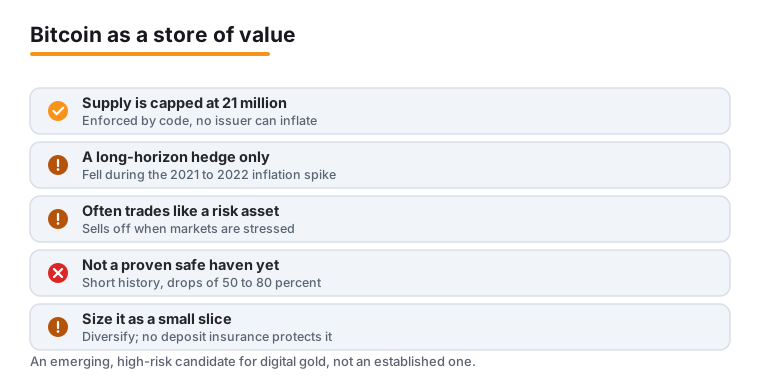
It is important to be precise about the evidence, because this is where careful writing matters most. Over long multi-year periods Bitcoin's price has risen far more than consumer prices, so a buy-and-hold holder has historically outpaced inflation by a wide margin. But over shorter windows the relationship has been inconsistent. During the inflation spike of 2021 to 2022, for example, Bitcoin fell sharply at the same time that headline inflation was high, behaving more like a risk asset than a safe haven. The honest summary is that Bitcoin has functioned as a long-horizon hedge against currency debasement for patient holders, while offering little protection, and sometimes the opposite, against short-term inflation shocks. Anyone relying on it as a hedge should understand which of those two claims they are actually making.
The bear case & risks
A genuinely useful page has to give the skeptical view its full weight. There are serious arguments against treating Bitcoin as a dependable store of value, and they deserve attention before any conclusion.
- Volatility undermines the core function. A store of value is supposed to preserve purchasing power steadily. Bitcoin has repeatedly fallen 50% to 80% from its highs and taken years to recover. An asset that can halve in months is difficult to rely on for near-term needs, regardless of its long-run trajectory.
- The track record is short. Bitcoin has existed since 2009. Gold's monetary history spans millennia and multiple collapses of states and currencies. A decade and a half, however eventful, is a thin basis for confidence that the asset will behave the same way through future crises it has never faced.
- It often trades like a risk asset. In several recent episodes Bitcoin's price has moved in step with speculative technology stocks rather than acting as a safe haven, selling off when markets are stressed and liquidity tightens. That correlation weakens the claim that it is a refuge during turmoil.
- Regulatory and legal uncertainty. Rules on ownership, taxation, exchanges, and custody differ sharply by country and continue to change. Some jurisdictions have restricted or banned aspects of Bitcoin use. Policy shifts can affect both price and the practicality of holding it. Always check the current rules where you live with official sources.
- Custody and operational risk. Self-custody puts full responsibility on the holder: lost private keys mean permanently lost coins, with no recovery and no helpline. Relying on an exchange or custodian instead introduces counterparty risk, as several high-profile failures have shown. Neither path carries deposit insurance comparable to a bank account.
- Energy and infrastructure dependence. Bitcoin relies on a global network of miners and on continuous electricity and internet access. The energy footprint of mining draws ongoing criticism, and the system's dependence on infrastructure is a vulnerability that physical gold does not share.
- The thesis is not guaranteed. Adoption could stall, a technical flaw could emerge, or another asset could displace it. Believing Bitcoin will hold value over time is a forward-looking bet, not an established fact.
None of these points proves that Bitcoin cannot be a store of value. They establish that it is an emerging, high-risk candidate for that role rather than a proven one, and that position sizing and risk tolerance matter enormously.
Long-term outlook
Bitcoin's path from curiosity to a seriously debated store of value has been marked by a series of milestones. In 2010, a programmer famously paid 10,000 BTC for two pizzas, the first known commercial transaction and now remembered each year as Bitcoin Pizza Day. The 2017 run toward roughly $20,000 brought mainstream attention. The arrival of regulated spot Bitcoin exchange-traded funds in the United States, declared effective by the SEC on 10 January 2024 and listed the next day, gave traditional investors a familiar way to gain exposure and pulled significant institutional capital into the asset. Reported assets in those funds have since fluctuated considerably with the market, so treat any specific figure as a snapshot and verify it against current data.
Several structural factors will shape the long-term outlook:
- Maturing access. Regulated funds, custodians, and clearer accounting treatment make it easier for institutions and ordinary savers to hold Bitcoin without managing keys directly, which may broaden and deepen demand.
- A predictable, tightening supply. With about 95% of all coins already issued and further halvings ahead, the flow of new Bitcoin keeps shrinking. Supporters argue this growing scarcity strengthens the store of value case over decades; the last coin is not expected to be mined until around 2140.
- Whether volatility eases. As the asset grows larger and ownership spreads across more long-term holders, some expect price swings to moderate. If that happens, Bitcoin would behave more like the stable store of value its proponents describe. If it does not, the reliability problem persists.
- The regulatory trajectory. Clearer, more consistent rules across major economies could reduce uncertainty and support adoption; restrictive or fragmented rules could do the opposite. This remains one of the largest unknowns.
The realistic conclusion is that Bitcoin and traditional assets are likely to coexist rather than one simply replacing the other. Many investors who accept the thesis treat Bitcoin as one modest component of a diversified portfolio, sized so that its volatility cannot do serious damage, alongside gold, equities, bonds, and cash. Whether it ultimately earns a permanent place as a mainstream store of value is still being decided by adoption, regulation, and time. This is general information, not financial, legal, or tax advice. Do your own research, verify current figures and laws with official sources, and consider speaking with a licensed professional before making decisions.
Frequently asked questions
Is Bitcoin a reliable store of value?
It is best described as an emerging and contested candidate rather than a proven one. Over long multi-year periods it has preserved and grown purchasing power for patient holders, but its sharp volatility, short history, and tendency to fall during market stress mean it has not yet matched the steadiness of established stores of value. It carries meaningfully higher risk than gold or cash.
How is Bitcoin different from gold as a store of value?
Both are scarce and sit outside the banking system, but gold has thousands of years of history and is physical, while Bitcoin has existed only since 2009 and is digital. Bitcoin has a fixed 21 million supply cap and is far easier to move, divide, and verify, whereas gold is heavy, costly to store, and slow across borders. Bitcoin is also considerably more volatile. Many investors hold both as complements.
Does Bitcoin actually protect against inflation?
The argument is that its capped supply shields holders from the currency debasement that affects government-issued money. The evidence is mixed: over long horizons it has outpaced consumer-price inflation, but during the 2021 to 2022 inflation spike it fell sharply rather than acting as a refuge. It has behaved more like a long-term hedge against currency debasement than a reliable hedge against short-term inflation.
What is the 21 million supply cap and why does it matter?
Bitcoin's protocol limits the total number of coins to 21 million, and that limit is enforced by software every participant independently verifies. New coins are issued on a fixed, decreasing schedule, with the block reward halving roughly every four years. Because no one can create additional coins, there is no way to expand the supply during a crisis, which is the foundation of the scarcity argument.
Is it safe to hold Bitcoin long term?
Holding carries real risks beyond price. If you self-custody, losing your private keys means losing the coins permanently with no recovery. Using an exchange or custodian introduces counterparty risk, and there is no deposit insurance comparable to a bank account. Regulation and tax treatment vary by country and change over time. Verify the current rules where you live with official sources and consider professional advice; this page is not financial, legal, or tax advice.
Last updated: 2026-06.