Home › Crypto Regulation › Chile
Bitcoin & Cryptocurrency Regulation in Chile
Quick answer — Chile, 2026
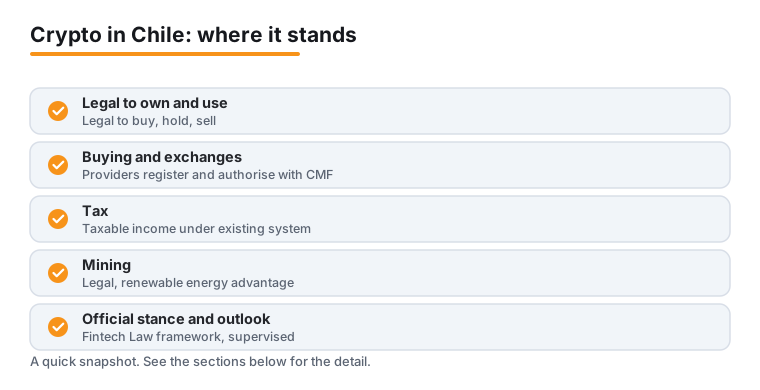
- Legal: Legal to own and trade, not legal tender, providers supervised under Fintech Law
- Tax: Gains taxable as income; no separate flat crypto tax
- Buying: Via CMF-registered exchanges after KYC, or P2P and ATMs
Chile has one of Latin America's most developed and digitally connected economies, and it now has one of the region's more complete legal frameworks for crypto-assets. Buying, holding and selling Bitcoin and other crypto-assets is legal, and since the country's Fintech Law (Ley No. 21,521) took full effect, the businesses that handle crypto operate under formal supervision by the financial regulator rather than in a legal grey zone. Crypto is not, however, legal tender: the Chilean peso (CLP) remains the only official currency, and no one is obliged to accept Bitcoin as payment.
This guide explains how Chile treats Bitcoin and digital assets as of 2026: the legal status, who regulates the sector, the key laws, how exchanges and other service providers must register, how crypto is taxed, anti-money-laundering rules, buying and using crypto in practice, mining, recent 2025 to 2026 developments, consumer risks, and how to verify everything against official sources. The rules are still maturing, so confirm details with the named regulators before acting. This article is general information as of 2026 and is not legal, tax or financial advice. For wider context see our guide to crypto regulation and our country regulation hub.
On this page: Legal status · Who regulates it · Taxes · How to buy · Mining
Is Bitcoin and crypto legal in Chile?
Yes. Buying, holding, selling and using Bitcoin and other crypto-assets is legal in Chile. There is no prohibition on individuals or businesses dealing in digital assets, and crypto exchanges operate openly under the country's Fintech Law framework.
What crypto is not in Chile is legal tender. The Chilean peso (CLP) is the only official currency, and no merchant is legally required to accept Bitcoin as payment. Crypto-assets are treated as private digital assets, not money. Two parties can agree to settle a transaction in crypto if both choose to, but that is a private arrangement rather than a legally enforceable means of payment in the way the peso is.
Chile has not moved to adopt Bitcoin as legal tender in the manner of El Salvador. The policy direction has instead been to recognise crypto-assets, bring the businesses that handle them under supervision, and protect consumers and the integrity of the financial system. Separately, the Central Bank of Chile has been exploring a possible central bank digital currency, often called a digital peso. That is a distinct, state-issued concept and is not the same thing as decentralised cryptocurrencies such as Bitcoin.
Who regulates crypto in Chile?
Several authorities share responsibility, each with a defined role:
- Comision para el Mercado Financiero (CMF) is the principal regulator. The Financial Market Commission supervises financial service providers under the Fintech Law and has issued the implementing rules for crypto-asset service providers, including their registration, authorisation and ongoing obligations.
- Banco Central de Chile (Central Bank of Chile) handles monetary policy and payment systems. Crucially, crypto-assets used as a means of payment, such as fiat-backed stablecoins, fall within the Central Bank's regulatory scope rather than the CMF's. The Central Bank is also exploring a possible central bank digital currency.
- Unidad de Analisis Financiero (UAF), Chile's financial intelligence unit, oversees anti-money-laundering and counter-terrorist-financing compliance under Law No. 19,913 and receives suspicious-operation reports.
- Servicio de Impuestos Internos (SII), the tax authority, sets out how crypto income is declared and taxed and has been actively auditing crypto operations.
You can confirm the regulator's role and find official guidance at the CMF's crypto-asset education page. This guide is general information as of 2026 and not legal advice; verify your situation with the CMF and the other named authorities.
Key laws and frameworks
The cornerstone of crypto regulation in Chile is the Fintech Law (Ley para promover la competencia e inclusion financiera, Law No. 21,521), promulgated in December 2022 and implemented through 2023 and 2024. It created a broad legal framework for financial technology and brought several crypto-related activities under formal supervision. You can read the official text at the Biblioteca del Congreso Nacional (Ley Chile).
The detailed rules sit in CMF regulation, principally General Rule No. 502 (Norma de Caracter General N. 502, NCG 502), issued in January 2024 and in force from 3 February 2024. NCG 502 gathers into a single instrument the Financial Service Providers Registry, the authorisation procedure, disclosure obligations, governance and risk-management rules, and capital and guarantee requirements. It also sets a specific, graduated regime for crypto-assets, including a published list of so-called Type A crypto-assets. The full rule is available as a PDF on the CMF website. The CMF has since amended NCG 502; on 9 February 2026 it issued General Rule No. 559 (NCG 559), which adds a new Chapter X dealing with Fintech services offered by entities the CMF already supervises, such as banks, that are not required to register in the providers registry.
A key distinction in the framework is between crypto-assets used as investment vehicles (regulated by the CMF) and those used as digital money, namely fiat-backed stablecoins, which fall under the Central Bank's scope. The CMF has continued to refine the rules since 2024, so always check the latest version of NCG 502 and related circulars rather than relying on a summary.
Licensing and registration of exchanges
Under the Fintech Law and NCG 502, businesses that provide regulated crypto services must enrol in the CMF's Financial Service Providers Registry. Registration applies whether a provider operates physically in Chile or offers services to people resident in the country. Regulated activities typically include:
- Operating an alternative transaction system (effectively a crypto exchange or trading venue)
- Custody of financial instruments, including crypto-assets
- Order routing and intermediation or brokerage
- Investment advice relating to crypto-assets
Registration alone is not enough to operate. A provider must separately obtain authorisation for each specific service it intends to offer, and authorised providers must meet requirements covering corporate governance, risk management, operational resilience, capital and guarantees, and anti-money-laundering and counter-terrorist-financing controls including customer identification (KYC).
The law set a transition deadline of 3 February 2025 for incumbents to file their registration and authorisation requests; entities that did not register must stop providing regulated services, and the CMF has enforced this: on 26 June 2026 it cancelled 17 registrations and rejected 7 registration and authorisation requests, leaving the cancelled firms able only to conclude existing operations and obliged to tell their clients. The CMF has a defined window to respond to applications, with longer periods for full authorisation than for registration. Because the list of fully authorised providers is still evolving, favour platforms that are transparent about their CMF registration and authorisation status, and you can verify a provider directly with the CMF.
Crypto and Bitcoin tax in Chile
Crypto is taxable in Chile. The tax authority, the Servicio de Impuestos Internos (SII), treats crypto-assets as intangible digital assets that are neither legal tender nor foreign currency, and it regards profits from dealing in them as taxable income.
In broad terms:
- Gains on selling or exchanging crypto are generally taxable. Disposing of crypto for pesos, swapping one crypto for another, or using crypto to pay for goods or services can each trigger a taxable gain measured against your acquisition cost. By contrast, simply buying and holding crypto, or moving it between your own wallets, is generally not a taxable event.
- Individuals declare gains through the annual income-tax return, where they are taxed under the Impuesto Global Complementario at marginal rates running from exempt below CLP 11,265,804 up to 40 per cent above CLP 258,696,240 for tax year 2026 (such as the Global Complementary or Additional Tax), while businesses are taxed under the corporate (first-category) income tax regime.
- Mining, staking and similar rewards are generally treated as income, valued at market price when received.
Chile has no separate flat crypto tax; crypto income slots into the existing income-tax system, so the applicable rate depends on whether you are an individual or a business and on your overall income. The SII can cross-reference exchange data, bank records and blockchain analysis. Rates, brackets, thresholds and reporting duties change over time and depend on your circumstances, so this guide avoids quoting specific percentages. Keep detailed records of every purchase, sale, swap and reward, including dates, amounts and CLP values, and confirm your duties with the SII or a qualified Chilean adviser. The SII publishes guidance in its crypto-assets FAQ. See also our general guide to crypto taxes. This is information, not tax advice.
AML and KYC rules
Crypto service providers in Chile sit inside the country's anti-money-laundering and counter-terrorist-financing (AML/CFT) regime, supervised by the Unidad de Analisis Financiero (UAF) under Law No. 19,913, alongside the prudential obligations imposed by the CMF.
In practice, regulated providers such as exchanges, custodians and brokers are expected to:
- Apply effective KYC procedures and verify the identity of customers
- Identify ultimate beneficial owners and screen for politically exposed persons and international sanctions or blacklists
- Maintain AML/CFT manuals, risk-based monitoring and a designated compliance officer
- Report suspicious operations, and certain cash transactions, to the UAF
- Maintain crime-prevention measures consistent with Chilean rules
For ordinary users, the visible effect is identity verification: reputable platforms require official identification (such as your Chilean ID and RUT, or a passport) and may request proof of address before you can trade, deposit or withdraw. Reporting thresholds and AML standards have been updated as the framework has matured, so providers should track the latest CMF and UAF requirements.
Buying and using crypto in practice
Chileans have several ways to buy crypto. Both international exchanges and Chile-based platforms serve the market, alongside peer-to-peer (P2P) trading and a small number of crypto ATMs. A typical first purchase looks like this:
- Choose a platform that serves Chile and is transparent about its CMF registration and authorisation status. Compare fees, supported payment methods, liquidity and security.
- Create and verify your account by completing KYC, which usually means submitting identification (such as your RUT or passport) and any required proof of address.
- Deposit funds, commonly Chilean pesos via bank transfer. Confirm your bank supports transfers to the platform and check deposit fees. In the past some Chilean banks were reluctant to serve crypto businesses, leading to disputes; access can still vary by institution.
- Place your order using a market or limit order, and review the total cost including spread and trading fees before confirming.
- Secure your holdings by enabling two-factor authentication and, for larger or longer-term amounts, moving funds to a private wallet, ideally a hardware wallet, with your recovery phrase backed up securely.
- Keep records of the date, amount and CLP value of each transaction to support tax reporting.
Crypto ATMs exist mainly in larger cities such as Santiago, but they are limited in number and usually charge more than online exchanges. Never share your private keys or recovery phrase with anyone.
Bitcoin mining in Chile
Bitcoin mining is legal in Chile, and the country has genuine natural advantages. Chile is a leader in renewable energy in South America, with substantial solar capacity in the Atacama Desert, one of the sunniest places on earth, plus growing wind generation. Abundant clean power and periods of surplus generation can make low-carbon mining attractive.
Mining is not, however, a turnkey opportunity. Several practical factors shape the picture:
- Electricity cost and access: profitability hinges on securing cheap, reliable power. Grid constraints and transmission bottlenecks in parts of the country can complicate large operations even where generation is plentiful.
- Hardware and climate: modern ASIC miners and efficient cooling are essential; some operators exploit the arid climate and renewable supply to improve efficiency.
- Compliance: miners are subject to general business, electricity, environmental and tax rules, and mining rewards are generally treated as taxable income (see the tax section).
There is no dedicated national crypto-mining licence, but anyone running a meaningful operation should treat it as a regulated business activity and confirm electricity, permitting and tax obligations locally. Chile's renewable profile gives it real potential as a sustainable mining location, though that potential depends on power agreements and infrastructure rather than regulation alone.
Recent developments (2025 to 2026)
The framework has continued to move quickly:
- Registration transition closed: the 3 February 2025 deadline for existing providers to file CMF registration and authorisation requests passed, marking the shift from a transitional phase to a supervised market under NCG 502.
- NCG 502 amended by NCG 559: on 9 February 2026 the CMF issued General Rule No. 559, which adds a new Chapter X to NCG 502. It covers Fintech services provided by entities the CMF already supervises (such as banks) that are not required to enrol in the providers registry, and it sets a prior-notification duty, with a transitional deadline of 30 April 2026 for those already offering such services to notify the CMF.
- Tax enforcement stepped up: in September 2025 the SII publicly said it had put crypto-asset operations in its sights, reporting 13 completed audit cases with additional collection of close to 5 billion pesos, involving undeclared crypto gains and unsubstantiated transaction costs. Treat declaration and record-keeping as a real compliance priority.
- New provider reporting declarations created: by Exempt Resolutions No. 113 and No. 114 of 26 August 2025, the SII created two annual sworn statements for crypto and digital-asset service providers. Declaration No. 1964 reports users resident or domiciled in Chile, and Declaration No. 1963 reports non-resident users, in each case identifying users, account controllers, wallet addresses and specified transactions (purchases, sales, exchanges, transfers and payments). Both are due for the first time by 30 June 2026 and support automatic exchange of information with foreign tax authorities.
- Stablecoin regulation under study: in 2026 the Central Bank of Chile said in its Informe de Sistemas de Pago of August 2026 that it is gathering information with a view to producing a proposal towards the end of 2026, and that the proposal will be a first regulatory approach complementary to the CMF provisions, with a view to a normative framework in 2027, gathering information from local platforms and consulting market participants, academics and other regulators as part of a broader digital-payments agenda.
- Digital peso exploration: the Central Bank continued its applied exploration of a possible central bank digital currency, a separate, state-issued initiative distinct from decentralised crypto. You can follow this work on the Central Bank's central bank digital currency page.
Because dates and obligations in this area can change, confirm any specific deadline or rule directly with the relevant authority before relying on it.
Consumer risks and protection
Crypto in Chile carries the same core risks as anywhere: sharp price volatility, the potential loss of funds through hacks or mistakes, scams and fraudulent schemes, and the challenge of safely self-custodying assets. Regulatory and tax rules can also change, affecting how you use or report your holdings.
The protective developments are real but partial. With the Fintech Law in force and the CMF progressively authorising exchanges and custodians, users dealing with registered, authorised providers benefit from governance, risk-management and AML standards that did not previously exist. The CMF also publishes alerts about unregulated or suspicious investment platforms, and dealing only with authorised providers is the single most effective way to reduce counterparty risk.
Practical safeguards for everyday users: use reputable, CMF-registered and authorised platforms; check the regulator's warnings before sending money to any platform you do not recognise; protect your private keys and recovery phrase; enable two-factor authentication; keep thorough records for tax; and be sceptical of anything promising guaranteed returns, which is a common hallmark of fraud. This guide is informational only and not legal, tax or financial advice.
Official sources and how to verify
Because the rules continue to evolve, always confirm the current position with the official authorities rather than third-party summaries. The primary sources are:
- CMF (Comision para el Mercado Financiero) for the regulator's role, the provider registry, authorisation and the crypto regime: the CMF crypto-asset guidance and the full text of NCG 502 (PDF).
- Ley Chile / Biblioteca del Congreso Nacional for the official text of the Fintech Law: Ley No. 21,521.
- SII (Servicio de Impuestos Internos) for tax treatment and declarations: the SII crypto-assets FAQ.
- Banco Central de Chile for stablecoins, payments and the digital peso: the Central Bank digital currency page.
For AML matters, the Unidad de Analisis Financiero (UAF) at uaf.cl is the relevant authority. This article is general information as of 2026 and is not legal, tax or financial advice; verify your specific situation with the named regulators, above all the CMF, or with a qualified Chilean professional. For more context, see our crypto regulation explainer.
What is changing: Chile's crypto rules in 2026 and 2027
Chile's crypto rulebook has not changed since February 2026. What moved is the pipeline, and it moved at the Banco Central de Chile rather than at the CMF. The Banco Central's Informe de Sistemas de Pago of August 2026 carries a chapter on stablecoins and states, among its own policy developments, that the stablecoin regulatory framework to be published for consultation forms part of a gradual regulatory approach.
On timing, the Banco Central's summary of the same report says the Ley Fintec gave the BCCh powers to regulate the issuance and functioning as a means of payment of stablecoins, that it is gathering information with a view to producing a proposal towards the end of this year, and that the proposal will be a first regulatory approach complementary to the CMF provisions, with a view to a normative framework in 2027. In plain terms: a consultation proposal late in 2026, a framework in 2027. Nothing has been published yet, so there is no text to read.
| Measure | Who | Stage in August 2026 | Expected timing | What it would mean |
|---|---|---|---|---|
| Stablecoin issuance framework | Banco Central de Chile, using Ley Fintec powers | Announced, no text published | Consultation proposal towards the end of 2026, framework in 2027 | Conditions for issuing stablecoins in Chile for use as a means of payment. Aimed at issuers and payment firms rather than individual holders |
| CMF norm required before banks may provide the services referred to in NCG 559 | CMF | Required by NCG 559, not issued | No date announced | Until it exists, banking entities may not provide the services the norm identifies |
| Sistema de Finanzas Abiertas (open finance) | CMF, NCG 514 as modified on 1 June 2026 | Adopted, entry into force pushed back | July 2027, phased | Not crypto specific, but it is the Ley Fintec limb that slipped in 2026 |
| Instant payments regulation for merchant acceptance | Banco Central de Chile | To be published for consultation | Stated in the August 2026 report | Peso payment rails, not crypto |
| Moneda Digital de Banco Central (CBDC) | Banco Central de Chile | Proof of concept testing since June 2025, no decision to issue | None stated | No practical effect on holders. The bank says information is still insufficient to decide |
One absence is worth stating as a finding. The CMF's own regulatory plan for 2026 and 2027, published on 4 March 2026, names no virtual asset norm. Its Ley Fintec entries are the open finance modification with technical annexes, a norm on complementary activities of entities registered in the Registro de Prestadores de Servicios Financieros, and normative files on financial statements for crowdfunding platforms and alternative trading systems. As of 12 August 2026 the CMF's public consultation list contained nothing on crypto, custody or the Ley Fintec. If you are waiting for the CMF to change the crypto rules, its published plan does not schedule it.
Crypto tax in Chile, in actual numbers
There is no separate crypto tax in Chile. Gains fall into the ordinary income tax system, and the rate depends on who holds the asset. For an individual who does not hold crypto through a business, the SII states that the mayor valor is the sale price less the tax adjusted acquisition cost, with the cost adjusted by the change in the consumer price index between the month before acquisition and the month before sale, and that the gain is taxed only with the Impuesto Global Complementario or the Impuesto Adicional as applicable. That guidance was last updated on 24 October 2025 and is published in the SII cryptocurrency FAQ.
These are the Impuesto Global Complementario brackets the SII publishes for tax year 2026, in Chilean pesos of annual taxable income.
| Annual taxable income (CLP) | Marginal rate |
|---|---|
| 0 to 11,265,804 | Exempt |
| 11,265,804 to 25,035,120 | 4% |
| 25,035,120 to 41,725,200 | 8% |
| 41,725,200 to 58,415,280 | 13.5% |
| 58,415,280 to 75,105,360 | 23% |
| 75,105,360 to 100,140,480 | 30.4% |
| 100,140,480 to 258,696,240 | 35% |
| Over 258,696,240 | 40% |
Source: SII, Impuesto Global Complementario table, ano tributario 2026. These are the same brackets that apply to other income, so a crypto gain is stacked on top of what you already earned that year rather than taxed in isolation.
If crypto is held in a business, the gain is taxed first at company level under the Impuesto de Primera Categoria. The SII publishes the rate as 27% under the Regimen General or Semi Integrado. Under the Pro Pyme General regime the rate is 25%, while a Pro Pyme Transparente company is released from the Impuesto de Primera Categoria and its owners pay their final taxes on the company result.
On VAT the position is settled and old. In Oficio N° 963 of 14 May 2018 the SII concluded that the sale of bitcoin or other virtual or digital assets is not subject to IVA because it falls on intangible goods. That ruling is published at sii.cl. Income tax still applies to the gain.
The reporting side is now built on an international standard. Resolucion Exenta N° 114 of 2025 created Declaracion Jurada Formulario N° 1964 for taxpayers with tax residence or domicile in Chile, and states that the obligation follows from the implementation of CARF and article 33 bis N° 1 of the Codigo Tributario. The SII filing instructions define the terms by reference to the OECD Crypto-Asset Reporting Framework, its XML format and the OECD list of Relevant Crypto-Assets, and define a crypto-asset service provider as anyone who, as a business, provides a service effecting exchange transactions for or on behalf of clients, whether as counterparty, as intermediary, or by making a trading platform available. The parallel return for users with tax residence abroad, Formulario 1963, was created by Resolucion Exenta N° 113 of 2025.
Enforcement in 2026: what the CMF actually did
The most concrete change in Chile during 2026 was not a new rule but the CMF using the one it has. On 26 June 2026 the CMF cancelled the registrations of 17 entities and individuals, 14 investment advisers and 3 other financial service providers, for failing to comply with requirements of Ley N° 21.521 and NCG N° 502. The CMF stated that they may not continue providing the financial services covered by the law, that they cease to be covered by the transitional authorisation the Ley Fintec granted, and that they must inform their clients of this and of how existing operations will be concluded.
On the same day the CMF rejected 7 registration and authorisation requests, citing incomplete documentation, missing information needed to determine the regulatory classification, absent financial statements audited by an external audit firm, and failure to evidence customer guarantees. The seven named firms are Inversiones ABJ SpA, Orionx SpA, Gaeval Servicios Financieros SpA, Inversiones JBT SpA, Factoring Nacional SpA, Sociedad de Inversiones XI Business Limitada and LTC Factoring SpA. Orionx is a Chilean crypto exchange, so the practical point for users is that a well known local platform had its request rejected by the regulator.
Separately, on 4 August 2026 the CMF published a market alert naming seven entries that are neither registered nor authorised: EXNESS, SUNIX, EL BARCO DRAGON SpA, an OKX impersonator listed as ACADEMIA DE PENSAMIENTO DE CAPITAL OPPENHEIMER, LAVANDBIT SUMMIT or LAVAND BIT, a BAK and BAK TRADE impersonator listed as CRISSTOMO SPA and INFINITY SPA, and WARREN BOWIE & SMITH with SECURCAP SECURITIES (MU) LTD and KALAMINION HOLDINGS LIMITED. Two of the seven are flagged by the CMF as imitators of real brands, which is the specific scam pattern to watch for in Chile right now.
Before sending money to any platform, check it against the CMF's Registro de Prestadores de Servicios Financieros, and read the result carefully. The registry itself warns that mere registration in it does not enable provision of the services regulated by the law. NCG 502 repeats the point and puts the responsibility on each entity to obtain authorisation alongside registration. Registered but not authorised is not the same as authorised.
How virtual assets fit into the Ley Fintec categories
Chile has no standalone crypto exchange licence. The CMF registry lists seven Ley Fintec services: plataformas de financiamiento colectivo, sistemas alternativos de transaccion, asesoria crediticia, asesoria de inversion, custodia de instrumentos financieros, enrutamiento de ordenes and intermediacion de instrumentos financieros. A crypto business is authorised under whichever of those it actually performs, most often a sistema alternativo de transaccion together with custodia and intermediacion, rather than under a crypto specific permission.
That structure produces one crypto specific listing rule. NCG 502, dated 12 January 2024, provides that in respect of virtual assets only crypto-assets that have a public document containing the technical specifications allowing the technology and the aspects relevant to buyers to be understood may be admitted to quotation, for example which assets are digitally represented, what rights the acquirer will have, against whom those rights run, and whether they are civil or natural obligations. In practice that is a disclosure gate: a token with no published specification cannot be listed by an authorised Chilean venue.
NCG 502 also sets capital on a sliding scale. For capital purposes a firm falls into Bloque 3 if it has more than 5.000 active clients, more than UF 500.000 in average daily transactions over the last three months, average daily custodied assets over UF 100.000, or revenue over UF 50.000 over the last twelve months. A Bloque 3 firm providing intermediacion or custodia must permanently hold adjusted equity or guarantees of at least the greater of UF 5.000 or 3 per cent, rising to 6 per cent, of its assets weighted by financial and operational risk. Bloque 1 firms are exempt from minimum capital and guarantees, and Bloque 2 firms providing intermediacion or custodia must hold at least UF 1.000. A firm reclassified upward gets six months to comply.
The February 2026 amendment changed who else may play. NCG 559, dated 9 February 2026, lets already supervised entities, namely securities intermediaries under Ley N° 18.045, product exchanges and brokers under Ley N° 19.220, general fund managers and portfolio managers under Ley N° 20.712, risk rating agencies, insurers and reinsurers, and entities regulated by Ley N° 18.876, begin providing Ley Fintec services by informing the CMF through CMF Supervisa, with no RPSF registration and no separate authorisation. Firms already providing them had to notify by 30 April 2026. Banks are handled separately: the norm says that for banks, provision of the services indicated in numeral 7 of the second paragraph of article 5 of Ley N° 21.521, in whatever is not already regulated by the Ley General de Bancos, will be subject to a specific norm the CMF must still issue, and that while that norm is not issued banking entities may not provide the services indicated. That norm does not appear in the CMF's published plan for 2026 and 2027.
Frequently asked questions
Is cryptocurrency legal in Chile?
Yes. Buying, holding, selling and using crypto-assets is legal in Chile, and exchanges operate openly under the Fintech Law. However, crypto is not legal tender; only the Chilean peso is official currency, so no one is obliged to accept Bitcoin as payment.
Who regulates crypto in Chile?
The main regulator is the Comision para el Mercado Financiero (CMF), which supervises crypto service providers under the Fintech Law (Law No. 21,521) and its rule NCG 502. The Central Bank of Chile handles payment-related crypto such as stablecoins, the UAF oversees anti-money-laundering compliance, and the SII handles tax.
Do crypto exchanges need a licence in Chile?
Yes. Under the Fintech Law and NCG 502, providers of regulated crypto services (such as exchanges, custody, brokerage, order routing and investment advice) must enrol in the CMF's Financial Service Providers Registry and obtain separate authorisation for each service. Existing providers had to file their requests by 3 February 2025. Favour platforms that are transparent about their CMF status.
Do I have to pay tax on crypto in Chile?
Generally yes. The SII treats crypto as a taxable intangible asset, and profits from selling, swapping or spending it, as well as mining and staking rewards, are typically subject to income tax. Simply holding or moving crypto between your own wallets is generally not taxable. Rates depend on whether you are an individual or a business and on your overall income, so keep detailed records and confirm your duties with the SII or a tax professional. This is not tax advice.
What are the AML and KYC rules for crypto in Chile?
Regulated crypto providers must apply AML/CFT controls supervised by the UAF under Law No. 19,913 and by the CMF. That means verifying customer identity (KYC), identifying beneficial owners, screening for sanctions and politically exposed persons, and reporting suspicious operations to the UAF. In practice you will be asked for official identification, such as your RUT or passport, before trading or withdrawing.
Do Chilean exchanges report my crypto to the tax authority?
Yes. Chilean crypto service providers file annual information returns identifying their users and reporting specified transactions: Declaracion Jurada 1964, created by SII Resolucion Exenta N° 114 of 2025 for users resident or domiciled in Chile, and Formulario 1963, created by Resolucion Exenta N° 113 of 2025 for users with tax residence abroad. Both are built on the OECD Crypto-Asset Reporting Framework. By Exempt Resolutions No. 113 and No. 114 of 26 August 2025, the SII created two annual sworn statements for crypto and digital-asset service providers: Declaration No. 1964 for users resident or domiciled in Chile and Declaration No. 1963 for non-resident users. Providers must identify users, wallet addresses and specified transactions such as purchases, sales, exchanges and transfers, with the first filing due by 30 June 2026. The data also supports automatic exchange of information with foreign tax authorities, so keep your own records accurate.
Has the CMF changed the crypto rules since NCG 502?
Yes. NCG 502, in force from 3 February 2024, remains the core rule, but the CMF has amended it. On 9 February 2026 it issued General Rule No. 559 (NCG 559), which adds a new Chapter X covering Fintech services offered by entities the CMF already supervises, such as banks, that are not required to enrol in the providers registry, with a prior-notification duty and a transitional deadline of 30 April 2026. Always check the latest version of NCG 502 and related rules on the CMF website.
Where can I verify Chile's crypto rules officially?
Check the official authorities directly: the CMF (cmfchile.cl) for the provider registry and crypto rules including NCG 502, the Biblioteca del Congreso Nacional (bcn.cl) for the text of Law No. 21,521, the SII (sii.cl) for tax, and the Banco Central de Chile (bcentral.cl) for stablecoins and the digital peso. This guide is general information as of 2026 and not legal advice.
Is Chile passing a crypto law in 2026?
No crypto specific statute exists, and the CMF's regulatory plan for 2026 and 2027, published on 4 March 2026, names no virtual asset norm. The only crypto rulemaking that can be verified as under way is at the Banco Central de Chile, which is preparing a stablecoin framework rather than a law. Crypto continues to be governed by the Ley Fintec (Ley N° 21.521) and CMF Norma de Caracter General N° 502 as amended by NCG N° 559 of 9 February 2026.
When will Chile regulate stablecoins, and what will it require?
The Banco Central de Chile said in its Informe de Sistemas de Pago of August 2026 that it is gathering information with a view to producing a proposal towards the end of 2026, and that the result will be a first regulatory approach complementary to the CMF rules, with a view to a normative framework in 2027. The Ley Fintec already gives it powers over the issuance and functioning of stablecoins as a means of payment. In an interview published on 13 July 2026, vice president Alberto Naudon described the model as one where the issuer backs each token with liquid and safe assets in a one to one proportion, and warned that a legal right to redeem at par is only meaningful if the holder has access to the issuer, a sufficiently fast process and a cost that does not make the promise irrelevant. No draft text exists yet, so any detail beyond that is speculation.
Can Chilean banks offer crypto services?
CMF Norma de Caracter General N° 559 of 9 February 2026 lets several kinds of already supervised firms provide Ley Fintec services by informing the CMF, but treats banks separately. It says that for banks, provision of the services indicated in numeral 7 of the second paragraph of article 5 of Ley N° 21.521, in whatever is not already regulated by the Ley General de Bancos, will be subject to a specific norm the CMF must still issue, and that while that norm is not issued banking entities may not provide those services. No date has been announced for it and it is not named in the CMF's plan for 2026 and 2027.
Do I pay VAT when I sell crypto in Chile?
No. In Oficio N° 963 of 14 May 2018 the SII concluded that the sale of bitcoin or other virtual or digital assets is not subject to IVA because it falls on intangible goods. Income tax still applies to the gain.
How do I check whether a Chilean crypto platform is legitimate?
Search the CMF's Registro de Prestadores de Servicios Financieros, and read the result carefully. The CMF warns on the registry itself that mere registration does not enable a firm to provide the services regulated by the law, because a separate authorisation is required. Also check the CMF's market alerts: on 4 August 2026 it named seven unregistered and unauthorised entries, two of them flagged as imitators of real brands, including a fake OKX listed as Academia de Pensamiento de Capital Oppenheimer.
Has a Chilean crypto exchange been refused authorisation?
Yes. On 26 June 2026 the CMF rejected seven registration and authorisation requests, and the crypto exchange Orionx SpA was among the named firms. The CMF cited failures to remedy observations or provide required documentation, including financial statements audited by an external audit firm and evidence of customer guarantees. On the same day the CMF cancelled the registrations of 17 other entities and individuals, 14 of them investment advisers.
Facts reviewed: 12 August 2026. Page updated: 12 August 2026.