Home › Crypto Regulation › Rwanda
Bitcoin & Cryptocurrency Regulation in Rwanda
Quick answer — Rwanda, 2026
- Legal: Owning not criminal, not legal tender; 2026 law licenses providers, unauthorised services illegal
- Tax: No crypto-specific tax; general RRA rules may apply
- Buying: Franc-to-crypto trading restricted; use licensed providers, verify with CMA
Rwanda's approach to cryptocurrency shifted decisively in 2026. For years the country had no dedicated crypto statute, and the National Bank of Rwanda (BNR) repeatedly warned the public against trading digital assets. On 5 May 2026 Parliament unanimously adopted a law governing virtual asset business, which was published in the Official Gazette on 28 May 2026 and is now in force. The result is one of East Africa's first comprehensive legal frameworks for the sector, built around licensing and tight controls rather than open adoption.
This page explains, in plain language, the current legal status of Bitcoin and other crypto-assets in Rwanda, who regulates them, how exchanges, tax, mining and consumer protection are treated, and where things are still evolving. This is general information as of 2026 and is NOT legal, tax or financial advice. The implementing regulations are still being written, so always verify the current position with the Capital Market Authority, the National Bank of Rwanda or the Rwanda Revenue Authority, or consult a qualified Rwandan professional, before acting. For broader background see our guide to crypto regulation.
On this page: Legal status · Who regulates it · Taxes · How to buy · Mining
Is Bitcoin and crypto legal in Rwanda?
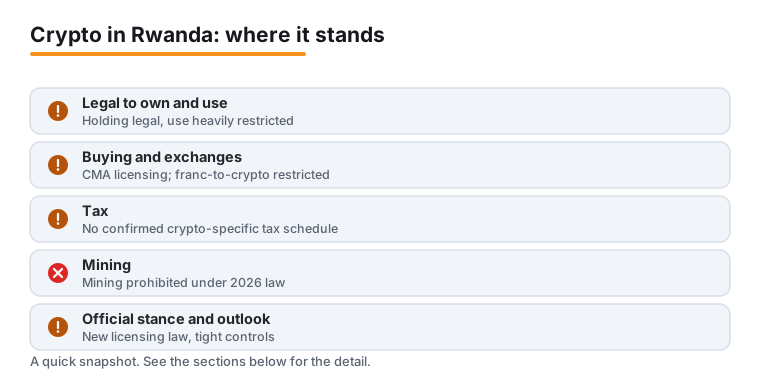
Owning Bitcoin and other crypto-assets is not in itself a crime in Rwanda, and the country has now created a legal pathway for licensed virtual asset businesses to operate. But "regulated" is not the same as "freely usable." Two points are central:
- Crypto is not legal tender. The National Bank of Rwanda has repeatedly stated that the Rwandan franc (FRW) is the country's sole legal tender and that crypto-assets are not recognised as a means of payment. Under current rules, crypto cannot be used for payments, exchanged into francs, or traded peer-to-peer (P2P) against the franc without authorisation.
- Services require a licence. Providing virtual asset services, such as running an exchange, custody, broking or token issuance, is only lawful if the provider is licensed by the regulator. Operating without authorisation is a criminal offence under the 2026 law.
So a legal framework now exists, but ordinary consumer use of crypto in Rwanda remains restricted and closely supervised rather than encouraged. This is general information as of 2026, not legal advice; verify the current position with the regulators named below.
Who regulates crypto in Rwanda?
Two public bodies share responsibility, plus the tax authority:
- Capital Market Authority (CMA) is the designated lead regulator for virtual assets under the 2026 law. The CMA licenses and supervises virtual asset service providers and is drafting the secondary regulations that will operate the licensing regime. Its official website is cma.rw.
- National Bank of Rwanda (BNR) is the central bank. It works with the CMA on financial stability, payment systems and systemic risk, and it is the body that has enforced the "crypto is not legal tender" position. Its official website is bnr.rw.
- Rwanda Revenue Authority (RRA) administers taxation, including any tax that applies to crypto-related income or gains. Its official website is rra.gov.rw.
Anti-money-laundering oversight also involves Rwanda's financial-intelligence functions, and the framework is described as aligning with Financial Action Task Force (FATF) standards.
Key crypto laws and frameworks in Rwanda
The cornerstone is the 2026 Law on Virtual Asset Business, formally Law number 023/2026 of 25 May 2026, adopted by Parliament on 5 May 2026 (passed unanimously with 69 votes in a joint session) and published in the Official Gazette on 28 May 2026. It replaces Rwanda's earlier stance, which relied mainly on central-bank warnings and the absence of dedicated legislation. Key features include:
- Scope. The rules cover virtual asset service providers (VASPs) such as exchanges, custodians, brokers and platforms that convert between fiat and digital assets, as well as token issuers. Some categories, including algorithmic stablecoins, privacy coins, NFTs and certain other assets, were reported as excluded from the regulated scope.
- Lead regulator. The CMA supervises the sector, coordinating with the BNR on stability and systemic risk.
- Entity-only licensing. Only incorporated legal entities may be licensed; individuals cannot obtain a VASP licence.
- AML/CFT. The framework imposes anti-money-laundering and counter-terrorist-financing obligations, reporting duties and compliance standards aligned with FATF guidance.
- Implementing rules pending. Detailed licensing procedures, capital requirements and conduct standards are being set out in secondary regulations that were still being finalised in mid-2026.
Because the rulebook is being built out, the practical detail may change. Treat the points above as the shape of the regime, and check the CMA for current specifics.
Licensing and registration of exchanges and VASPs
Under the new framework, exchanges and other platforms serving Rwandan users are expected to be licensed by the CMA, meet AML and know-your-customer (KYC) standards, and comply with reporting, conduct and capital requirements. Important practical points:
- Only entities can be licensed. Individuals cannot hold a VASP licence; a provider must be an incorporated company.
- Franc-to-crypto trading is restricted. The BNR has made clear that buying or selling crypto directly against the franc, including via P2P features, is not permitted without authorisation. On 5 April 2026 it publicly warned after the exchange Bybit added FRW peer-to-peer support, reaffirming the prohibition. Other exchanges, including Binance, had offered FRW pairs for longer without the same public response.
- Penalties for operating without authorisation. The 2026 law carries substantial fines and possible imprisonment for unlicensed activity. Reported figures include a fine of RWF 70 million to RWF 100 million for a company that provides virtual asset services without a licence, RWF 120 million to RWF 150 million for issuing virtual assets without approval, and RWF 15 million to RWF 20 million for marketing virtual asset business without authorisation. Prohibited activities such as unauthorised mining, ATMs or mixer services are reported to draw fines of RWF 20 million to RWF 30 million and imprisonment of two to three years for individuals, and RWF 70 million to RWF 100 million for legal entities.
As licensed providers come online, the safest route will be a VASP that is authorised by the CMA and transparent about its compliance status. Always verify a provider's licensing directly with the CMA before depositing funds. See our regulation hub for how licensing works in other countries.
Crypto and Bitcoin tax in Rwanda
The 2026 virtual asset law is primarily a licensing and supervision statute; it does not, on its own, create a bespoke crypto tax code. Crypto activity in Rwanda is therefore generally expected to fall under existing tax principles administered by the Rwanda Revenue Authority rather than a separate crypto-specific rate. Depending on the facts, that can mean profits from crypto-related business activity are subject to business or income tax, that individual gains may be assessed under applicable capital-gains or income provisions, and that indirect taxes and reporting obligations apply to licensed providers.
We deliberately do not quote a specific crypto rate here, because Rwanda has not published a confirmed crypto-specific tax schedule and general tax rates can change. Anyone with meaningful crypto income or holdings should obtain a written position from the RRA or a qualified Rwandan tax adviser. For general principles see our crypto tax guide. This section is general information, not tax advice.
AML and KYC rules
Anti-money-laundering (AML) and counter-terrorist-financing (CFT) obligations sit at the heart of Rwanda's virtual asset regime. The 2026 law and its implementing rules are described as aligning with FATF standards, and licensed VASPs are expected to:
- Verify customer identity through KYC checks before providing services.
- Monitor transactions and maintain records.
- Report suspicious activity to the relevant authorities.
- Apply controls consistent with the FATF "travel rule" and related guidance.
The law also reportedly prohibits mixer or tumbler services that obscure transaction flows, reflecting AML priorities. For users, the practical takeaway is that any legitimate, authorised provider will require identity verification; a platform that asks for none should be treated with caution.
Buying and using crypto in practice
Given the current restrictions, the lawful, lower-risk path is narrow and likely to develop as licensed providers appear. In the meantime:
- Holding may not be illegal, but transacting through unlicensed channels can be. Some Rwandans have accessed crypto through international exchanges and informal P2P channels. That activity sits in a grey area, and transacting through unlicensed providers or against the franc can fall foul of the rules and offers little consumer protection.
- Check the provider's licence. Prefer a VASP that is licensed, or in the process of being authorised, by the CMA. Avoid platforms that quietly enable franc-to-crypto trading without authorisation.
- Understand currency limits. Direct franc-to-crypto purchases are restricted; know exactly how funding and cashing out will work before committing funds.
- Secure your assets and keep records. You are responsible for safeguarding your keys, and you should retain transaction history for any tax reporting with the RRA.
If you cannot find an authorised, transparent route, the responsible choice may be to wait until the licensing regime is operational rather than rely on informal channels that carry legal and fraud risk.
Bitcoin mining and crypto ATMs in Rwanda
Despite Rwanda's well-known investment in clean energy, particularly hydropower, the 2026 law takes a restrictive line on infrastructure:
- Mining. Crypto mining was reported as among the prohibited activities under the new framework, rather than being courted as an industry. Anyone considering a mining venture should assume it is not permitted without explicit regulatory approval and should confirm the current position with the CMA.
- Crypto ATMs. Virtual asset cash machines (Bitcoin ATMs) were also reported as prohibited. In practice there is no established, lawful Bitcoin ATM network in Rwanda, and operating one without explicit approval would be unauthorised.
If you have seen references to crypto ATMs or mining operations in Rwanda, treat them with caution, as they may be outdated, unofficial, or operating outside the law. The country's renewable-energy strengths are real but do not currently translate into a green light for crypto mining.
Recent developments (2025 to 2026)
The pace of change has been rapid:
- March 2026. Rwanda's Cabinet approved a draft Virtual Asset Service Provider framework, and the CMA released a draft proposal outlining a licensing regime while keeping crypto outside the payments system.
- April 2026. The National Bank of Rwanda publicly warned on 5 April after the exchange Bybit added FRW P2P support, reaffirming that crypto-assets cannot be used for payments, exchanged into francs, or traded P2P against the franc without authorisation.
- 5 May 2026. Parliament unanimously adopted the law governing virtual asset business in a joint session.
- 28 May 2026. The law was published in the Official Gazette and entered into force.
- Mid-2026 onward. The CMA began drafting secondary regulations to operate the licensing regime, and a multi-agency workshop (CMA, central bank, revenue authority, law enforcement, the stock exchange and the law commission) was held to raise awareness.
The BNR has also signalled interest in a state-led digital payments path, including reported work on a central bank digital currency (CBDC) pilot. Watch official CMA and BNR announcements for the latest.
Consumer risks and protection
Rwanda's regulators have consistently framed crypto as high-risk. Key concerns for residents:
- Limited protection. The BNR has stressed that anyone facilitating franc-linked P2P trades, whether as a user, merchant or intermediary, does so with no legal protection and no avenue for recourse in the event of loss.
- Fraud and pyramid schemes. Lawmakers cited protecting citizens from fraud and pyramid schemes linked to unregulated crypto activity as a driver of the new law. Be wary of any scheme promising guaranteed returns.
- Conversion and usage limits. Restrictions on franc-to-crypto trading and on crypto as a payment instrument can make it hard to move in and out of positions lawfully.
- Volatility and an evolving rulebook. Crypto is volatile everywhere, and because implementing regulations are still being finalised, the rules affecting holdings, providers and tax could change.
General principles apply: never invest more than you can afford to lose, use only authorised providers, secure your own keys, and keep records. This is information, not financial advice.
Official sources and how to verify
Crypto law in Rwanda is new and still being implemented, so confirm anything important against primary sources before acting. The official bodies are:
- Capital Market Authority (CMA), the lead regulator for virtual assets and the body issuing licensing rules.
- National Bank of Rwanda (BNR), the central bank, for the legal-tender position, payment-system rules and public warnings.
- Rwanda Revenue Authority (RRA), for tax treatment and reporting obligations.
The full text of the 2026 Law on Virtual Asset Business, Law number 023/2026 of 25 May 2026, is published in Rwanda's Official Gazette. When checking a provider, ask whether it holds a current CMA licence and confirm it directly with the CMA. Remember that this page is general information as of 2026 and is NOT legal advice; verify the current position with the named official regulators or a qualified Rwandan professional. For related reading, see our crypto regulation guide and the regulation hub.
Frequently asked questions
Is cryptocurrency legal in Rwanda in 2026?
Holding crypto is not itself criminal, and Rwanda adopted a law on 5 May 2026, published in the Official Gazette on 28 May 2026, regulating virtual asset business. But crypto is not legal tender, it cannot be used for payments or exchanged into francs without authorisation, and providing crypto services requires a licence from the Capital Market Authority. Unauthorised activity is a criminal offence. This is general information, not legal advice; verify with the CMA and the National Bank of Rwanda.
Who regulates crypto in Rwanda?
The Capital Market Authority (CMA, cma.rw) is the lead regulator for virtual assets under the 2026 law, working with the National Bank of Rwanda (BNR, bnr.rw) on financial stability and payment-system matters. The Rwanda Revenue Authority (RRA, rra.gov.rw) handles tax. AML rules aligned with FATF standards also apply.
Can I trade Rwandan francs for Bitcoin?
Direct franc-to-crypto trading is restricted. The National Bank of Rwanda has stated that crypto-assets cannot be used for payments, exchanged into francs, or traded peer-to-peer against the franc without authorisation, and in April 2026 it warned a major exchange that added franc support. Use only authorised providers and verify the current rules before transacting.
Is Bitcoin mining allowed in Rwanda?
Reporting on the 2026 law indicates crypto mining is among the prohibited activities unless expressly approved. Despite Rwanda's renewable-energy resources, mining is not currently a permitted activity by default. Confirm the current position with the Capital Market Authority before pursuing any mining venture.
How is crypto taxed in Rwanda?
Rwanda has not published a confirmed crypto-specific tax schedule, so crypto activity is generally expected to fall under existing tax rules administered by the Rwanda Revenue Authority, such as business, income or capital-gains provisions depending on the facts. We do not quote a crypto-specific rate here because none is confirmed and rates can change. Confirm your position with the RRA or a qualified Rwandan tax adviser. This is general information, not tax advice.
What is the name and number of Rwanda's crypto law?
The framework is Law number 023/2026 of 25 May 2026 regulating virtual asset business. Parliament adopted it in a joint session on 5 May 2026, and it was published in the Official Gazette on 28 May 2026, at which point it entered into force. The Capital Market Authority is the lead regulator and is drafting the secondary regulations.
Are crypto ATMs allowed in Rwanda?
No. Reporting on the 2026 law indicates that virtual asset ATMs are among the activities prohibited unless expressly approved. Operating a crypto ATM without authorisation is treated as an offence, with reported fines of RWF 20 million to RWF 30 million and possible imprisonment for individuals. There is no established lawful Bitcoin ATM network in Rwanda. Confirm the current position with the CMA.
Where can I verify Rwanda's crypto rules?
Use the primary sources: the Capital Market Authority (cma.rw) for licensing and virtual asset rules, the National Bank of Rwanda (bnr.rw) for the legal-tender position and public warnings, and the Rwanda Revenue Authority (rra.gov.rw) for tax. The full text of Law number 023/2026 on Virtual Asset Business is published in Rwanda's Official Gazette. Because implementing regulations are still being finalised, always check the latest official guidance before acting.
Facts reviewed: 30 June 2026. Page updated: 3 August 2026.