Home › Crypto Regulation › South Korea
Bitcoin & Cryptocurrency Regulation in South Korea
Quick answer — South Korea, 2026
- Legal: Legal to own and trade via licensed channels, not legal tender
- Tax: 22 percent on annual gains above 2.5 million won, government confirms 1 January 2027 start
- Buying: Via KoFIU-registered exchanges with real-name verified bank account
South Korea is one of the world's most active cryptocurrency markets, with millions of verified users and consistently high trading volumes. Owning, buying, selling and holding Bitcoin and other crypto assets is legal for individuals, and the country runs a tightly supervised exchange sector built around real-name verified bank accounts. As of 2026, South Korean crypto regulation follows a two-phase approach: the Virtual Asset User Protection Act already governs custody and market conduct, while a broader Digital Asset Basic Act covering stablecoins, corporate participation and token issuance is still being debated in the National Assembly.
This guide explains the current legal status of crypto in South Korea, who the regulators are, the laws that apply, how exchanges are licensed, how crypto is taxed, the AML and KYC rules, and the main risks to weigh before investing. This is general information as of 2026 and is not legal, tax or financial advice. Korean crypto rules are evolving quickly, so always confirm specifics with the official regulators named below, such as the Financial Services Commission (FSC), the Korea Financial Intelligence Unit (KoFIU) and the National Tax Service (NTS), or with a licensed adviser, before acting. You can find more general background in our guide to crypto regulation.
On this page: Legal status · Who regulates it · Taxes · How to buy · Mining
Is Bitcoin and crypto legal in South Korea?
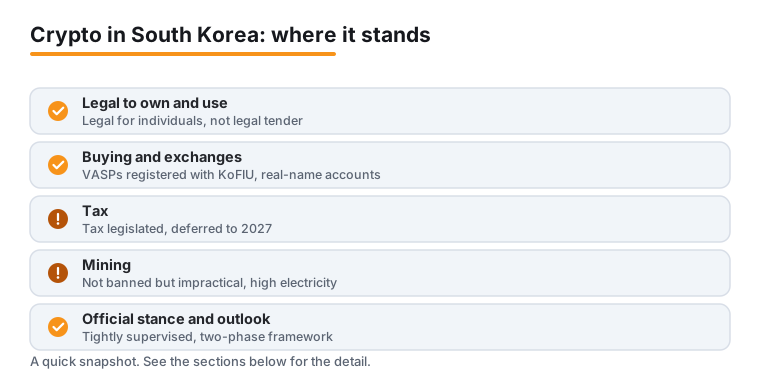
Yes. Buying, holding, selling and trading Bitcoin and other crypto assets is legal in South Korea for individuals using licensed channels. There is no ban on personal ownership, and the country hosts several large, government-registered exchanges that serve a very large domestic user base.
Crypto is, however, not legal tender. The South Korean won remains the only legal tender, and no merchant is obliged to accept Bitcoin. Korean law treats crypto as a regulated “virtual asset” rather than as currency, which shapes how it is supervised, taxed and used in payments.
The practical questions for most residents are therefore not whether they can use crypto, but which obligations apply: identity and real-name bank-account verification when using a registered exchange, and reporting duties as the tax framework comes into force. Using unregistered or offshore platforms can expose users to legal and consumer-protection risks, and the authorities have acted to block access to unregistered foreign providers.
Who regulates crypto in South Korea?
Several public bodies share oversight of the sector. The key institutions are:
- Financial Services Commission (FSC) is the lead financial regulator. It sets policy, issues subordinate regulations and supervises virtual-asset service providers (VASPs), and it runs a dedicated Virtual Asset Committee. Official site: Financial Services Commission (fsc.go.kr).
- Korea Financial Intelligence Unit (KoFIU) sits within the FSC and handles VASP registration and anti-money-laundering (AML) supervision. Official site: Korea Financial Intelligence Unit (kofiu.go.kr).
- Financial Supervisory Service (FSS) carries out inspections and day-to-day supervision of financial institutions.
- National Tax Service (NTS) is responsible for tax administration, including the planned virtual-asset tax.
- Bank of Korea, the central bank, is closely involved in stablecoin and digital-currency policy and has explored a central-bank digital currency. Official site: Bank of Korea (bok.or.kr).
If you want to confirm the current rules, the FSC and KoFIU sites publish press releases and guidance in English. See also our overview at crypto regulation by country.
Key crypto laws and frameworks
Two laws form the backbone of the current regime, with a third under debate:
- The Act on Reporting and Use of Specific Financial Transaction Information (often called the Specific Financial Information Act). Amendments that took effect on 25 March 2021 brought VASPs into the AML framework, requiring them to register with KoFIU and apply customer due diligence, suspicious-transaction reporting and the FATF “travel rule”.
- The Act on the Protection of Virtual Asset Users (the Virtual Asset User Protection Act), which took effect on 19 July 2024. It introduced user-protection rules including segregation and safekeeping of customer deposits and assets, cold-wallet storage requirements, insurance or reserve funds against hacking, and prohibitions on unfair trading practices such as price manipulation, with powers for regulators to inspect and sanction VASPs.
This is widely described as the first phase of regulation. A second-phase Digital Asset Basic Act has been proposed to create a unified framework covering token issuance, disclosure, custody, stablecoins and corporate participation. It was introduced by Rep. Min Byung-deok on 10 June 2025, and a further ruling party draft followed in April 2026. FSC chairman Kim Byoung-hwan said on 29 July 2026 that the government draft is ready, and around ten pending digital asset and stablecoin bills are to be merged into a single bill. Ruling Democratic Party lawmakers plan to propose the combined bill in September 2026, after the party's 17 August national convention, with passage targeted before the end of 2026. The bill has missed announced deadlines repeatedly since mid 2025, and nothing in it binds anyone until it passes.
Licensing and registration of exchanges (VASPs)
South Korea regulates exchanges tightly. To operate legally, a virtual-asset service provider must register with KoFIU and meet a defined set of conditions, which have historically included obtaining Information Security Management System (ISMS) certification, securing real-name verified accounts at a partner bank, and meeting AML and operational standards. Major domestic platforms include Upbit, Bithumb, Coinone, Korbit and Gopax.
A defining feature of the Korean market is the real-name verified account system. To trade with Korean won, users generally need a real-name bank account at a bank partnered with the exchange, and the bank account holder, exchange account holder and verified identity must match. This is designed to curb anonymity, money laundering and tax evasion.
Recent supervisory developments to be aware of:
- The FSC has reaffirmed a plan to cap large-shareholder stakes in domestic exchanges, intended to limit concentration risk.
- VAUPA conduct rules require segregation of user funds, cold-wallet storage of the bulk of customer assets, and insurance or reserve coverage.
- A long-standing restriction on corporate and institutional accounts has been phased out. The FSC set out a staged approach: nonprofit bodies such as charities and universities were allowed to sell donated crypto first, followed by professional investors, then listed companies. Under guidelines reported to be finalised in early 2026, corporate participants may invest up to 5 percent of their equity capital per year, limited to the top 20 crypto assets by market capitalisation and traded only on the country's five largest registered exchanges. Reporting said this opened access to roughly 3,500 companies and institutions.
If you are choosing a platform, prioritise providers registered with KoFIU and confirm current onboarding, banking and eligibility requirements directly, as the rules continue to evolve.
Crypto and Bitcoin tax in South Korea
South Korea has legislated a tax on gains from virtual assets, but its start date has been postponed several times. After repeated postponements, Deputy Prime Minister and Minister of Economy and Finance Koo Yun-cheol told the National Assembly Strategy and Finance Committee on 29 July 2026 that taxation will proceed as scheduled from 1 January 2027, though the timeline has changed before and remains subject to political decisions, so you should confirm the current position rather than assume it is settled.
The principles set out in the legislation and public debate include:
- Gains on virtual assets are intended to be taxed as a category of income, generally on the profit (disposal value minus acquisition cost and related fees).
- The rate set in the Income Tax Act is a combined 22 percent (a 20 percent national rate plus a 2 percent local surtax) applied to annual gains above a basic deduction of 2.5 million won, so smaller or casual investors below the threshold would not be taxed.
- Domestic exchanges are expected to play a central role in transaction reporting to the tax authority.
- Treatment of activities such as airdrops, staking, mining and lending has been a recognised area of uncertainty.
Because rates, thresholds and start dates have shifted with each revision, do not rely on any figure quoted in an article, including this one. Confirm the current rules, rates and effective date with the National Tax Service or a qualified Korean tax professional before filing or trading. For general background, see our guide to crypto taxes. This section is general information, not tax advice.
AML, KYC and the travel rule
Anti-money-laundering rules are central to how crypto is supervised in South Korea. Under the Specific Financial Information Act, VASPs registered with KoFIU must perform customer due diligence (KYC), monitor transactions, and file suspicious-transaction reports. The same framework implements the FATF travel rule, requiring exchanges to share originator and beneficiary information when virtual assets move between providers above a defined threshold.
Practical features of the regime:
- Real-name banking. The matching of bank, exchange and identity records is the cornerstone of KYC for won trading and makes anonymous accounts impractical.
- Travel rule. The travel rule threshold is 1 million won. Legislative amendments and enforcement decrees under consideration would abolish it, so that originator and beneficiary information would have to accompany every transfer between service providers regardless of size. No enacted text sets a date.
- Enforcement against unregistered providers. Authorities have moved to block access to foreign VASPs operating without KoFIU registration.
For users, the upshot is that compliant trading is fully identity-verified, and attempting to bypass these controls carries legal and consumer-protection risk. Always confirm current requirements with KoFIU or your exchange.
Buying and using crypto in practice
For most residents, the standard route is a domestic, KoFIU-registered exchange linked to a real-name bank account. A typical process looks like this:
- Choose a registered exchange. Select a provider registered with KoFIU and check its current banking partnerships and supported assets.
- Complete identity verification (KYC). Provide the required identification and personal details.
- Set up a real-name verified bank account. Open or link an account at the exchange's partner bank so that your bank and exchange identities match; this is usually required to deposit and trade in won.
- Deposit Korean won and place a buy order for Bitcoin or another asset.
- Secure your holdings. Enable strong account security, and consider moving long-term holdings to a personal wallet you control.
- Keep records. Retain transaction histories for tax and reporting purposes as the tax framework comes into force.
As for spending crypto, remember it is not legal tender, so acceptance is voluntary and limited. Onboarding and banking requirements change, and foreign residents and non-residents may face additional or different requirements, so confirm eligibility and the exact steps with your chosen exchange before opening an account.
Bitcoin mining in South Korea
There is no outright ban on owning mining hardware in South Korea, but large-scale Bitcoin mining is not a major domestic industry. The main constraint is economics rather than a specific prohibition: South Korea has relatively high electricity costs and limited cheap surplus power, which makes energy-intensive proof-of-work mining hard to operate profitably at scale compared with lower-cost regions.
Other relevant factors include:
- Energy and environmental policy. National priorities around energy efficiency and emissions weigh against power-hungry operations, and any sizeable facility would need to account for grid and sustainability considerations.
- Tax and reporting. Income or assets earned from mining can carry tax and reporting implications, an area flagged as needing clearer rules under the developing tax regime.
Anyone considering mining should model electricity costs carefully, check local regulations and tax treatment, and confirm the current position with the relevant authorities before investing in equipment.
Stablecoins, remittances and foreign exchange
Cross-border money movement in South Korea is governed by the Foreign Exchange Transactions Act, which channels international transfers through licensed foreign-exchange banks and applies reporting and documentation requirements. This framework makes informal crypto-based remittances legally sensitive, because moving value across borders outside authorised channels can conflict with foreign-exchange controls.
Stablecoins have become a major policy focus. The proposed Digital Asset Basic Act would bring fiat-referenced stablecoins inside the regulatory perimeter, with reporting describing requirements for issuer authorisation and reserves exceeding 100 percent of circulating supply, held separately from the issuer's balance sheet. A central dispute has been who may issue stablecoins: the Bank of Korea has pushed for bank-led issuance, reported to include a requirement that banks hold a majority stake of about 51 percent in any issuer, while the FSC has argued for allowing a broader set of regulated issuers, citing international examples. Reporting also indicated that stablecoins used in cross-border or foreign-exchange transactions would be treated as a means of payment under the Foreign Exchange Transactions Act. This disagreement contributed to delays in the bill during late 2025 and 2026.
Practical takeaways:
- Using regulated exchanges and licensed providers keeps activity within the rules; routing value through unregistered channels to evade foreign-exchange controls can carry legal risk.
- Exchange-rate volatility and conversion costs can offset the savings on a transfer.
- Stablecoin rules are actively developing, so confirm the current legal treatment with the FSC before relying on crypto or stablecoins for payments or remittances.
Recent developments (2025-2026)
South Korea's regime continued to move quickly in 2025 and 2026. Notable developments reported during this period include:
- Corporate participation reopened. A roughly nine-year restriction on corporate and institutional crypto accounts was being phased out. Guidelines reported to be finalised in early 2026 let listed companies and professional investors invest up to 5 percent of equity capital per year, confined to the top 20 assets by market capitalisation and to the five largest registered exchanges.
- Tax timeline. The government confirmed on 29 July 2026 that the 22 percent virtual asset gains tax starts on 1 January 2027, and the finance ministry decided not to include a further postponement in the forthcoming tax revision bill. An opposition bill that would delete virtual asset income from the Income Tax Act, introduced on 19 March 2026 by Song Eon-seok of the People Power Party, was taken up by the Strategy and Finance Committee on the same day and sent to its tax subcommittee.
- Digital Asset Basic Act. FSC chairman Kim Byoung-hwan said on 29 July 2026 that a government draft is ready and that around ten pending bills will be consolidated into one, with ruling Democratic Party lawmakers aiming to propose the combined bill in September 2026 and pass it within the year. The Bank of Korea told the National Assembly finance committee in July 2026 that won stablecoins should first be issued through bank-led consortiums, a position the FSC has not adopted.
- Tighter exchange supervision. The FSC and the ruling party's digital asset task force agreed in March 2026 on a 20 percent cap on any single shareholder in a licensed exchange, with exceptions of up to 34 percent by enforcement decree and a three year grace period after passage, to be carried in the Digital Asset Basic Act. Bithumb's controlling shareholder holds more than 73 percent and Binance owns more than 67 percent of Gopax, so both would have to restructure. The National Assembly Research Service warned the cap could infringe fundamental rights including property rights and the freedom to conduct business.
Because these items were still moving, treat dates and details as provisional and verify the latest status with the FSC and KoFIU.
Consumer risks and protection
South Korea combines high adoption with active, evolving regulation, which creates both opportunity and uncertainty. The Virtual Asset User Protection Act improved safeguards by requiring deposit segregation, cold-wallet storage of the bulk of customer assets and insurance or reserve coverage, but risks remain:
- Market volatility and the potential for sharp losses; only commit funds you can afford to lose.
- Platform and custody risk from hacks, insolvency or operational failures, despite improved protections; consider self-custody for long-term holdings.
- Regulatory and tax uncertainty. The tax start date and the Digital Asset Basic Act, including stablecoin and corporate rules, were still being finalised, so costs and access could change.
- Fraud and hype around speculative tokens, which the market's enthusiasm has historically attracted; be cautious with unfamiliar projects.
- Unregistered platforms. Using offshore or unregistered providers forfeits Korean user protections and can be unlawful.
None of this is investment advice. Do your own research, use KoFIU-registered providers, and consider speaking with a licensed financial adviser before committing capital.
Official sources and how to verify
Crypto rules in South Korea are changing rapidly, so it is important to confirm the current position with primary, official sources rather than relying on summaries. The most authoritative starting points are:
- Financial Services Commission (FSC) for policy, VASP supervision, and English-language press releases and guidance on the Virtual Asset User Protection Act and the proposed Digital Asset Basic Act.
- Korea Financial Intelligence Unit (KoFIU) for VASP registration status, AML/KYC and travel-rule requirements.
- Bank of Korea for stablecoin and digital-currency policy.
- The National Tax Service (NTS) for the current status, rates and effective date of the virtual-asset tax.
This page is general information as of 2026 and is not legal, tax or financial advice; please verify your specific situation with the named official regulators, especially the Financial Services Commission, or a licensed Korean adviser before acting. For broader context, see our crypto regulation guide.
What is changing: status as of August 2026
Two dated changes are already law and are not waiting on the National Assembly. A third, the Digital Asset Basic Act, is not law and should not be treated as one.
- 20 August 2026, tighter exchange entry rules. An amendment to the Act on Reporting and Using Specified Financial Transaction Information, passed on 29 January 2026 and promulgated on 19 February 2026, takes effect on 20 August 2026. It adds a statutory definition of major shareholders and extends disqualification checks to them, brings financial condition, social credibility, staffing, IT and internal control into the entry review, and lets KoFIU attach conditions when it accepts a registration. Every exchange already on the register must re-report under the amended Article 7 within three months, so by 20 November 2026. There were 27 registered virtual asset service providers as of 8 January 2026, against 29 approved in the first round of reviews in December 2021. If you use a smaller platform, check that it is still registered after November.
- 1 January 2027, the gains tax starts. On 29 July 2026 Deputy Prime Minister and Minister of Economy and Finance Koo Yun-cheol told the National Assembly Strategy and Finance Committee that taxation is proceeding as scheduled from next year, noting the current deferral runs only to the end of 2026. The finance ministry decided not to include a further postponement in the forthcoming tax revision bill. Gains on transfers and lending of virtual assets are taxed as other income at 20 percent plus a 2 percent local surtax, a combined 22 percent, on annual net gains above a 2.5 million won basic deduction. It applies to Korean residents on worldwide gains, and first filings fall due in May 2028 for the 2027 tax year. There is no loss carryforward in the current design, a point opposition lawmakers raised at the same hearing. An opposition bill that would delete virtual asset income from the Income Tax Act was taken up by the same committee on 29 July 2026 and sent to its tax subcommittee, so the date is committed but not immune.
- The Digital Asset Basic Act is still a bill. FSC chairman Kim Byoung-hwan said on 29 July 2026 that the government draft is fully prepared, and reporting the same day said around ten pending digital asset and stablecoin bills will be merged into one. Ruling Democratic Party lawmakers have said they will reconstitute the party task force after the 17 August national convention and propose a combined bill in September 2026, with passage targeted before the end of the year. The bill has missed announced deadlines repeatedly since mid 2025. Until it passes, the operative rulebook is the Virtual Asset User Protection Act of 19 July 2024 plus the Specific Financial Information Act.
What has not changed: crypto is legal to own and trade, it is not legal tender, and won trading still requires a real-name verified bank account at the exchange's partner bank.
The legislative pipeline and when each piece moves
Stages below are as at 3 August 2026. Only the first three rows are law.
| Measure | Stage | What it does | Timing |
|---|---|---|---|
| Amendment to the Specific Financial Information Act | Adopted, not yet in force | Major shareholder vetting and expanded entry screening for exchanges; mandatory re-reporting by existing registrants | In force 20 August 2026; re-reports due 20 November 2026 |
| Electronic Securities Act and Capital Markets Act, tokenised securities amendments | Adopted, not yet in force | Recognises distributed ledgers as a valid securities registration ledger and allows broker distribution of investment contract securities | Passed 15 January 2026, effective February 2027 |
| Income Tax Act, virtual asset gains tax | Adopted, not yet in force | 22 percent combined on annual net gains above 2.5 million won, taxed as other income | Applies from 1 January 2027, first filings May 2028 |
| Bill to abolish the virtual asset gains tax | In parliament | Would remove virtual asset income from the Income Tax Act | Sent to tax subcommittee 29 July 2026, no vote scheduled |
| Digital Asset Basic Act | In parliament, being consolidated | Licensing of digital asset businesses, token disclosure, market conduct, custody, stablecoins | Combined bill targeted for September 2026, passage targeted within 2026 |
| Won stablecoin issuance rules, inside the Digital Asset Basic Act | Drafted, in dispute | Issuer licensing, reserves, redemption rights; Bank of Korea wants bank-led consortiums to have priority | Tied to the Digital Asset Basic Act; unresolved as of August 2026 |
| 20 percent cap on exchange major shareholders, inside the Digital Asset Basic Act | Agreed by regulator and ruling party, not enacted | Caps a single holder at 20 percent, with exceptions to 34 percent by enforcement decree | Three year grace after passage for the largest exchanges, six for smaller ones |
| Capital Markets Act revision for spot crypto ETFs | Announced only | Would add virtual assets to eligible ETF underlying assets | Revision to be pursued in the second half of 2026; no bill text published |
| Travel rule threshold abolition | Proposed | Removes the 1 million won floor so all transfers carry originator and beneficiary data | Not scheduled |
Sources for the rows above: the 2026 Chambers country practice guide, Korean counsel commentary on the split between the stablecoin and security token tracks, and the FSC plan announced on 14 July 2026.
Enforcement: what the regulators have actually done
The Virtual Asset User Protection Act and the AML regime are not dormant. Recent penalties show how the rules are applied, and how often they are contested.
- Upbit, operated by Dunamu. A three month partial business suspension in 2025 and a fine of about 35.2 billion won for transactions with unregistered virtual asset service providers, inadequate customer due diligence and failures in suspicious transaction reporting. Dunamu has challenged the fine, and filing the objection suspends its enforcement while the administrative court reviews the case.
- Bithumb, March 2026. A fine of about 36.8 billion won and a six month partial business suspension for comparable violations. The suspension did not take effect: the Seoul Administrative Court granted a stay of execution on 1 May 2026. Whether the fine was also stayed was not clarified.
- Coinone, April 2026. A fine of about 5.2 billion won and a three month partial business suspension.
- First market manipulation conviction under the new regime, February 2026. In the case concerning the ACE token, the Seoul Southern District Court convicted the defendants on 4 February 2026. The chief executive received three years imprisonment, a 500 million won fine and about 845 million won of forfeiture, over automated wash trading that generated roughly 7.1 billion won.
The fines and the conviction are recorded in the 2026 Chambers country practice guide. On the supervisory side, the Financial Supervisory Service set out a 2026 work plan focused on detecting price manipulation, including monitoring of large-holder activity, coordinated trading and deposit and withdrawal suspensions used to move prices. After an incident at Bithumb in early February 2026, the FSC held an emergency meeting and ordered a review of internal controls across all domestic exchanges.
The practical reading for a user: large fines and suspension orders against the biggest platforms are real, but they are routinely appealed, and a suspension reported in the press may never take effect. Check a platform's current status with KoFIU rather than relying on the headline.
Frequently asked questions
Is cryptocurrency legal in South Korea?
Yes. Owning, buying, selling and trading crypto is legal for individuals through licensed, KoFIU-registered exchanges. However, crypto is not legal tender; only the Korean won is, and the sector is tightly supervised under the Virtual Asset User Protection Act, which took effect on 19 July 2024. Always use registered providers and verify current rules with the FSC.
Who regulates cryptocurrency in South Korea?
The Financial Services Commission (FSC) is the lead regulator, with the Korea Financial Intelligence Unit (KoFIU) handling VASP registration and anti-money-laundering supervision, the Financial Supervisory Service (FSS) conducting inspections, the National Tax Service (NTS) administering tax, and the Bank of Korea involved in stablecoin and digital-currency policy. The FSC publishes English guidance at fsc.go.kr.
Do I have to pay tax on crypto gains in South Korea?
South Korea has legislated a tax on virtual-asset gains, but its start date has been postponed several times. Reporting in 2025 and 2026 pointed to an effective date of 1 January 2027, with a combined rate of around 22 percent on annual gains above a 2.5 million won deduction. These details have changed before, so do not rely on any quoted figure; check the current position with the National Tax Service or a qualified tax professional. This is not tax advice.
What licence does a crypto exchange need to operate in South Korea?
An exchange (a virtual-asset service provider) must register with the Korea Financial Intelligence Unit (KoFIU) under the Specific Financial Information Act and meet its conditions, which have historically included ISMS information-security certification, real-name verified bank accounts at a partner bank, and AML compliance. It must also follow the user-protection rules of the Virtual Asset User Protection Act. Confirm current requirements with KoFIU.
Why do Korean exchanges require a real-name bank account?
To trade crypto with Korean won, users generally need a real-name verified bank account at the exchange's partner bank, with matching identity details. This system is designed to reduce anonymity, money laundering and tax evasion, and it is a defining feature of how regulated exchanges operate in South Korea and a core part of the country's KYC framework.
Can companies in South Korea hold crypto, and what about stablecoins?
A roughly nine-year restriction on corporate and institutional crypto accounts has been phased out, with guidelines reported to take effect in 2026 allowing listed companies and professional investors to invest within defined limits. Stablecoin rules are part of the proposed Digital Asset Basic Act, which was delayed partly over a dispute about who may issue stablecoins. Verify the latest position with the FSC, as these rules were still evolving.
How much crypto can a Korean company invest under the new rules?
Under the FSC roadmap of 13 February 2025 and guidelines reported in January 2026, corporations and registered professional investors would be able to allocate up to 5 percent of equity capital a year to crypto. Korean counsel recorded the phase covering listed companies as still unannounced as of April 2026, and corporate real-name account issuance remained restricted in practice. Reporting said purchases are limited to the top 20 assets by market capitalisation and to the country's five largest registered exchanges. Because figures like these have shifted during the rollout, confirm the current limits with the FSC before acting.
Which crypto exchanges are used in South Korea?
The main domestic, KoFIU-registered platforms include Upbit, Bithumb, Coinone, Korbit and Gopax. To trade with Korean won, users generally need a real-name verified bank account at the exchange's partner bank, with matching identity details. Using unregistered or offshore providers forfeits Korean user protections and can be unlawful, so check a platform's registration status with KoFIU before signing up.
When does South Korea's crypto tax actually start, and how much is it?
From 1 January 2027. On 29 July 2026 Deputy Prime Minister and Minister of Economy and Finance Koo Yun-cheol told the National Assembly Strategy and Finance Committee that taxation is proceeding as scheduled from next year, and the finance ministry decided not to include a further postponement in the forthcoming tax revision bill. Gains on transfers and lending of virtual assets are taxed as other income at 20 percent plus a 2 percent local surtax, a combined 22 percent, on annual net gains above a 2.5 million won basic deduction. It applies to Korean residents on worldwide gains and the first filings fall due in May 2028. There is no loss carryforward in the current design. Two things could still move the numbers: an opposition bill to abolish the tax was sent to a tax subcommittee on the same day, and a National Tax Service commissioned study reported on 31 July 2026 recommends raising the basic deduction to 7.5 million won, which would need an amendment to the Income Tax Act and has not been adopted. This is general information, not tax advice.
What changes for crypto exchanges on 20 August 2026?
An amendment to the Act on Reporting and Using Specified Financial Transaction Information, passed on 29 January 2026 and promulgated on 19 February 2026, takes effect on 20 August 2026. It adds a statutory definition of major shareholders and extends disqualification checks to them, brings financial condition, social credibility, staffing, IT and internal control into the entry review, and lets KoFIU attach conditions when it accepts a registration. Every already-registered exchange must re-report under the amended Article 7 within three months, meaning by 20 November 2026. There were 27 registered providers as of 8 January 2026. Users should verify a platform is still on the KoFIU register after November before depositing funds.
Has the Digital Asset Basic Act passed, and when will it?
No. As of August 2026 it is still a bill. It was introduced by Rep. Min Byung-deok on 10 June 2025, and a further ruling party draft followed in April 2026. On 29 July 2026 FSC chairman Kim Byoung-hwan said the government draft is fully prepared, and reporting the same day said around ten pending digital asset and stablecoin bills will be merged into a single bill. Ruling Democratic Party lawmakers have said they will reconstitute the party task force after the 17 August national convention and propose the combined bill in September 2026, with passage targeted before the end of 2026. The two unresolved issues are who may issue won-pegged stablecoins, where the Bank of Korea wants bank-led consortiums to have priority, and a proposed 20 percent cap on any single shareholder in an exchange. The bill has missed announced deadlines repeatedly since mid 2025, so treat the timetable as a target rather than a schedule. Until it passes, the binding rules are the Virtual Asset User Protection Act and the Specific Financial Information Act.
Can a Korean company buy crypto now?
Not as freely as headlines suggest. The FSC published a phased roadmap on 13 February 2025 reopening corporate access after the 2017 ban, starting with law enforcement agencies, designated non-profits and exchanges, then a pilot covering roughly 3,500 corporate entities including listed companies and registered professional investors, then ordinary corporations. Guidelines reported in January 2026 set a limit of 5 percent of equity capital a year, confined to the top 20 assets by market capitalisation and the five largest registered exchanges. However, Korean counsel recorded the listed-company phase as still unannounced as of April 2026, and corporate real-name account issuance stayed restricted in practice. A company should confirm with its bank whether an account can actually be opened before assuming access.
Will there be a spot Bitcoin ETF in South Korea?
Not yet, and not without a law change. The Capital Markets Act currently limits ETF underlying assets to financial investment products, currencies and general commodities, which excludes crypto. On 14 July 2026, as part of the Economic Growth Strategy for the Second Half of 2026, the FSC said it would pursue a revision during the second half of 2026 to add virtual assets to that list. No bill text has been published and no listing date exists, so there is nothing to plan around yet.
Facts reviewed: 5 August 2026. Page updated: 5 August 2026.
Related guides
More countries in the region
Practical guides