Home › Crypto Regulation › United Arab Emirates
Bitcoin & Cryptocurrency Regulation in United Arab Emirates
Quick answer — United Arab Emirates, 2026
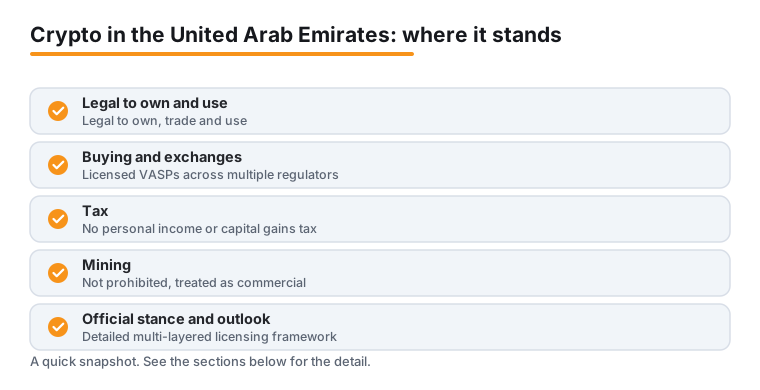
- Legal: Legal to own and trade, not legal tender
- Tax: No personal income or capital gains tax on individuals
- Buying: Via exchanges licensed by VARA, CMA or free-zone regulators
The United Arab Emirates is one of the most actively regulated crypto jurisdictions in the world. Buying, selling, holding and building with virtual assets is legal, but the sector sits inside a detailed, multi-layered licensing system rather than a free-for-all. Federal authorities set baseline policy and run a national regime for onshore activity, while the Emirate of Dubai and the two financial free zones (ADGM in Abu Dhabi and the DIFC in Dubai) operate their own separate rulebooks. Which regulator applies to you depends on where you are based and what you do.
This page is a general overview of how Bitcoin and other virtual assets are treated in the UAE as of 2026, covering legal status, the main regulators, key laws, exchange and VASP licensing, taxation, AML and KYC rules, buying and using crypto in practice, mining, recent developments, consumer risks, and how to verify the rules with official sources. This is general information as of 2026 and is not legal, tax or financial advice; UAE crypto rules change frequently and differ by emirate and free zone, so always confirm the current position with the named official regulator or a qualified UAE adviser before acting. For wider context, see our guide to crypto regulation and our country regulation hub.
On this page: Legal status · Who regulates it · Taxes · How to buy · Mining
Is Bitcoin and crypto legal in the UAE?
Yes. Owning, trading and using Bitcoin and other virtual assets is legal in the UAE, and the country has built dedicated regulatory frameworks rather than banning the sector. However, cryptocurrency is not legal tender. The UAE dirham (AED) remains the only official currency, so businesses are not obliged to accept crypto as payment, and crypto is treated as a virtual asset rather than money.
The practical position is that activity is legal but conditional. Individuals can generally buy, hold and sell virtual assets, but any business that provides crypto services to the public, such as exchanges, brokers, custodians and certain payment providers, must hold a licence from the relevant authority. Operating an unlicensed virtual asset business, or marketing one to UAE residents without authorisation, can carry significant penalties. The UAE also enforces strict anti-money-laundering (AML) and counter-terrorism-financing standards across the sector.
Who regulates crypto in the UAE?
Regulation is shared across several authorities, and identifying the right one is the single most important step before doing business here:
- Capital Market Authority (CMA) is the federal regulator for virtual assets in onshore (mainland) UAE outside Dubai and outside the two financial free zones. The CMA is the former Securities and Commodities Authority (SCA), renamed and reconstituted with effect from 1 January 2026 under Federal Decree-Laws No. 32 and No. 33 of 2025. Its official website is still hosted at sca.gov.ae.
- Virtual Assets Regulatory Authority (VARA) is the dedicated regulator for virtual assets in the Emirate of Dubai, including Dubai's commercial free zones but excluding the DIFC. VARA runs a detailed rulebook covering exchanges, broker-dealers, custody, lending, advisory and issuance. See vara.ae.
- Central Bank of the UAE (CBUAE) oversees the payments system, stored-value facilities and payment tokens (including stablecoins used for payments). Its Payment Token Services Regulation (PTSR), issued on 7 June 2024 and in force from 6 July 2024, is the dedicated stablecoin framework: dirham-pegged payment tokens require a full CBUAE Issuer Licence, foreign payment tokens require registration, and algorithmic and privacy-focused tokens are not permitted for payments. Its remit over virtual-asset payment services was further supported by Federal Decree-Law No. 6 of 2025. See centralbank.ae.
- Abu Dhabi Global Market (ADGM) / FSRA is a financial free zone in Abu Dhabi with its own established digital-asset regime under the Financial Services Regulatory Authority.
- Dubai International Financial Centre (DIFC) / DFSA is a separate financial free zone with its own crypto-token regime under the Dubai Financial Services Authority.
The CMA framework operates alongside the others and expressly excludes the two financial free zones; it does not override VARA in Dubai. A firm must work out which regulator governs its location and activity, then obtain the matching licence.
Key crypto laws and frameworks in the UAE
Several instruments make up the current framework, and the most significant ones are recent:
- Federal Decree-Laws No. 32 and No. 33 of 2025 reconstituted the SCA as the Capital Market Authority from 1 January 2026 and expanded the definition of regulated financial products to include virtual assets, bringing crypto-asset service providers within the federal capital-markets perimeter.
- CMA Decision No. 4/R.M/2026 introduced a comprehensive new framework for virtual-asset activities, replacing the previous SCA virtual-asset regime in full. It expands the number of regulated activities (for example dealing, custody, arranging deals and advice) and sets higher capital, governance and compliance thresholds, with transitional arrangements for existing firms.
- Federal Decree-Law No. 6 of 2025 (on the Central Bank, regulation of financial institutions and activities, and insurance) brought payment services using virtual assets more explicitly under CBUAE supervision.
- VARA's Virtual Assets and Related Activities Regulations 2023 and its rulebooks govern Dubai. VARA activated its Issuance Rulebook for fiat-referenced and asset-referenced tokens in mid-2025, moving from sandbox programmes to full commercial operations, and has issued updated versions of its rulebooks.
- Federal Law No. 10 of 2025 on combating money laundering, terrorism financing and the financing of proliferation, which took effect on 14 October 2025 and replaced the earlier Federal Decree-Law No. 20 of 2018.
Because these frameworks are updated often, treat any specific rule as a starting point and confirm the latest version directly with the relevant regulator.
Licensing and registration of exchanges and VASPs
Any virtual-asset service provider (VASP) serving or targeting the UAE must be licensed. Under UAE AML law it is prohibited for natural or legal persons to act as a VASP without authorisation from the competent regulator. The right licence depends on location:
- VASPs operating in or targeting Dubai (outside the DIFC) apply to VARA, typically through a two-stage process that moves from an initial approval to a full operating licence, with licensed activities such as exchange, broker-dealer, custody, lending and advisory services.
- VASPs in onshore UAE outside Dubai and outside the free zones apply to the CMA under its activity-based licensing model.
- Firms in ADGM are licensed by the FSRA, and firms in the DIFC by the DFSA, each under its own framework.
Common obligations across all regimes include fit-and-proper assessments, minimum capital, robust governance, custody safeguards, technology and cybersecurity controls, AML/KYC programmes, and marketing rules. Under the cooperation arrangement between the federal regulator and VARA, a Dubai-licensed firm can also be recognised at federal level so it can operate more widely in the UAE. Always check a provider's current licence on the regulator's public register before depositing funds; VARA, for example, maintains a public register at vara.ae.
Crypto and Bitcoin tax in the UAE
The UAE is widely seen as tax-light for individual crypto holders, but the detail matters and differs for businesses. The UAE does not levy a personal income tax or a capital gains tax on individuals, so personal gains from buying, holding and selling crypto in a private capacity are generally not taxed at the individual level. This is a major reason the UAE attracts crypto investors.
For businesses, federal corporate tax applies at 0% on taxable income up to AED 375,000 and 9% above that, under Federal Decree-Law No. 47 of 2022, effective for financial years starting on or after 1 June 2023. A separate Domestic Minimum Top-up Tax sets a 15% minimum effective rate for UAE members of multinational groups with global revenues of EUR 750 million or more, for financial years starting on or after 1 January 2025. Individuals are only drawn into corporate tax where turnover from a business or business activity exceeds AED 1,000,000 in a Gregorian calendar year; wages and personal investment income are excluded from that calculation, under Cabinet Decision No. 49 of 2023. On indirect tax, Cabinet Decision No. 100 of 2024 amended the VAT Executive Regulations to exempt the transfer and conversion of virtual assets, and the safeguarding and management of virtual assets, from value-added tax (VAT). The change took effect on 15 November 2024, and the exemption for transfers and conversions applies retroactively from 1 January 2018, which may require some businesses to review their historic VAT position. Note that crypto mining is treated differently from trading for VAT purposes, so mining businesses should not assume the same exemption applies.
The UAE has also signed the OECD's multilateral agreement to adopt the Crypto-Asset Reporting Framework (CARF), with reporting expected to go live in 2027 and the first automatic exchanges of information in 2028. CARF increases transparency but does not in itself create a new personal tax. The headline figures are a 0% and 9% corporate tax split at AED 375,000 of taxable income, a 5% standard VAT rate, and no personal income tax at federal or Emirate level. What varies is whether your particular activity counts as a business at all, and whether a free zone or top-up tax rule applies to your structure. Confirm your position with the Federal Tax Authority or a qualified UAE adviser. See also our crypto tax guide. This is general information, not tax advice.
AML, KYC and the Travel Rule
AML and counter-terrorism-financing compliance is a foundational requirement for crypto in the UAE, not an optional extra. The governing federal law is now Federal Law No. 10 of 2025, in effect since 14 October 2025, which replaced Federal Decree-Law No. 20 of 2018 and is reinforced by implementing regulations.
Licensed VASPs must run full customer due diligence, verify identity and (where relevant) source of funds, monitor and report suspicious transactions, keep records for set periods, appoint qualified compliance and money-laundering reporting officers, and train staff. The UAE applies the FATF Travel Rule, requiring originator and beneficiary information to accompany qualifying virtual-asset transfers, consistent with FATF Recommendation 15. The CBUAE has issued guidance for licensed financial institutions on the risks of dealing with virtual assets and VASPs. For users this means you should expect identity verification at sign-up, possible proof-of-address and source-of-funds requests, and transaction screening on any regulated platform.
Buying and using crypto in practice
Residents can buy crypto through licensed exchanges and brokers, and several major global and regional platforms have obtained UAE licences via VARA, ADGM, the DIFC or the CMA. The general rule is to favour platforms that clearly state which UAE regulator licenses them, and to verify that on the regulator's register. Expect full KYC at sign-up.
The dirham is freely convertible and the UAE does not run restrictive foreign-exchange capital controls, so funding and withdrawing from exchanges is relatively straightforward compared with many emerging markets. Even so, banks apply their own compliance policies, and large or unusual crypto-related transfers can trigger additional checks, so use an account in your own name and keep records. A practical buying path is: choose a regulated platform; create and verify your account; deposit dirhams; place a modest first order; enable two-factor authentication and consider qualified custody or reputable self-custody for longer-term holdings; and keep transaction confirmations. Crypto ATMs and conversion kiosks exist in parts of the UAE, especially Dubai, but operators are regulated VASPs subject to KYC and monitoring; their fees and spreads are usually higher than a licensed online exchange, and unlicensed kiosks should be avoided. Promotions of unlicensed virtual-asset products to the public are restricted, so be sceptical of peer-to-peer offers and guaranteed-return schemes.
Bitcoin mining in the UAE
Bitcoin mining is not prohibited in the UAE, and relatively low industrial energy costs in some areas, combined with heavy investment in data-centre and energy infrastructure, have attracted large-scale and institutional mining interest. Mining is generally treated as a commercial activity rather than a hobby, which means operators should expect to deal with business licensing, metered and legitimate energy supply arrangements, and tax treatment.
Two points deserve emphasis. First, mining is taxed differently from personal investing: the Federal Tax Authority set the position out in VAT Public Clarification VATP039, issued on 13 January 2025. Mining on your own account is outside the scope of VAT, which also means input VAT on rigs, electricity and maintenance cannot be recovered, because there is no taxable supply. Mining performed on behalf of another person is a taxable supply of services, taxed at the 5% standard rate, with input tax recovery available against it and possible zero-rating where the recipient is outside the UAE and the conditions are met, and mining profits can fall within the corporate tax regime, so professional advice is important before scaling up. Second, the UAE has national clean-energy and net-zero ambitions, and the policy direction favours efficient operations and renewable or surplus power. Miners should plan around energy-efficiency expectations and stay current with both federal and emirate-level rules, which continue to evolve.
Recent developments (2025 to 2026)
The pace of change has been rapid. The headline development is the reconstitution of the federal securities regulator: the SCA became the Capital Market Authority (CMA) on 1 January 2026 under Federal Decree-Laws No. 32 and No. 33 of 2025, and in 2026 the CMA issued Decision No. 4/R.M/2026, a comprehensive virtual-asset framework that replaces the old SCA regime, broadens the list of licensed activities and raises capital and governance standards, with transitional arrangements for existing firms.
Other notable moves include Federal Decree-Law No. 6 of 2025 expanding the Central Bank's oversight of virtual-asset payment services; the new AML law (Federal Law No. 10 of 2025) taking effect on 14 October 2025; VARA activating its stablecoin and token Issuance Rulebook in mid-2025 and updating its rulebooks; ADGM's FSRA refining its digital-asset framework (including notification-based listing criteria, fiat-referenced-token rules effective from 1 January 2026, and a consultation on staking); the DFSA consulting on enhancements to its crypto-token regime; and the UAE signing the OECD CARF agreement in 2025 ahead of a 2027 go-live. Treat federal references as evolving and verify the current rulebook before relying on it.
On the market side, activity has grown alongside the rules, with 52 entries on VARA's public register of licensed VASPs when checked in August 2026, alongside separate licensees in ADGM, the DIFC and under the Central Bank. VARA introduced a framework for exchange-traded crypto derivatives through Version 2.1 of its Exchange Services Rulebook, adding suitability checks and leverage, margin and segregation controls for leveraged products. On stablecoins, the CBUAE approved a dirham-backed stablecoin (DDSC) for launch on the ADI Chain, and RAKBank received in-principle approval to issue an AED-backed stablecoin, both under the Payment Token Services Regulation. In May 2026, Crypto.com became the first virtual-asset service provider to receive a full Stored Value Facilities licence from the CBUAE, tied to crypto payments for Dubai government services, with settlement in dirhams or approved dirham-backed stablecoins.
Consumer risks and protection
The UAE's frameworks emphasise consumer protection through licensing conditions, custody safeguards, disclosure and marketing rules, audits and ongoing supervision, and regulators do impose penalties and publish them. VARA fined 19 unlicensed firms between AED 100,000 and AED 600,000 on 7 October 2025, and in June 2026 issued notices of fines against MX Global LTD (MEXC), licensed VASP CoinMENA FZE and Peken Global Limited (KuCoin), followed by Shelbit General Trading L.L.C on 24 July 2026. Under Federal Decree-Law No. 6 of 2025 the Central Bank can fine licensed financial institutions up to AED 1,000,000,000. That structure reduces some risks but does not remove the risks inherent in the assets themselves.
Crypto prices are highly volatile, markets can move sharply, and past performance does not predict future results; we make no price predictions and nothing here is a recommendation. For individuals, the biggest day-to-day risks are scams, custody mistakes (lost keys or recovery phrases), and using unlicensed services. Sensible precautions include using only regulated and verified platforms, enabling two-factor authentication, never sharing private keys or recovery phrases, diversifying rather than concentrating, investing only what you can afford to lose, and being cautious of unlicensed peer-to-peer deals and guaranteed-return schemes. If you are unsure, speak to a licensed UAE financial adviser. This section is general information, not financial advice.
Official sources and how to verify
Because UAE crypto rules change frequently and vary by emirate and free zone, always confirm the current position with the official regulator rather than relying on summaries. Useful starting points include:
- Capital Market Authority (CMA, formerly SCA) for the federal onshore virtual-asset framework.
- Virtual Assets Regulatory Authority (VARA) for Dubai, including its rulebooks and public register.
- Central Bank of the UAE (CBUAE) for payments, stablecoins and AML guidance.
- UAE Government portal (u.ae) for a plain-language overview of virtual-asset regulation.
- UAE Ministry of Finance for CARF and tax-transparency commitments, and the Federal Tax Authority for VAT and corporate tax.
For free-zone matters, consult ADGM and the DIFC directly. To check whether a specific platform is authorised, look it up on the relevant regulator's public register before depositing funds. This page is general information as of 2026, not legal advice, and you should verify the rules with the named official regulator.
What is changing between August 2026 and early 2027
The UAE's legal position on crypto is settled. Its compliance calendar is not. Four dated events sit between now and early 2027, and they hit different groups.
| What | Stage | Date | Who it affects and how |
|---|---|---|---|
| Transitional period under Federal Decree-Law No. 6 of 2025 ends | Law in force, grace period expiring | 16 September 2026 | Firms providing payment services using virtual assets, and the platforms and technology providers that facilitate them, must be licensed or registered by the Central Bank or stop the in-scope activity. |
| CMA public consultation on its approach to virtual asset service providers closes | Open consultation | 30 September 2026 | Anyone wanting to shape the onshore federal rules before further changes. Expect follow-on rule amendments after it closes. |
| Transitional arrangements under CMA Decision No. 4/R.M/2026 end | Decision in force, transition running | 2027, exact date disputed | Existing onshore virtual-asset licensees must be fully compliant, including the higher capital floors. Published summaries give 1 January 2027 and 13 February 2027, so confirm your own date with the CMA. |
| OECD CARF reporting begins | Adopted, not yet in force | 2027 reporting year, first exchanges by 2028 | UAE crypto-asset service providers must collect tax residency and transaction data and report it for exchange with participating jurisdictions. |
The nearest is the most consequential. Federal Decree-Law No. 6 of 2025 was issued on 8 September 2025 and published in the Official Gazette on 15 September 2025, with a one-year transitional period ending 16 September 2026. It repeals the 2018 Central Bank Law, gives the Digital Dirham explicit legal tender recognition, and brings payment services using virtual assets, along with the technology providers and platforms that facilitate financial services, under Central Bank supervision. Maximum penalties are AED 1,000,000,000 for licensed financial institutions, AED 20,000,000 for specified financial market infrastructure violations and AED 5,000,000 for authorised individuals. Ordinary holders are not directly caught, but the service they use may be.
The CMA consultation is the live chance to comment on the onshore regime. The CMA is seeking views on awareness of the plans, the impact on business opportunities and investor protection, and improvements to transparency, compliance and confidence in financial markets. No consultation paper reference number was published in the sources available for this update.
Crypto tax in the UAE: the actual numbers
The page above is right that individuals are not taxed on personal crypto gains. Here are the figures behind that, and the point at which an individual stops being a private investor in the eyes of the law.
- Personal income tax: none. There is no federal or Emirate-level personal income tax in the UAE, and as a result no individual tax registration or reporting obligation.
- Corporate tax: 0% on taxable income up to AED 375,000 and 9% above it, under Federal Decree-Law No. 47 of 2022, effective for financial years starting on or after 1 June 2023. Rates and threshold.
- Natural persons: the AED 1,000,000 line. Under Cabinet Decision No. 49 of 2023, a natural person only comes within corporate tax where turnover from a business or business activity exceeds AED 1,000,000 in a Gregorian calendar year, and wages, personal investment income and real estate investment income are excluded from that calculation. A private holder trading their own portfolio is outside the regime; someone running crypto activity as a business past AED 1,000,000 of turnover is not. Cabinet Decision No. 49 of 2023.
- Domestic Minimum Top-up Tax: 15% minimum effective rate for UAE members of multinational groups with global revenues of EUR 750 million or more in at least two of the four preceding financial years, for financial years starting on or after 1 January 2025. Ministry of Finance.
- VAT: 5% standard rate. Cabinet Decision No. 100 of 2024 exempts the transfer of ownership and conversion of virtual assets, with both retroactive to 1 January 2018.
- Mining VAT is different, and the rule is written down. See the mining section below.
None of this is tax advice, and whether your activity counts as a business at all is the part that turns on your own structure and residency.
What the CMA framework actually requires onshore
CMA Decision No. 4/R.M/2026 was issued on 13 February 2026 as a standalone rulebook that supersedes Decision No. 26/R.M/2023, replacing the former SCA virtual-asset regime rather than amending it. It is built from five modules covering general requirements, conduct of business, alternative trading systems, anti-money laundering and counter-terrorist financing, and prudential obligations.
The regulated activities expand from three to eight, each needing its own licence: dealing as principal, dealing as agent, providing custody, arranging custody, operating a multilateral trading facility, providing investment advice, portfolio management, and arranging investment deals. Minimum paid-up capital runs from AED 500,000 for operating a multilateral trading facility up to AED 4,000,000 for dealing activities, with higher figures where client assets are held. Firms offering more than one activity need a licence for each, and capital requirements have risen across most activities, so migration involves a gap analysis across capital, governance and compliance.
Two prohibitions matter to ordinary holders. Providing financial services related to privacy tokens is prohibited, as is providing financial services related to algorithmic tokens. A CMA-licensed firm therefore cannot offer you a privacy coin such as Monero or Zcash, or an algorithmic stablecoin. The CMA also asserts explicit extraterritorial reach over any person targeting clients within the UAE, including from outside the country or from a financial free zone.
Enforcement is real and public
The UAE's regulators publish their penalties, which makes it easy to check whether a platform is in trouble before you deposit.
- On 7 October 2025 VARA penalised 19 unlicensed firms, with fines from AED 100,000 to AED 600,000 plus cease-and-desist orders, for unlicensed virtual asset activity and breaches of VARA's Marketing Regulations.
- On 22 June 2026 VARA issued a notice of fines against MX Global LTD, operating as MEXC, for providing virtual asset broker-dealer and exchange services to customers in Dubai without a licence between 2022 and April 2026, and for onboarding users without meeting KYC obligations.
- Also on 22 June 2026 VARA issued a notice of fines regarding supervisory and enforcement action against CoinMENA FZE, an already-licensed VASP. A notice against Peken Global Limited, linked to KuCoin, followed on 24 June 2026, and one against Shelbit General Trading L.L.C on 24 July 2026. Full notice list.
Before depositing, check the firm on VARA's public register, which showed 52 results when checked in August 2026, across broker-dealer, exchange, management and investment, Category 1 VA issuance, custody, lending and borrowing, and advisory services. Firms holding only in-principle approval are listed separately and are prohibited from servicing clients until fully licensed.
Free zone changes in 2026: ADGM and the DIFC
Both financial free zones moved during 2026, and one has an open pipeline item that matters for miners.
- ADGM staking. On 29 April 2026 the FSRA finalised a regulatory framework for the staking of virtual assets, following Consultation Paper No. 10 of 2025. It extends to non-Proof of Stake models with materially similar characteristics, and limits rewards provided to clients to Accepted Virtual Assets and Accepted Fiat-Referenced Tokens.
- ADGM mining guidance, in progress. The Registration Authority published Discussion Paper No. 1 of 2026, Proposed Guidance on Crypto Mining Activities, on 23 January 2026. It closed on 20 March 2026 and final guidance has not been issued. ADGM treats mining as a licensable commercial activity rather than a regulated financial service. Consultation list.
- ADGM AML, in progress. Consultation Paper No. 1 of 2026, Proposed Enhancements to the Anti-Money Laundering Framework of the FSRA, was published on 30 April 2026 and closed on 14 May 2026. Final rules are pending.
- DIFC token rules. Following Consultation Paper No. 168, the DFSA's updated Crypto Token rules came into force on 12 January 2026. The DFSA no longer maintains a list of Recognised Crypto Tokens; firms must assess and document suitability themselves against five criteria and reassess at least every six months. As at 12 January 2026 the DFSA recognised three Fiat Tokens: EURC, USDC and RLUSD. Final rules summary.
- DIFC privacy token ban. The same package prohibited privacy tokens from trading, promotion, fund activity and derivatives in or from the DIFC, along with anonymising tools such as mixers and tumblers. The ban applies to regulated activity, not to holding privacy coins in a personal wallet.
The practical consequence for a DIFC user is that the range of tokens available may now differ between firms, because each firm decides what it can justify listing.
Frequently asked questions
Is cryptocurrency legal in the UAE?
Yes. Buying, holding and trading crypto is legal in the UAE, and the country has dedicated regulatory frameworks rather than a ban. However, cryptocurrency is not legal tender; the dirham remains the only official currency, and businesses that provide crypto services to the public must be licensed by the relevant authority.
Who regulates crypto in the UAE?
Regulation is layered. The Capital Market Authority (CMA, the former SCA, renamed from 1 January 2026) is the federal regulator for virtual assets onshore outside Dubai and the financial free zones; VARA regulates virtual assets in Dubai; the Central Bank oversees payments and stablecoins; and the ADGM (FSRA) and DIFC (DFSA) free zones run their own regimes. The right regulator depends on your location and activity.
Do I pay tax on crypto in the UAE?
The UAE does not impose personal income or capital gains tax on individuals, so personal crypto gains are generally untaxed at the individual level. Businesses may be subject to corporate tax. Transfers, conversions and custody of virtual assets were exempted from VAT under Cabinet Decision No. 100 of 2024 (with the transfer and conversion exemption applying retroactively from 2018), while mining is treated differently. The UAE is also adopting the OECD CARF reporting standard. Rates and rules change, so verify with the Federal Tax Authority or a qualified adviser. This is not tax advice.
What licence does a crypto exchange need in the UAE?
It depends on location. An exchange operating in or targeting Dubai (outside the DIFC) needs a VARA licence; one operating onshore elsewhere in the UAE applies to the CMA; firms in ADGM are licensed by the FSRA and firms in the DIFC by the DFSA. Operating as a VASP without authorisation is prohibited, and all licensees must meet capital, governance and AML/KYC requirements. Always check a provider on the regulator's public register before using it.
What changed with crypto regulation in the UAE in 2025 and 2026?
The biggest change is that the federal securities regulator (SCA) became the Capital Market Authority (CMA) on 1 January 2026 under Federal Decree-Laws No. 32 and No. 33 of 2025, and the CMA issued Decision No. 4/R.M/2026, a new virtual-asset framework that replaces the old SCA regime. Other changes include Federal Decree-Law No. 6 of 2025 expanding Central Bank oversight of crypto payment services, a new AML law (Federal Law No. 10 of 2025) effective 14 October 2025, VARA activating its token Issuance Rulebook, free-zone updates in ADGM and the DIFC, and the UAE signing the OECD CARF agreement.
Can I mine Bitcoin in the UAE?
Mining is not prohibited and the UAE has attracted significant mining investment, but it is generally treated as a commercial activity subject to business licensing, legitimate metered energy supply and tax. Notably, mining has not received the same VAT treatment as crypto transfers and conversions, and mining profits can fall within corporate tax, so professional advice is recommended before operating at scale.
Are stablecoins regulated in the UAE?
Yes. The Central Bank's Payment Token Services Regulation, in force since 6 July 2024, governs stablecoins used for payments. Dirham-pegged payment tokens require a full Issuer Licence from the Central Bank, foreign payment tokens require registration, and algorithmic and privacy-focused tokens are not allowed for payments. In 2026 the Central Bank approved a dirham-backed stablecoin (DDSC) on the ADI Chain and gave RAKBank in-principle approval for an AED-backed stablecoin. Local retail crypto payments are settled in dirhams or approved dirham-backed tokens.
Can I pay for Dubai government services with crypto?
This is starting to happen through licensed channels. In May 2026 Crypto.com became the first virtual-asset service provider to receive a full Stored Value Facilities licence from the Central Bank, tied to crypto payments for Dubai government services, with settlement in dirhams or approved dirham-backed stablecoins. Availability depends on the specific service and provider, so check the current position before relying on it.
What is the 16 September 2026 deadline for crypto firms in the UAE?
Federal Decree-Law No. 6 of 2025 was issued on 8 September 2025 and published in the Official Gazette on 15 September 2025, with a one-year transitional period. By 16 September 2026, anyone providing payment services using virtual assets, and the platforms and technology providers that facilitate them, must be licensed or registered by the Central Bank of the UAE or stop the in-scope activity. Ordinary holders are not directly caught, though the service they use may be. Maximum penalties under the law are AED 1,000,000,000 for licensed financial institutions, AED 20,000,000 for specified financial market infrastructure violations and AED 5,000,000 for authorised individuals.
Is the UAE working on any new crypto rules right now?
Yes. The Capital Market Authority has a public consultation open on its proposed regulatory approach to virtual asset service providers, running until 30 September 2026, which is the main live opportunity to comment before the onshore federal rules are refined further. In ADGM, the Registration Authority consulted on Proposed Guidance on Crypto Mining Activities under Discussion Paper No. 1 of 2026, which closed on 20 March 2026 with final guidance still pending, and the FSRA consulted on AML framework enhancements under Consultation Paper No. 1 of 2026, which closed on 14 May 2026 with final rules still pending. Transitional arrangements under CMA Decision No. 4/R.M/2026 also run into 2027.
How much corporate tax would I pay on crypto activity in the UAE?
Corporate tax is 0% on taxable income up to AED 375,000 and 9% above that, under Federal Decree-Law No. 47 of 2022, for financial years starting on or after 1 June 2023. A natural person only comes within the regime if turnover from a business or business activity exceeds AED 1,000,000 in a Gregorian calendar year, under Cabinet Decision No. 49 of 2023; wages and personal investment income are excluded from that calculation. Very large groups face a Domestic Minimum Top-up Tax setting a 15% minimum effective rate where global revenues are EUR 750 million or more, for financial years starting on or after 1 January 2025. There is no personal income tax at federal or Emirate level. This is general information, not tax advice.
Which coins can a UAE-licensed platform not offer me?
CMA Decision No. 4/R.M/2026 prohibits providing financial services related to privacy tokens and to algorithmic tokens, so a CMA-licensed onshore firm cannot offer you a privacy coin such as Monero or Zcash, or an algorithmic stablecoin. The DFSA separately prohibited privacy tokens from trading, promotion, fund activity and derivatives in or from the DIFC with effect from 12 January 2026, together with anonymising tools such as mixers and tumblers. That ban covers regulated activity rather than personal wallets, so it does not stop a resident holding privacy coins themselves.
Has VARA actually fined anyone?
Yes, and it publishes the notices. On 7 October 2025 VARA penalised 19 unlicensed firms with fines from AED 100,000 to AED 600,000 plus cease-and-desist orders, for unlicensed virtual asset activity and marketing breaches. On 22 June 2026 it issued a notice of fines against MX Global LTD, operating as MEXC, for providing broker-dealer and exchange services to customers in Dubai without a licence between 2022 and April 2026 and for onboarding users without meeting KYC obligations, and a notice the same day regarding action against licensed VASP CoinMENA FZE. Further notices followed against Peken Global Limited, linked to KuCoin, on 24 June 2026, and Shelbit General Trading L.L.C on 24 July 2026.
Do I pay VAT if I mine crypto in the UAE?
It depends who you mine for. Under FTA VAT Public Clarification VATP039, issued on 13 January 2025, mining on your own account is outside the scope of VAT, and input VAT on hardware, electricity and maintenance cannot be recovered because there is no taxable supply. Mining performed on behalf of another person is a taxable supply of services at the 5% standard rate, with input tax recovery available against it, and supplies to recipients outside the UAE may qualify for zero-rating where the conditions are met. This sits apart from the VAT exemption for transfers of ownership and conversions of virtual assets under Cabinet Decision No. 100 of 2024.
What leverage can I use on crypto derivatives in Dubai?
VARA's Exchange Services Rulebook Version 2.1 took effect on 31 March 2026 and created a permanent regime for exchange-traded virtual asset derivatives, including futures, options, contracts for difference and perpetuals. Retail access is allowed, but leverage is capped at 5 to 1 and initial margin cannot fall below 20 per cent, alongside mandatory suitability assessments, access to training, asset segregation and disclosure requirements. These limits apply to VARA-licensed platforms in Dubai, not to offshore venues.
Facts reviewed: 3 August 2026. Page updated: 3 August 2026.