Home › Crypto Regulation › Poland
Bitcoin & Cryptocurrency Regulation in Poland
Quick answer — Poland, 2026
- Legal: Legal to buy, hold and use, not legal tender; MiCA applies
- Tax: Disposals taxed at flat 19%, reported on PIT-38; swaps and holding not taxed
- Buying: Via EU-authorised platforms, often licensed in other EU states, after KYC
Cryptocurrency is legal in Poland. You may lawfully buy, hold, sell and use Bitcoin and other crypto-assets, and businesses may accept them by mutual agreement. Crypto is not legal tender, however: the only official currency is the Polish złoty (PLN), and no one is obliged to accept Bitcoin. As an EU member state, Poland is directly bound by the EU's Markets in Crypto-Assets Regulation (MiCA), which has applied across the bloc since 30 December 2024. What has been unsettled is the national law needed to appoint a supervisor and run MiCA's licensing regime: that act (the Act on the Crypto-Assets Market) had a turbulent path through 2025 and 2026 and was vetoed by the President three times, most recently on 11 June 2026, so at the 1 July 2026 end of MiCA's transitional window Poland still had no designated authority able to grant national CASP licences. The intended supervisor is the Polish Financial Supervision Authority (Komisja Nadzoru Finansowego, KNF).
This page is general information as of 2026 and is NOT legal, tax or financial advice. Poland's crypto framework is changing quickly. Always verify the current position with the official regulator, the KNF, with the tax authorities, or with a qualified Polish adviser before acting. For background, see our guide to crypto regulation and the country regulation hub.
On this page: Legal status · Who regulates it · Taxes · How to buy · Mining
Legal status of Bitcoin and crypto in Poland
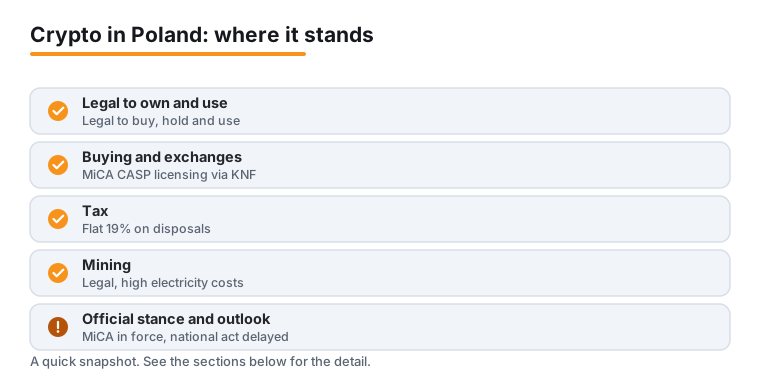
Bitcoin and other cryptocurrencies are legal to buy, hold, trade and use in Poland. There is no ban, and crypto activity is treated as a regulated commercial activity rather than a prohibited one. At the same time, crypto-assets are not legal tender and are not recognised as money or as electronic money in the ordinary sense; the official currency is the złoty, and merchants are free to refuse crypto.
The practical distinction is between using crypto, which is clearly legal for individuals, and operating a crypto business, which is legal but increasingly dependent on registration and, under MiCA, on a licence. Service providers such as exchanges, brokers and custodians must meet anti-money-laundering (AML) obligations, including customer identification (KYC) and reporting of suspicious activity, so ordinary users should expect identity verification when opening an account on a Polish or EU-facing platform.
Who regulates crypto in Poland
Several bodies share responsibility:
- Komisja Nadzoru Finansowego (KNF): the Polish Financial Supervision Authority, the intended national competent authority for MiCA. The KNF supervises the wider financial market and is the body designated to grant and oversee Crypto-Asset Service Provider (CASP) licences once the national act is in force. See the regulator at knf.gov.pl.
- Ministry of Finance and the General Inspector of Financial Information (GIIF): the Ministry maintains the pre-MiCA register of virtual-currency activity, and the GIIF is Poland's Financial Intelligence Unit, receiving suspicious-transaction reports and enforcing AML rules.
- National Revenue Administration (Krajowa Administracja Skarbowa, KAS): the tax authority, responsible for crypto taxation and, going forward, for receiving platform data under EU tax-reporting rules.
- Narodowy Bank Polski (NBP): the central bank, which has repeatedly warned that crypto-assets are not legal tender and carry significant risk; see nbp.pl.
Key laws and frameworks
Poland's crypto rulebook rests on two main layers.
EU MiCA
MiCA (Regulation (EU) 2023/1114) replaces the old patchwork of national rules with a single EU regime built around licensed CASPs. It has applied directly in Poland since 30 December 2024, with provisions on stablecoins (asset-referenced and e-money tokens) having applied from mid-2024. Because MiCA is a regulation, it applies without national transposition, but each member state must designate a competent authority and set local enforcement details. The KNF publishes MiCA guidance via knf.gov.pl and the government's INFO MiCA resource.
The national Crypto-Asset Market Act
Poland needed a national act (the Act on the Crypto-Assets Market, ustawa o rynku kryptoaktywów) to appoint the KNF as competent authority and switch on CASP licensing. Its passage was repeatedly contested. The Sejm passed successive versions, but the President (Karol Nawrocki) vetoed the act three times, in December 2025, in February 2026, and again on 11 June 2026, over concerns about the breadth of KNF powers, including account and transaction blocking and domain-blocking, and over compliance costs for smaller firms. As a result the act had not entered into force by MiCA's 1 July 2026 transitional deadline, leaving Poland without a national CASP-licensing regime for the time being. The act never entered into force. A Sejm attempt to override the second veto failed on 17 April 2026, with 243 votes in favour, 191 against and 3 abstentions, 20 short of the 263 required. The Sejm then passed a third version on 15 May 2026 by 241 votes to 200, and the President vetoed it on 11 June 2026. On the day of that veto the finance minister, Andrzej Domański, said there would be a fourth bill because the government cannot allow the market to remain unregulated, but he gave no draft and no date.
AML framework
The Act of 1 March 2018 on counteracting money laundering and terrorist financing has applied to virtual-currency businesses since 2021. Its articles 129m to 129z are the basis for the Register of Activities in the Field of Virtual Currencies, run by the Director of the Tax Administration Chamber in Katowice, with a registration fee of PLN 616. Those AML duties still apply, but from 1 July 2026 an entry in the register no longer entitles anyone to provide virtual currency services in Poland or abroad.
Licensing and registration of exchanges and VASPs
There are two overlapping regimes during the transition.
The pre-MiCA virtual-currency register
Until MiCA fully takes over, crypto businesses operate under the Register of Activities in the Field of Virtual Currencies (rejestr działalności w zakresie walut wirtualnych), kept by the Minister of Finance and run by the Director of the Tax Administration Chamber in Katowice. Entry, often called a Polish VASP registration, requires meeting AML conditions and paying a registration fee (in the region of a few hundred złoty). The list of registered entities is published by the Ministry of Finance on gov.pl.
MiCA CASP authorisation
Under MiCA, providing crypto-asset services in the EU requires a CASP licence from a national competent authority. In Poland that authority is to be the KNF, once the national act is in force. MiCA includes a transitional window for firms already active before 30 December 2024, ending no later than 1 July 2026 under the regulation, after which a full CASP authorisation is required. Because Poland's national act had not entered into force by that deadline, the KNF was not in a position to grant national CASP licences, so at the time of writing Polish firms could not obtain a Polish CASP authorisation and several sought licences in other EU states instead. A CASP licensed elsewhere in the EU can in principle passport services into Poland, which is why many platforms available to Polish users are authorised in other EU states. The KNF still cannot accept CASP applications. Its communication on the end of the transitional period, dated 23 June 2026, confirms that no Polish body has been designated as the supervisory authority under MiCA apart from for issuers of tokens that are e-money, and that an entry in the Polish virtual currency register is not an authorisation under MiCA.
Crypto and Bitcoin taxation in Poland
Crypto taxation is comparatively well defined. Since 2019, income from the paid disposal of virtual currency, that is selling crypto for fiat or using it to pay for goods or services, is treated as income from monetary capital and taxed at a flat 19% rate. Key points as commonly applied:
- Crypto-to-crypto swaps are tax-neutral at the moment of exchange; the taxable event is normally conversion to fiat or spending the crypto.
- Holding is not a taxable event.
- Costs are deductible. Documented acquisition costs and exchange fees reduce the taxable base, and where costs exceed proceeds in a year they can generally be carried forward against future crypto income.
- No minimum threshold: income must be reported regardless of amount.
- Reporting is annual on the PIT-38 form, filed in the window from 15 February to 30 April for the previous tax year.
Poland is implementing the EU's DAC8 crypto tax-reporting rules, under which platforms will report user transaction data to KAS, making accurate record-keeping essential. Mining and staking may be treated differently depending on whether the activity looks personal or business in nature. Do not treat the 19% figure as fixed for your situation; verify with KAS or a Polish tax adviser. See our crypto taxes overview.
AML and KYC rules
Crypto businesses are obligated entities under Poland's AML/CFT Act and must run full AML programmes. In practice this means:
- Customer identification (KYC): verifying who customers are, typically via an ID document and sometimes proof of address, before meaningful trading or withdrawals.
- Transaction monitoring and risk assessment.
- Reporting suspicious transactions to the General Inspector of Financial Information (GIIF), Poland's Financial Intelligence Unit.
- An appointed AML officer in a managerial role responsible for compliance.
- Periodic reporting to the GIIF.
For ordinary users, the visible effect is mandatory identity verification on regulated platforms. MiCA adds further provider-level obligations on governance, disclosures and custody. AML enforcement during the transition continues to sit with the Ministry of Finance and the GIIF until the KNF fully assumes supervision under the national act.
Buying and using crypto in practice
Polish residents can buy crypto through global and EU-based exchanges, broker apps, peer-to-peer marketplaces and Bitcoin ATMs. Bank transfers in PLN, cards, and instant payment systems such as BLIK are widely supported. Whatever route you choose, expect identity verification under AML rules. A sensible path:
- Choose a reputable platform that supports Polish users and PLN and is registered or authorised in the EU. During the transition, many trustworthy services are CASP-authorised in another EU state.
- Verify your account by completing KYC with an ID document.
- Deposit in PLN to avoid currency-conversion costs.
- Buy with a market or limit order; you can buy a fraction of a coin.
- Secure your holdings by withdrawing larger amounts to a wallet you control, such as a hardware wallet, and back up your recovery phrase offline.
- Keep records of every transaction for PIT-38 reporting.
Bitcoin ATMs exist mainly in larger cities and are convenient for small cash purchases, but usually cost noticeably more than buying online and apply KYC that scales with the amount.
Bitcoin mining in Poland
Bitcoin mining is legal in Poland, with no specific prohibition on running mining hardware; both hobbyist and commercial miners operate. The decisive factor is economics, especially electricity cost: Poland's retail power prices are relatively high by European standards, and the grid has historically leaned on coal, though renewables are a growing share. Considerations:
- Energy cost and sourcing. Profitability hinges on the price per kilowatt-hour; some operators pursue renewables or off-peak arrangements.
- Tax treatment. Mined coins generally have tax consequences, and a sustained, organised operation may be treated as a business; clarify with a tax adviser.
- Practical setup. Heat, noise and electrical safety matter, and large installations may need commercial electricity contracts.
For most individuals, mining profitably with home equipment is difficult at Polish power prices; many participate through mining pools or simply buy and hold instead.
Recent developments (2025-2026)
The dominant story is the delayed national implementation of MiCA. While MiCA itself applied from the end of 2024, the Polish Act on the Crypto-Assets Market needed to appoint the KNF and activate CASP licensing was vetoed by the President in December 2025, again in February 2026, and a third time on 11 June 2026, amid debate over the breadth of KNF enforcement powers, including the ability to block accounts, transactions and domains and impose large fines, and over compliance costs for smaller firms. As a result the act had not entered into force by MiCA's 1 July 2026 transitional deadline, and Poland became the only EU member state with no national competent authority able to grant CASP authorisations, and it was still the only one in August 2026. The KNF publicly warned in early 2026 that, without a designated authority, firms based in Poland would lose the ability to provide crypto-asset services and that services would instead depend on providers licensed in other EU member states passporting in. In practice a number of Polish operators have sought CASP authorisation in other EU countries such as Lithuania, Germany or Estonia.
In parallel, Poland is implementing the EU's DAC8 crypto tax-reporting framework. A related law (sometimes described as a crypto-assets tax package) was passed by the Sejm on 19 December 2025, and under DAC8 platforms will report user and transaction data to the tax authority KAS, with the first data expected around mid-2027. During the gap, the pre-MiCA virtual-currency register continued to operate. The version that was vetoed had been adopted by the Council of Ministers on 8 May 2026 and, according to the Ministry of Finance, was substantively identical to the earlier ones apart from harsher penalties: the maximum prison term for unauthorised provision of crypto-asset services was raised to 8 years and the maximum fine to PLN 20 million, and the maximum period for which trading in a crypto-asset could be suspended at the KNF's request was raised to 24 months. None of that is in force.
Consumer risks and protection
Crypto is high-risk and largely outside the safety nets that cover bank deposits. The NBP and KNF have repeatedly warned the public about these risks. Key points:
- No deposit guarantee. Crypto holdings are not covered by Poland's bank deposit guarantee scheme; if a platform fails or is hacked, you may lose funds.
- Volatility. Prices can swing sharply; only commit money you can afford to lose, and be wary of leverage.
- Scams and fraud. Fake investment schemes, phishing and impersonation are common. Be sceptical of guaranteed or fixed returns.
- Irreversibility. Crypto transactions generally cannot be reversed; mistakes and theft are often permanent.
- Custody risk. Coins held on a platform depend on its solvency and security; self-custody shifts that responsibility to you.
MiCA is intended to improve consumer protection over time through disclosure, capital and custody standards for licensed providers. The KNF publishes warnings and a public list of entities it has flagged; check it before using an unfamiliar service. See our crypto regulation guide for context.
Official sources and how to verify
Because the framework is evolving, verify any detail before you rely on it. Authoritative starting points:
- Polish Financial Supervision Authority (KNF): the regulator and intended MiCA competent authority, with MiCA guidance and public warnings: knf.gov.pl.
- Ministry of Finance (gov.pl): the virtual-currency activity register and official communications for crypto businesses: gov.pl/web/finance.
- Narodowy Bank Polski (NBP): the central bank, for its position on crypto and consumer warnings: nbp.pl.
- INFO MiCA (fintech.gov.pl): the government's MiCA information hub: fintech.gov.pl.
For tax questions, consult the National Revenue Administration (KAS) or a licensed Polish tax adviser. This article is general information as of 2026, not legal advice; confirm the current rules with the KNF or another competent authority before acting.
What is changing: Poland's crypto rules in August 2026
Nothing was signed. The transitional window in Article 143(3) of Regulation (EU) 2023/1114 (MiCA) closed on 1 July 2026 and Poland reached that date with no national implementing act. As of early August 2026 that is still the position: Poland has designated no competent authority for crypto-asset services, so the KNF cannot accept, examine or grant a CASP authorisation, and Poland is the only EU member state in that position.
Three things changed in practice at the deadline.
- The Polish register stopped being a permission. The Director of the Tax Administration Chamber in Katowice confirmed that an entry in the Register of Activities in the Field of Virtual Currencies is not an authorisation under MiCA and that after 1 July 2026 it no longer entitles a firm to provide virtual currency services in Poland or abroad.
- ESMA called for an orderly wind-down. Its public statement of 23 June 2026 expects providers without a MiCA authorisation to stop onboarding new EU clients, cease marketing and solicitation, and limit activity to what clients need in order to sell or transfer crypto-assets or close positions, while keeping anti-money-laundering controls running throughout.
- The KNF restated the gap. Its communication on the end of the transitional period, dated 23 June 2026, says no Polish body has been designated as the supervisory authority under MiCA, with the single exception of issuers of tokens that are e-money.
Continuity of service for Polish users therefore rests entirely on firms authorised in other member states and passporting in. The KNF had already published a position on the absence of a designated supervisor on 10 February 2026.
Crypto legislation in Poland: adopted, blocked and pending
One EU regulation is in force and binds Poland directly. Every Polish attempt to build the national machinery around it has failed so far. This is the pipeline as it stands.
| Measure | Stage | What it does | Timing |
|---|---|---|---|
| Regulation (EU) 2023/1114 (MiCA) | In force | Directly applicable EU licensing regime for crypto-asset service providers, stablecoin issuers and token offerors. Each member state must designate a competent authority. | Applies since 30 December 2024. The transitional period under Article 143(3) ended on 1 July 2026. |
| Ustawa o rynku kryptoaktywów (Act on the Crypto-Assets Market) of 15 May 2026 | Vetoed, not in force | Would have designated the KNF, opened CASP licensing and created the sanctions regime. The version adopted by the Council of Ministers on 8 May 2026 was substantively identical to the earlier ones apart from harsher penalties: the maximum prison term for unauthorised provision of crypto-asset services was raised to 8 years and the maximum fine to PLN 20 million, and the maximum period for which trading in a crypto-asset could be suspended at the KNF's request was raised to 24 months. | Passed by the Sejm on 15 May 2026 by 241 votes to 200, vetoed on 11 June 2026. The previous veto had survived a Sejm override attempt on 17 April 2026, when 243 votes in favour fell 20 short of the 263 needed. |
| Fourth government bill | Announced only | Finance minister Andrzej Domański said the government will not leave the market unregulated and does not intend to change direction, meaning KNF supervision again. | Announced 11 June 2026. No draft published and no date given. |
| Presidential, Polska 2050 and Konfederacja drafts | In parliament, not adopted | The presidential and government texts both put supervision with the KNF and differ mainly on the scope of the KNF's powers to block crypto-asset accounts and on the level of administrative and criminal sanctions. Polska 2050 would let banks provide crypto-asset services through a dedicated organisational unit. Konfederacja stresses proportionality of the requirements placed on market participants. | First reading and referral to the Sejm Public Finance Committee on 12 May 2026. The committee treated the government text as the leading one. None of these has become law. |
| PiS private members bill (RPW/16436/2026) | Filed, no sign of progress | Would classify the organising of crypto trading as an unfair market practice and prohibit it, while leaving private ownership lawful, with prison terms of 6 months to 8 years, up to 10 years for property of great value, account blocking by the ABW at the request of the UOKiK president, website blocking by internet access providers, and two months for platforms to return client funds. Not government policy. | Filed 11 May 2026 by 17 deputies represented by Zbigniew Kuźmiuk. It has not advanced procedurally. |
| Ministry of Finance draft regulation on bank risk management | Draft, in consultation | Would require banks with direct or indirect crypto-asset exposure to assess that exposure within their credit and counterparty risk procedures and report the assessment to the KNF. It amends the existing regulation on risk management systems and internal control in banks, alongside CRD VI changes. | Published 24 June 2026. No entry-into-force date reported. |
What to watch: whether the Ministry of Finance publishes a fourth draft, and whether it is written to attract the President's signature. Overriding a veto needs a three-fifths majority in the Sejm, which the governing coalition has failed to reach every time it has tried.
What actually applies while there is no national act
Poland has no national crypto-assets statute. Say that once, then look at what does govern the market, because four things do.
- AML. The Act of 1 March 2018 on counteracting money laundering and terrorist financing applies to virtual-currency businesses. Its articles 129m to 129z create the Register of Activities in the Field of Virtual Currencies, run by the Director of the Tax Administration Chamber in Katowice, with a registration fee of PLN 616. The register and its AML duties still exist. What ended on 1 July 2026 is the idea that the entry is a permission to trade.
- Tax. The veto changed nothing here. Income from the paid disposal of virtual currency is taxed at a flat 19 percent on proceeds less documented acquisition costs, declared on PIT-38 by 30 April for the previous year, and a swap of one cryptocurrency for another stays tax-neutral until one of them is finally sold.
- Supervision. The KNF is the competent authority for issuers of e-money tokens and for nothing else in crypto. For any other crypto service there is no Polish supervisor to complain to, and complaints have to go to the authority that licensed the provider in its home member state.
- Redress against the state. Polish lawyers are arguing that the missing statute is an actionable legislative omission under Article 417(1) paragraph 4 of the Civil Code, which covers damage caused by failure to issue a normative act required by law, with the State Treasury as defendant. No directly analogous precedent exists, and the obvious defence is that firms could have licensed elsewhere in the EU.
Where the platforms serving Polish users are actually licensed
Because no Polish CASP licence exists, every lawful route into the Polish market runs through another member state. A review of the ESMA register published in July 2026 counted roughly 280 firms authorised as CASPs across the EU, of which only 18 hold the class 3 permission needed to run a trading platform. Estimates of how many Polish registered providers were left without a route vary by source, from about 1,400 to about 2,000.
- Polish-linked licence holders identified in July 2026: XTB Limited in Cyprus, WEB3 Technology B.V. trading as Ari10 in the Netherlands, and SIA AlphaRoute trading as Kanga Exchange in Latvia.
- Foreign platforms holding class 3 trading-platform permissions include Kraken in Ireland, Bitstamp in Luxembourg, OKX and Gate in Malta, Bybit in Austria, Bitvavo in the Netherlands and Coinmate in the Czech Republic.
- Verify any provider against the ESMA public register before you deposit. An entry in the old Polish virtual currency register is not evidence of a MiCA licence, and the Katowice tax chamber has said so explicitly.
Frequently asked questions
Is cryptocurrency legal in Poland?
Yes. Buying, holding, trading and using cryptocurrency is legal for individuals in Poland, and businesses may accept it by agreement. Crypto is not legal tender, though, since the official currency is the złoty, and crypto service providers must comply with anti-money-laundering rules and, under the EU's MiCA regulation, licensing requirements.
Who regulates cryptocurrency in Poland?
The Polish Financial Supervision Authority (Komisja Nadzoru Finansowego, KNF) is the intended national supervisor for crypto-asset service providers under MiCA. During the transition, the Ministry of Finance and the General Inspector of Financial Information (GIIF) handle the pre-MiCA virtual-currency register and AML oversight, and the National Revenue Administration (KAS) handles tax. As of 2026, the national act was vetoed for a third time on 11 June 2026 and never entered into force, so the KNF is the competent authority only for issuers of e-money tokens and cannot license or supervise crypto-asset service providers.
How is crypto taxed in Poland?
Income from disposing of virtual currency, that is selling for fiat or spending it, is taxed as monetary capital income at a flat 19% rate, reported annually on the PIT-38 form between 15 February and 30 April. Crypto-to-crypto swaps are tax-neutral at the point of exchange, and simply holding is not taxable. Documented acquisition costs are deductible. Rates and rules can change, so verify with the National Revenue Administration (KAS) or a Polish tax adviser; this is not tax advice.
Do crypto exchanges need a licence in Poland?
During the MiCA transition, crypto businesses operate under the Register of Activities in the Field of Virtual Currencies kept by the Ministry of Finance (run from Katowice). Under MiCA, providing crypto-asset services requires a CASP authorisation from the national competent authority, which in Poland is to be the KNF once the national act is in force. A CASP licensed in another EU state can passport services into Poland. The transitional period for firms active before 30 December 2024 runs no later than 1 July 2026 under MiCA.
Why was Poland's crypto law delayed?
Although MiCA applied across the EU from 30 December 2024, Poland needed a national act to appoint the KNF and switch on CASP licensing. That bill was vetoed by the President three times, in December 2025, in February 2026, and again on 11 June 2026, amid debate over the breadth of KNF powers (including blocking of accounts, transactions and domains, and large fines) and compliance costs. As a result the act had not entered into force by MiCA's 1 July 2026 transitional deadline, leaving Poland without a national CASP-licensing authority for the time being. Because the timeline has shifted repeatedly, check the current position with the KNF.
Can I still use a crypto exchange in Poland after 1 July 2026?
In practice most Polish users continued to use exchanges through providers authorised under MiCA in other EU member states, which can passport their services into Poland. Because Poland had not put its national act into force by the 1 July 2026 deadline, firms based in Poland could not obtain a Polish CASP licence, and the KNF warned that domestic providers without an EU authorisation could lose the ability to offer services. If you use a platform, check that it is CASP-authorised somewhere in the EU, and be aware that unlicensed services may restrict deposits, trading or withdrawals. Confirm the current position with the KNF.
Where are the crypto platforms that Polish residents use actually licensed?
Because Poland could not yet issue national CASP licences, many operators serving Polish users hold MiCA authorisations from other EU states, and by July 2026 the identifiable Polish-linked holders were XTB Limited in Cyprus, WEB3 Technology B.V. trading as Ari10 in the Netherlands, and SIA AlphaRoute trading as Kanga Exchange in Latvia. A firm licensed in one EU state can passport across the bloc, including into Poland. This does not remove the usual risks, so still verify a platform's authorisation and check the KNF's public warning list before signing up.
Is my crypto protected if a platform fails in Poland?
No. Crypto holdings are not covered by Poland's bank deposit guarantee scheme, so if a platform is hacked or becomes insolvent you may lose your funds. Crypto transactions are generally irreversible. MiCA introduces custody, disclosure and capital standards for licensed providers over time, but these do not eliminate risk. Use reputable EU-authorised platforms, consider self-custody for larger holdings, and check the KNF's public warnings before using an unfamiliar service.
Can a company get a crypto licence in Poland in August 2026?
No. Poland has still not designated a competent authority for crypto-asset services, so the KNF cannot accept, examine or grant a CASP authorisation. The only route for a Polish business is to apply in another EU or EEA state and passport the service back into Poland. The one exception is issuers of e-money tokens, where the KNF is the competent authority.
What happened to my Polish virtual currency register entry on 1 July 2026?
It stopped being a permission to trade. The Director of the Tax Administration Chamber in Katowice confirmed that an entry in the Register of Activities in the Field of Virtual Currencies is not an authorisation under MiCA and that after 1 July 2026 it does not entitle a firm to provide virtual currency services in Poland or abroad. The register still exists and the AML obligations attached to it still apply.
Is a fourth Polish crypto law coming, and when?
Finance minister Andrzej Domański said on 11 June 2026, the day of the third veto, that there would be a fourth act because the government cannot allow the market to remain unregulated. He gave no timetable, said it was too early to discuss detailed solutions, and no draft had been published as of early August 2026. Separate drafts from the President, Polska 2050 and Konfederacja were referred to the Sejm Public Finance Committee on 12 May 2026 and have not become law.
What is ESMA telling unlicensed crypto firms to do?
In a public statement of 23 June 2026, ESMA said providers without a MiCA authorisation should immediately stop onboarding new EU clients, cease marketing and solicitation, and limit their activity to what is necessary for clients to sell or transfer crypto-assets or close positions, while keeping anti-money-laundering controls in place throughout the wind-down. Clients of unauthorised providers do not have MiCA protections and should check the provider in the ESMA public register.
Facts reviewed: 5 August 2026. Page updated: 5 August 2026.