Home › Crypto Regulation › Peru
Bitcoin & Cryptocurrency Regulation in Peru
Quick answer — Peru, 2026
- Legal: Legal to own and trade, not legal tender, no full market law yet
- Tax: No dedicated crypto tax law, gains taxable under income rules, rates proposed
- Buying: Via global and regional exchanges and P2P with KYC
Peru is one of Latin America's more active cryptocurrency markets, with steady retail adoption in cities such as Lima, Arequipa and Cusco, a busy peer-to-peer trading scene and strong interest in Bitcoin and stablecoins for savings and remittances. The SBS, Peru's banking and insurance regulator, has estimated that around one million Peruvians hold cryptoassets. Industry figures reported in 2026 put Peru among the larger crypto economies in the region, with much of the activity in dollar-pegged stablecoins used for saving in dollars and for cheaper cross-border remittances rather than for speculation. The legal picture, however, is still maturing. As of 2026 Peru does not have a single, comprehensive crypto law that licenses exchanges and sets out full market conduct rules. Instead, the country regulates the sector mainly through anti-money-laundering (AML) obligations, while a broader framework bill remains under discussion in Congress.
This guide explains where Peru stands on crypto legality, who the regulators are, how the main laws work, how taxes are generally treated, and the practical realities of buying, mining and using crypto. It is general information as of 2026 and is NOT legal, tax or financial advice. Rules here change quickly, so always verify the current position with the named official Peruvian authorities, above all the SBS, or with a qualified local professional before acting. See also our guide to crypto regulation and the country regulation hub.
On this page: Legal status · Who regulates it · Taxes · How to buy · Mining
Is Bitcoin and crypto legal in Peru?
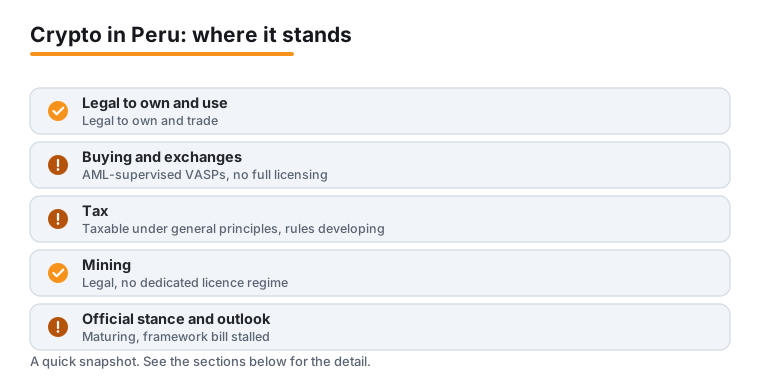
Yes. Buying, holding, selling and trading Bitcoin and other cryptoassets is legal in Peru. Peruvian law does not prohibit individuals or businesses from owning or transacting in digital assets, and a range of local, regional and international platforms serve Peruvian users.
However, legal is not the same as fully regulated. Cryptoassets are not legal tender in Peru. The official currency is the Peruvian sol (PEN), issued and backed by the central bank, and no person or merchant is obliged to accept crypto as payment. Both the pending framework bill and the Banco Central de Reserva del Peru (BCRP) have been explicit that cryptoassets are not money. Crypto is therefore treated as a private asset rather than as currency, and holders do not benefit from the deposit guarantees and consumer protections that cover regulated banks. For much of its history the sector operated in a legal gray zone, neither banned nor comprehensively governed, though that has begun to change as AML rules take effect.
Who regulates crypto in Peru?
Peru has no single dedicated crypto regulator. Several authorities touch the sector, each within its own mandate:
- SBS and its UIF: The Superintendencia de Banca, Seguros y AFP (SBS) supervises the financial system and houses the Unidad de Inteligencia Financiera (UIF), Peru's Financial Intelligence Unit. Since 2024 the SBS/UIF supervises virtual asset service providers for AML compliance. The SBS has stated it does not directly oversee crypto as an investment product and has warned about the risks.
- SMV: The Superintendencia del Mercado de Valores oversees securities. A token that behaves like a regulated security could fall under its remit.
- BCRP: The central bank addresses monetary matters, reiterates that crypto is not legal tender, warns about volatility, and is exploring a central bank digital currency (the Sol Digital).
- SUNAT: The national tax authority (Superintendencia Nacional de Aduanas y de Administracion Tributaria) handles taxation and has signaled it intends to tax crypto gains.
Because responsibilities are split, the right authority to consult depends on your activity. Always confirm the current position directly with the relevant body.
Key crypto laws and frameworks in Peru
Peru's current rules center on AML and counter-terrorist-financing (AML/CFT) controls rather than a full market-licensing regime. The main building blocks are:
- Supreme Decree 006-2023-JUS (July 2023): Incorporated Virtual Asset Service Providers, known locally as Proveedores de Servicios de Activos Virtuales (PSAV), into the AML system as obligated subjects that must report to the UIF. Covered activities include exchange between crypto and fiat or between cryptoassets, transfers, custody or administration, and participation in new issues.
- SBS Resolution 2648-2024 (in force August 2024): Approved the detailed money-laundering and terrorist-financing prevention standard (the SPLAFT regime) for PSAVs under UIF supervision. It sets out a risk-based approach, the duty to appoint a compliance officer, customer identification, suspicious-activity reporting and the obligation to execute UIF freezing orders. PSAVs were given 120 days to adapt.
- Travel Rule (FATF Recommendation 16): The resolution incorporates the Travel Rule, requiring providers to collect and share originator and beneficiary information for domestic and international transfers. This chapter takes effect two years after publication, around August 2026.
This is general information and not legal advice; for the exact wording and current status, consult the SBS directly.
Pending framework law for cryptoassets
Separately from the AML rules, a broader bill, the Ley Marco para la Comercializacion de Criptoactivos (Framework Law for the Commercialization of Cryptoassets), has been debated in Congress for several years. If enacted, it is expected to set operating rules for crypto exchange platforms and could introduce clearer registration, authorization and consumer-protection requirements. The bill itself states that cryptoassets are not considered legal tender.
As of 2026 the bill had NOT become law. Reporting indicates that during 2025 it was sent back to committee for further study, reflecting a continuing lack of consensus on the legal nature of cryptoassets and on which authority should supervise an integrated regime. Until any such law is enacted and published, the practical regime in Peru remains AML-focused. Because the legislative status can change, verify the latest position through Congress and the SBS rather than relying on summaries.
Licensing and registration of exchanges (VASPs)
Peru does not yet operate a full licensing regime that authorizes crypto exchanges as financial institutions. What exists today is the AML framework. Under Supreme Decree 006-2023-JUS and SBS Resolution 2648-2024, PSAVs that are domiciled or incorporated in Peru, including local branches of foreign companies, are obligated subjects supervised by the UIF.
In practice this means a covered provider must register and report to the UIF, appoint a compliance officer, run a money-laundering prevention system, identify customers, monitor activity, file suspicious-transaction reports and, as the Travel Rule phases in, collect and transmit transfer information. These are AML obligations rather than a prudential or market-conduct license of the kind a bank or broker holds. If the pending framework law is enacted, a more formal authorization or registration regime for exchanges could follow. For now, confirm a platform's compliance status and the current requirements with the SBS.
Crypto and Bitcoin tax in Peru
Crypto activity in Peru can create tax obligations, but the specific rules are still being developed. As of 2026 there is no dedicated crypto tax law; SUNAT has indicated that, under existing income-tax principles, profits from disposing of crypto can be taxable, and crypto received from activities such as mining, staking, airdrops or as payment may also be taxable as income. In broad terms, a taxable event typically arises when you dispose of crypto at a gain, for example selling for soles, swapping tokens or spending it. Businesses face corporate income tax on crypto profits, while individuals are generally taxed on gains.
In February 2025 SUNAT's superintendent, Victor Mejia, publicly signaled that the authority was preparing a proposal to amend the Income Tax Law to treat individuals' crypto gains as second-category (capital) income and companies' gains as third-category income, and to strengthen its access to crypto-transaction data. Press reporting at the time referenced an indicative 5 percent rate for individuals and the standard 29.5 percent corporate rate for companies, but these figures were part of an announced proposal, not enacted law. By mid 2025 no such amendment had been passed, and the exact rates, categories and thresholds remained subject to legislative change, so this guide treats them as provisional rather than settled. Because penalties for under-reporting can be substantial, keep detailed records of every transaction (dates, amounts, values in soles and counterparties) and confirm your obligations with SUNAT or a Peruvian tax adviser. See our crypto taxes overview. This section is informational only and not tax advice.
AML and KYC rules for crypto users
AML and know-your-customer (KYC) checks are now the most concrete part of Peru's crypto regime. Because PSAVs are obligated subjects under the UIF, reputable services operating in or serving Peru are expected to verify customer identity, monitor transactions and report suspicious activity. Expect to submit identification when you open an account or trade, and be prepared for source-of-funds questions on larger amounts.
The SBS Resolution 2648-2024 standard formalizes these duties for providers, including a compliance officer, a risk-based prevention system and suspicious-transaction reporting. The Travel Rule provisions, phasing in around August 2026, will additionally require providers to collect and share originator and beneficiary information when crypto is transferred between them. For individuals, the practical effect is more identity verification and more information sharing between platforms over time. To learn how these obligations fit international standards, see our crypto regulation guide.
Buying and using crypto in practice
Peruvians typically access crypto through several routes:
- Global exchanges: Major international platforms generally serve Peruvian residents and support deposits via bank transfer or card, subject to their own onboarding rules.
- Regional and local platforms: Latin American exchanges and local over-the-counter desks cater to soles-denominated trading.
- Peer-to-peer (P2P): P2P marketplaces are popular and let buyers and sellers transact directly using local payment methods.
- Bitcoin ATMs: A limited number of machines operate, mostly in Lima, usually at higher fees and spreads than online platforms; numbers and locations change, so check a live locator first.
A common path is: choose a reputable provider that serves Peru and supports soles funding; complete KYC; deposit soles by bank transfer, card or a P2P trade; place your order; then secure holdings in a personal wallet (a hardware wallet for meaningful amounts) and safeguard the recovery phrase. Remittances are a notable use case, since crypto and stablecoins can settle cross-border transfers quickly and, according to industry commentary, at a lower cost than the roughly 6.6 percent average charged on traditional remittances to Peru, though conversion fees, KYC, the incoming Travel Rule and possible tax all apply. Keep records of every purchase, sale and transfer with dates and soles values for future tax reporting, start small while learning, and never share private keys or recovery phrases.
Bitcoin mining in Peru
Bitcoin mining is legal in Peru and has drawn interest from local entrepreneurs and outside investors, partly because of the country's significant renewable-energy resources. Peru generates a large share of its electricity from hydropower, and there is growing discussion of pairing mining with solar and wind to lower its carbon footprint.
There is no dedicated mining license regime today. The main practical considerations are familiar for any mining jurisdiction: electricity cost and reliability, hardware import and customs, cooling, and profitability given Bitcoin's price and network difficulty. Miners still face general business, electricity and tax obligations, and income from mining is generally treated as taxable. As environmental and tax discussions continue, the operating environment may evolve, so confirm local permitting, utility and tax requirements before investing.
Recent developments (2025-2026)
The clearest direction of travel is toward greater regulatory clarity, built on the AML foundation:
- AML supervision live: Since August 2024, PSAVs have been supervised by the UIF under SBS Resolution 2648-2024, following their incorporation as obligated subjects in 2023.
- Travel Rule phasing in: The transfer-information provisions take effect around August 2026, aligning Peru with FATF standards.
- Tax proposal: In February 2025 SUNAT's superintendent Victor Mejia signaled plans to amend the Income Tax Law to capture crypto gains (as second-category income for individuals, with reporting citing an indicative 5 percent rate) and to improve data access, but by mid 2025 no amendment had been enacted and the specifics remained proposals.
- Framework bill stalled: The Ley Marco para la Comercializacion de Criptoactivos remained pending and was reported to have been returned to committee in 2025, so no comprehensive market-licensing law was in force.
- Central bank digital currency: The BCRP continued to explore a digital sol while reiterating that crypto is not legal tender.
Because these items are evolving, treat dates and proposals as provisional and verify the latest status with the official sources below.
Consumer risks and protection
The main risks for Peruvian users are familiar across crypto markets: price volatility, scams and fraudulent schemes, exchange or wallet security failures, and limited legal recourse if a platform collapses, because crypto sits outside the protections that cover regulated banking and investment products. Regulatory and tax uncertainty is an added, Peru-specific risk while the framework is still being built, and crypto is not legal tender, so no one is obliged to accept it.
Practical protection comes from using established, AML-compliant providers, staying alert to fraud, enabling strong security (two-factor authentication, hardware wallets, careful key custody), keeping thorough records, and only committing money you can afford to lose. The BCRP and SBS have repeatedly warned about volatility and the absence of guarantees. If a provider claims to be authorized or regulated by a Peruvian authority, verify that claim directly with the named body before sending funds.
Official sources and how to verify
Because Peru's crypto rules are evolving, always confirm the current position with primary official sources rather than secondhand summaries. The key authorities are:
- Superintendencia de Banca, Seguros y AFP (SBS), including its UIF, for AML supervision of virtual asset service providers and official warnings.
- Banco Central de Reserva del Peru (BCRP) for monetary matters, the legal-tender status of the sol and central-bank digital currency work.
- SUNAT, via the gob.pe government portal, for tax obligations and any new crypto tax rules.
For the status of the framework bill, consult the Congreso de la Republica record, and for securities questions consult the SMV. This guide is general information as of 2026 and is NOT legal advice; verify any decision with the named official regulator, above all the SBS, or a qualified Peruvian professional. See also our regulation hub for other countries.
Frequently asked questions
Is cryptocurrency legal in Peru?
Yes. Owning, buying, selling and trading crypto is legal in Peru. However, cryptoassets are not legal tender, no merchant is obliged to accept them, and holders do not enjoy the protections that apply to regulated banking products. This is general information, not legal advice; verify with the SBS .
Who regulates crypto in Peru?
There is no single dedicated crypto regulator. The SBS and its Financial Intelligence Unit (UIF) supervise anti-money-laundering compliance by virtual asset service providers, the SMV handles securities-type matters, the central bank (BCRP) covers monetary issues, and SUNAT handles taxation. A framework law that would create broader oversight remained pending in Congress as of 2026.
What laws govern crypto exchanges in Peru?
The core rules are Supreme Decree 006-2023-JUS, which made virtual asset service providers (PSAV) obligated subjects for anti-money laundering, and SBS Resolution 2648-2024, in force since August 2024, which sets the detailed AML prevention standard under UIF supervision. There is no full market-licensing law yet; a Travel Rule for transfer information phases in around August 2026.
Do I have to pay tax on crypto in Peru?
Generally, crypto gains and crypto-denominated income can be taxable under existing income-tax principles, and in February 2025 SUNAT's superintendent Victor Mejia signaled a plan to formalize this by treating individuals' gains as second-category income (reporting referenced an indicative 5 percent rate) and companies' gains as third-category income at the 29.5 percent corporate rate. These were announced proposals rather than enacted rules, and by mid 2025 no amendment had passed, so treat the figures as provisional. Keep detailed records and confirm with SUNAT or a tax professional. This is not tax advice.
Is crypto legal tender in Peru?
No. The only legal tender is the Peruvian sol, issued and backed by the BCRP. Cryptoassets are treated as private assets, not money, and no one is required to accept them as payment. The BCRP has repeatedly warned about crypto volatility and is exploring its own digital sol.
Are crypto exchanges licensed in Peru?
Not in a full prudential sense. Providers domiciled or operating in Peru must comply with AML obligations under UIF supervision, including registration, a compliance officer, customer identification and suspicious-activity reporting, but this is an AML regime rather than a market-conduct license. A broader licensing framework would require the pending framework law to be enacted. Verify a provider's status with the SBS .
How do most Peruvians use crypto?
Industry data reported in 2026 suggests much of Peru's crypto activity involves dollar-pegged stablecoins used for saving in dollars and for cross-border remittances, rather than only speculative trading. Access is mainly through global exchanges, regional platforms and peer-to-peer trading, with a limited number of Bitcoin ATMs, mostly in Lima. These figures come from private-sector sources and are not official statistics.
Did Peru pass a crypto law in 2025 or 2026?
No comprehensive crypto market law was enacted. The Ley Marco para la Comercializacion de Criptoactivos remained a pending bill and was reported to have been returned to committee in 2025. The concrete rules in force are the anti-money-laundering obligations under Supreme Decree 006-2023-JUS and SBS Resolution 2648-2024, supervised by the UIF, with the Travel Rule phasing in around August 2026. Confirm the latest status with Congress and the SBS .
Facts reviewed: 30 June 2026. Page updated: 3 August 2026.