Home › Crypto Regulation › Venezuela
Bitcoin & Cryptocurrency Regulation in Venezuela
Quick answer — Venezuela, 2026
- Legal: Legal to own and use, not legal tender; regulator SUNACRIP under reorganisation since 2023
- Tax: No comprehensive crypto tax code; income rules apply and IGTF extended to some crypto payments
- Buying: Via international exchanges and a very large P2P market, mostly in USDT stablecoin
Venezuela has one of the world's most active grassroots cryptocurrency economies. After years of hyperinflation, currency controls and limited access to the international banking system, dollar-pegged stablecoins (above all USDT, also called Tether) and Bitcoin have become practical tools for saving, getting paid and receiving money from relatives abroad. By late 2025, analysts estimated that a meaningful share of everyday transactions and remittances moved over crypto rails.
The legal picture is unusual and still evolving. Crypto is lawful for individuals to own and use, and Venezuela was an early mover in creating a formal regulatory body and even a state-backed token. Yet the framework has shifted repeatedly: the main regulator was paralysed by a 2023 corruption scandal and placed under a multi-year reorganisation, the state petro token was discontinued in January 2024, and crypto mining went from licensed to banned. This page explains where things stand for 2026: legal status, the regulators, the key laws, licensing, tax, AML and KYC, buying and using crypto in practice, mining, recent developments, consumer risks, and how to verify everything against official sources. This is general information as of 2026 and is NOT legal, tax or financial advice; rules in Venezuela change frequently, so verify anything important with the named official regulator (SUNACRIP) and a qualified local professional before acting. See also our guide to crypto regulation and the regulation hub.
On this page: Legal status · Who regulates it · Taxes · How to buy · Mining
Is Bitcoin and crypto legal in Venezuela?
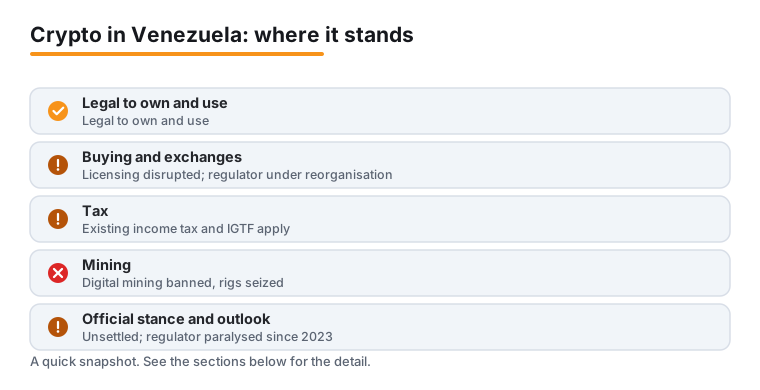
Yes. Owning, buying, selling and using Bitcoin and other cryptocurrencies is legal for individuals in Venezuela. There is no prohibition on holding digital assets, and crypto is widely used in everyday commerce, especially USDT, which functions as a de facto parallel store of value and means of payment for groceries, rent, school fees and cross-border transfers.
Venezuela went further than most countries by formally recognising cryptoassets in law. A 2018 decree and a January 2019 constitutional decree created a national superintendency to license and supervise crypto activity, and the government launched its own oil-backed token, the petro. In practice the system has been turbulent: the petro was discontinued in January 2024, and the supervisory body has operated under a forced reorganisation since 2023. Personal crypto use is clearly legal and common, but official oversight of businesses and service providers has been inconsistent and is still being rebuilt. For business activity, confirm the current rules directly with the regulator before relying on any older guidance.
Who regulates crypto in Venezuela?
The lead crypto authority is SUNACRIP, the National Superintendency of Cryptoassets and Related Activities (Superintendencia Nacional de Criptoactivos y Actividades Conexas). Created by constitutional decree in early 2019, it was given broad powers to regulate the creation, issuance, organisation, operation, exchange, mining and use of cryptoassets, including registering and authorising exchanges, exchange offices and miners. Its official site is sunacrip.gob.ve, though the site may be intermittently available while the agency is reorganised.
Other authorities interact with crypto, especially for businesses and for converting between crypto and bolivars:
- Banco Central de Venezuela (BCV), the central bank, sets monetary policy, issues the bolivar and publishes official exchange rates: bcv.org.ve.
- SENIAT, the national tax administration, handles tax collection and reporting: seniat.gob.ve.
The 2023 restructuring, ordered by presidential decree, placed the agency under a reorganisation board headed by lawyer Anabel Pereira Fernandez; its founding head, Joselit Ramirez, was removed and later arrested in connection with a large oil-linked corruption case. The restructuring was ordered by decreto N° 4.788 of 17 March 2023, published in Gaceta Oficial Extraordinaria N° 6.739, and extended three times: decreto N° 4.865 (Gaceta Oficial N° 42.717) from 17 September 2023, decreto N° 4.926 (Gaceta Oficial N° 42.840) from 17 March 2024, and decreto N° 5.003 (Gaceta Oficial N° 42.964) from 17 September 2024. That last extension ran six months, and no further extension or decree restoring normal operation appears in published gazette records. Anyone relying on a SUNACRIP authorisation or registration should verify its current status directly with the agency.
Key laws and regulatory framework
The foundation of Venezuela's crypto rules is decree-based rather than a single conventional statute:
- 2018 decree. On 9 April 2018, Gaceta Oficial Extraordinaria N° 6.370 and N° 6.371 published a decree on cryptoassets and the petro sovereign cryptocurrency, issued by the National Constituent Assembly. Its petro provisions are now dead letter: the Plataforma Patria, the only place the token was redeemable, closed its crypto wallets from 15 January 2024.
- Constituent Decree on the Integral System of Cryptoassets (January 30, 2019). Published in Gaceta Oficial N° 41.575, this is the comprehensive framework. It covers the constitution, issuance, organisation, operation and use of cryptoassets in Venezuela, including buying, selling, exchange, mining and related services, and designated SUNACRIP as the supervising authority. Venezuelan practitioners note that it has never been formally repealed, which is why crypto business activity is legally unsettled rather than unlawful. It also tasked SUNACRIP with maintaining registries of miners, exchange offices and other crypto service providers.
- Subsequent SUNACRIP rules. Over time the superintendency issued operational rules, including measures on cryptoasset remittances between individuals.
Because the framework has changed several times and active supervision has been uneven since 2023, treat any specific rule with caution and confirm it against current official decrees. A useful neutral reference for the legal background is the United States Law Library of Congress survey on Venezuela's cryptoasset regulation: Law Library of Congress: Regulatory Approaches to Cryptoassets, Venezuela.
Licensing and registration of exchanges and VASPs
Under the 2019 framework, crypto businesses such as exchanges, exchange offices, intermediaries and miners have historically been required to register with and obtain authorisation from SUNACRIP, and SUNACRIP was charged with maintaining registries of these service providers. Individuals do not need a licence to hold or use crypto.
The practical reality for 2026 is that this licensing regime has been disrupted. SUNACRIP's operations were suspended in 2023 amid a major corruption scandal, and the agency has been kept under a forced reorganisation that has been extended repeatedly. During this period, licensing, enforcement and oversight have lacked clarity, leaving many participants operating in a legal grey zone. If you are setting up or relying on a crypto business in Venezuela, do not assume an older authorisation is still valid; verify the current registration requirements and the status of any licence directly with SUNACRIP.
Crypto and Bitcoin tax in Venezuela
Cryptocurrency is not tax-free in Venezuela simply because it is digital. There is no dedicated comprehensive crypto tax code, so the tax authority generally applies existing law: crypto can be treated as an asset, and income earned in crypto and gains from disposing of it can fall within ordinary income tax rules administered by SENIAT.
A particularly important measure is the Tax on Large Financial Transactions (Impuesto a las Grandes Transacciones Financieras, IGTF). Venezuela extended this tax to certain payments made in foreign currency and in cryptoassets not issued by the State, as a way to encourage use of the bolivar. The current rate is set by Decreto N° 4.972, published in Gaceta Oficial Extraordinaria N° 6.821 on 12 July 2024 and effective from 15 July 2024. It fixes the IGTF at 0 percent for the taxpayers listed in numerals 1 to 4 of article 4 of the IGTF Law, which covers transactions in bolivars, while taxpayers under numerals 5 and 6, meaning payments made in currency other than legal tender and in cryptoassets not issued by the Republic, remain subject to 3 percent. In short: pay a designated special taxpayer in USDT and 3 percent IGTF applies; pay the same amount in bolivars and it does not. These ranges and the transitional rate applied at any given time change by decree, so the exact rate for a specific transaction should be confirmed with SENIAT or a local tax professional rather than assumed. The treatment of crypto under the IGTF has also shifted over time, and some crypto operations have at points been exempted.
Venezuela's tax measures do change by decree, so confirm anything material with SENIAT, but the current figures are on the record: 3 percent IGTF on payments in foreign currency or non-State cryptoassets to a designated special taxpayer, 0 percent on bolivar transactions since 15 July 2024, and progressive ISLR of 6 to 34 percent for individuals on gains realised when crypto is sold or disposed of, with holding itself untaxed. In practice: assume crypto income and gains may be taxable; keep clear records of transactions, dates and bolivar-equivalent values at the official rate; and expect reporting obligations to differ between individuals and businesses and between holding, trading and being paid in crypto. Authorities have signalled tighter enforcement, including use of exchange KYC data. This is not tax advice; consult a Venezuelan tax professional and check the SENIAT portal for current obligations. See our general crypto taxes guide for background concepts.
AML and KYC requirements
Venezuela's crypto framework brings cryptoasset service providers within the scope of anti-money-laundering (AML) and know-your-customer (KYC) expectations. Registered exchanges, exchange offices and intermediaries are expected to identify customers and monitor transactions, and the regulator was empowered to set rules covering these activities. Sanctions compliance is an added layer: international sanctions on Venezuela mean reputable global platforms apply enhanced screening, and some restrict Venezuelan users or features.
For everyday users, the practical effect is that reputable exchanges require identity verification (typically an ID document and proof of address) before you can trade or withdraw, and they may apply transaction monitoring. Using regulated platforms and keeping your own documentation reduces fraud and compliance risk. Because supervision has been inconsistent during the reorganisation period, the rigor of AML and KYC enforcement varies by provider; confirm a platform's standing before relying on it.
Buying and exchanging crypto in practice
Venezuelans buy and sell crypto through a mix of international exchanges, regional platforms and a very large peer-to-peer (P2P) market. P2P is especially important because foreign-exchange controls, banking limitations and sanctions complicate access to some global services; users transact directly, settling in bolivars via bank transfer or mobile payment in exchange for USDT or Bitcoin.
- Stablecoins dominate. Because the bolivar loses value quickly, most everyday activity is in USDT, often on low-fee networks, with people converting to bolivars only when they need to spend locally.
- FX controls and the exchange rate. Venezuela operates currency controls and a managed official rate published by the BCV that has historically diverged from parallel-market rates. That gap is a core reason crypto became popular, but it also means the bolivar value of holdings can move sharply.
- Service availability varies. Sanctions and the shifting regulatory environment mean some international platforms restrict Venezuelan users or features, so verify availability before relying on any single service.
- Compliance and custody. Reputable exchanges apply KYC and AML checks; for meaningful amounts, consider moving funds to a wallet you control, with a securely stored backup phrase and two-factor authentication.
Be alert to scams, fake P2P counterparties and platforms that may restrict Venezuelan users. Confirm a service is currently available and reputable before sending money, and keep records of trades for tax purposes.
Bitcoin mining in Venezuela
Mining is where Venezuela's stance has flipped most dramatically. Cheap, heavily subsidised electricity once made the country attractive for Bitcoin mining, and the government formally legalised and regulated it, requiring miners to register with SUNACRIP and, at one stage, to operate through a state-run national mining pool.
That has reversed. Amid a severe electricity crisis and following the 2023 to 2024 corruption scandal, authorities moved to disconnect crypto-mining operations from the national grid and seized large quantities of equipment, including thousands of mining rigs. The government has stated that an absolute ban on digital mining in the national territory is in force, framing it as protecting an overloaded power system and as an anti-corruption measure, and warning that illegal mining will be sanctioned. Enforcement has continued into 2026: authorities publicly reaffirmed the ban in May 2026, and raids under a named operation (reported as Operation Cazador) seized roughly 4,000 mining machines at a single site in Maracay, on top of the thousands of rigs confiscated earlier. Officials tied the crackdown to record electricity demand, reported as a nine-year peak of about 15,579 megawatts.
For 2026, the safe assumption is that operating mining hardware in Venezuela is prohibited and can lead to confiscation and penalties. Treat it as high-risk and verify the current legal position with official sources first. This is not legal advice.
Recent developments (2025 to 2026)
Several threads define the current period:
- Stablecoins as a financial lifeline. USDT use deepened across the everyday economy through 2025, used for savings, payments and remittances as inflation persisted and dollars were scarce; by late 2025 some reports estimated crypto was involved in roughly a tenth of everyday retail payments such as groceries.
- Crypto and oil exports. Reports through 2024 and 2025 indicate Venezuela and its state oil company PDVSA increasingly used USDT to settle oil sales after the reimposition of US sanctions, with some accounts putting a large share of oil revenue through stablecoins. The development has drawn international scrutiny and responses, including Tether stating it would freeze and having frozen wallets linked to sanctions evasion.
- Regulator still in flux. SUNACRIP has remained under reorganisation following its 2023 restructuring, with licensing, enforcement and oversight continuing to lack clarity.
- Mining ban upheld. Authorities have reaffirmed the prohibition on digital mining and continued enforcement actions against operators drawing on the strained grid.
- Tighter tax reach. Authorities signalled firmer tax enforcement on crypto through 2025, including applying the IGTF to foreign-currency and non-State cryptoasset payments and expecting exchanges to share user data with the tax authority.
- The petro is gone. The state-issued petro token was wound down in January 2024 and holdings converted to bolivars, so references to it in older articles are obsolete.
Expect continued heavy grassroots use dominated by stablecoins, alongside an official framework that remains unsettled.
Consumer risks and protection
Venezuela illustrates both the promise and the peril of crypto in a stressed economy. The benefits, financial inclusion, faster and cheaper remittances and a way to hold value outside a depreciating currency, are real and widely used. But the risks are significant, and formal consumer protection for crypto is limited while the regulator is being rebuilt:
- Regulatory whiplash. The petro was abolished, the regulator paralysed and reorganised, and mining went from legal to banned. Further shifts are likely.
- Enforcement uncertainty. The gap between what the law says and how it is applied can be wide, which complicates dispute resolution and recourse.
- Sanctions and access. United States sanctions have been eased since January 2026 through a series of OFAC general licences, including GL 57 of 14 April 2026 authorising financial services involving the Banco Central de Venezuela, Banco de Venezuela, Banco Digital de los Trabajadores and Banco del Tesoro. The underlying programme remains in place, previously blocked property is not unblocked, and general licences can be revoked, so screening, frozen funds and restricted accounts are still live risks, but platform availability has been improving rather than tightening.
- Volatility, scams and irreversibility. Bitcoin is volatile; stablecoins reduce price swings but carry issuer and regulatory risk. P2P fraud, fake counterparties and the irreversibility of crypto transactions remain ever-present.
- Infrastructure. Electricity shortages and patchy internet undermine reliability and access to funds.
Protect yourself by using reputable platforms, verifying counterparties, keeping records, holding your own keys for larger amounts, and never investing more than you can afford to lose. This is not financial advice.
Official sources and how to verify
Because the rules change often, always confirm the current position with primary official sources rather than relying on older articles:
- SUNACRIP (the crypto regulator, for licensing, registration and mining rules): sunacrip.gob.ve. The site may be intermittently available during the reorganisation; check it for the latest official notices.
- SENIAT (the tax authority, for income tax, the IGTF and reporting): seniat.gob.ve.
- Banco Central de Venezuela (BCV) (for the official exchange rate and monetary policy): bcv.org.ve.
- Law Library of Congress (neutral background on the legal framework and the 2019 decree): loc.gov Venezuela cryptoassets report.
For the most authoritative position, the legal framework is set out in decrees published in the Official Gazette (Gaceta Oficial). The information on this page is general and current as of 2026; it is NOT legal advice. Verify anything important with SUNACRIP and a qualified Venezuelan legal or tax professional before acting. See also our crypto regulation guide.
What is changing in August 2026
Two things have moved the practical picture since this page was last reviewed, and neither of them is a crypto law. The first is political. Nicolas Maduro was captured by a United States military operation on 3 January 2026 and flown to New York to face criminal charges, and Delcy Rodriguez moved from vice president to acting president (MercoPress, 20 July 2026). On 1 August 2026 the government side, led by National Assembly president Jorge Rodriguez, and an opposition bloc led by Dinorah Figuera each named six-member delegations and announced that formal dialogue would open with a first in-person meeting in Caracas the following week (Infobae, 1 August 2026).
The second is sanctions. United States restrictions have been eased rather than abolished, through a sequence of OFAC general licences: GL 46 on 29 January 2026 covering Venezuelan-origin oil, GL 47 on 3 February, GL 48 on 10 February (Hunton Andrews Kurth), then GL 56 and GL 57 on 14 April 2026. GL 57 is the one that matters for crypto, because it authorises financial services involving four named institutions: the Banco Central de Venezuela, Banco de Venezuela, Banco Digital de los Trabajadores and Banco del Tesoro (Baker McKenzie, 24 April 2026). This is carve-out relief, not removal: the underlying sanctions programme still stands, previously blocked property is not unblocked, and general licences can be withdrawn.
For an ordinary holder the effect is on access, not legality. International platforms have started shipping consumer products aimed at Venezuela. OKX activated a virtual Visa Platinum card for KYC-verified Venezuelan users on 11 July 2026, funded from USDT or USDC balances with no issuance, monthly, annual or inactivity fee and a 0.1 percent spread on conversion, converting to bolivars at the point of sale (CriptoNoticias, 11 July 2026). Binance has not launched. Its support account confirmed on 2 August 2026 only that access to a prepaid Mastercard in Venezuela is being deployed gradually, with no launch date announced (CriptoNoticias, 3 August 2026). Domestically, banking and stablecoin infrastructure has been converging, with the Venezuelan fintech Crixto Venezuela describing bank integration that turns bolivars into USDT in a few seconds over Pago Movil APIs (CriptoNoticias, 21 April 2026).
What has not changed: there is no new crypto statute, SUNACRIP has no published decree restoring normal operation, and mining is still prohibited.
Crypto legislation: what is in force and what is coming
Venezuela does have a crypto-specific law, which makes it unusual in the region. The problem is not absence of a framework but absence of a functioning regulator to run it. Here is the named instrument behind each part of the system.
| Instrument | Status | What it does |
|---|---|---|
| Decreto Constituyente sobre el Sistema Integral de Criptoactivos, Gaceta Oficial N° 41.575, 30 January 2019 | In force, never repealed | Creates SUNACRIP and gives it authority over issuance, exchange, mining and use of cryptoassets; mandates registries of miners, exchange offices and service providers |
| Cryptoasset and petro decrees, Gaceta Oficial Extraordinaria N° 6.370 and 6.371, 9 April 2018 | In force but largely obsolete | First decree-level recognition of cryptoassets and of the petro; the Plataforma Patria closed its crypto wallets from 15 January 2024, so the petro provisions are dead letter |
| Decreto N° 4.972, Gaceta Oficial Extraordinaria N° 6.821, 12 July 2024 | In force from 15 July 2024 | Sets IGTF at 0 percent for bolivar transactions and preserves the rate on payments in foreign currency and in cryptoassets not issued by the Republic |
| Sudeban Resolución N° 010.25, Gaceta Oficial N° 43.098, published 31 March 2025 | In force | Bank anti-money-laundering rulebook, replacing Resolución 083.18 of 2018; governs how banks treat account activity, including crypto-linked flows |
| Decretos N° 4.788, 4.865, 4.926 and 5.003 | Restructuring ordered 2023, last traced extension ran from 17 September 2024 | Place SUNACRIP under a restructuring commission and extend it three times in six-month blocks |
| Reform of the 2019 cryptoasset framework | Working group only | National Assembly subcommittee gathering proposals; no bill text, no timetable |
The pipeline, stated plainly: the only crypto legislation being discussed is the reform effort inside the National Assembly's Innovation Subcommittee, chaired by deputy Genkerve Tovar. As of 10 June 2026 that work consisted of technical working groups evaluating industry proposals and assembling a working paper with a view to presenting a project. No draft has been published, no first discussion has been scheduled, and Tovar gave no date beyond the short or medium term (CriptoNoticias, 10 June 2026). Treat it as a signal of direction, not as pending law.
The unresolved question underneath all of this is SUNACRIP's own status. The restructuring ordered by decreto N° 4.788 in March 2023 was extended three times, the last running six months from 17 September 2024. No fourth extension and no decree restoring normal operation appear in published gazette records (Acceso a la Justicia). Whether the process lapsed or was renewed without visible publication cannot be established, so anyone relying on a SUNACRIP registration should check with the agency directly rather than assume.
What crypto actually costs in tax
The page previously declined to quote rates. They are now documentable, so here they are, with the caveat that Venezuelan tax rates are set by decree and can change quickly.
| Tax | Rate | What it hits |
|---|---|---|
| IGTF (Tax on Large Financial Transactions) | 0 percent | Transactions in bolivars by taxpayers under numerals 1 to 4 of article 4 of the IGTF Law, since 15 July 2024 |
| IGTF | 3 percent | Payments made in foreign currency, or in cryptoassets not issued by the Republic, to a SENIAT-designated special taxpayer |
| ISLR (income tax) | 6 to 34 percent, progressive | Gains realised on sale or disposal of crypto by individuals. Simply holding is not taxed |
The IGTF split is deliberate policy: Decreto N° 4.972 fixed the rate at 0 percent for taxpayers in numerals 1 to 4 of article 4 while keeping numerals 5 and 6, meaning payments in currency other than legal tender and in cryptoassets not issued by the Republic, at 3 percent (Forvis Mazars). In practice the 3 percent only bites when the recipient is formally classified as a special taxpayer by SENIAT. A business without that designation cannot collect IGTF even when it receives USDT, the rate applies whether the crypto sits on an exchange or in a self-custodied wallet, and there is no statutory minimum amount (Galac). The progressive ISLR scale for resident individuals runs from 6 percent on the first 1,000 tax units to 34 percent above 6,000 tax units (PwC Worldwide Tax Summaries).
On filing, individuals declare annually through the SENIAT portal using Formulario DPN 25, reporting crypto disposal gains as territorial income. For the 2025 tax year the deadline was 31 March 2026, with the liability payable in three equal instalments, the second and third falling 20 and 40 days after the first. Omitting crypto income is treated as an incomplete or fraudulent return, carrying fines reported at 100 to 300 percent of the omitted tax plus late-payment interest (CriptoNoticias, 12 March 2026). Keep records of every disposal with dates and bolivar-equivalent values. This is not tax advice.
Why the mining ban is legally unusual
The prohibition on mining is real and enforced, but it does not rest on a law. The electricity ministry issued a communique on 7 May 2026 maintaining what it called the absolute prohibition of mining across national territory, warning that anyone mining illicitly would be sanctioned with the full weight of the law and announcing a special supervision plan with other agencies. The justification was energy: national demand reached 15,579 megawatts, the highest figure recorded in nine years, while around 35 percent of Venezuelan households face daily outages (CriptoNoticias, 7 May 2026).
The legal oddity is that the 2019 Decreto Constituyente, which legalised mining and created the registry of miners, has never been formally repealed. Venezuelan practitioners have argued publicly that mining is not illegal by definition under Venezuelan law, and that SUNACRIP's restructuring produced an operational vacuum or administrative uncertainty rather than an express derogation of the rules (CriptoNoticias, 12 May 2026).
None of that helps anyone in practice. Equipment is being seized, and an argument that a decree was never repealed is not a defence at the point where machines are confiscated. Treat mining as prohibited. The nuance matters only for one reason: it means a future reform bill, or a restructuring decision, could restore licensed mining without needing to pass a new statute.
Bank AML rules that reach P2P users
Venezuela's P2P market settles in bolivars through banks and Pago Movil, which means the rules that actually govern most crypto users are banking rules, not crypto rules. The current instrument is Sudeban Resolución N° 010.25, dated 20 March 2025 and published in Gaceta Oficial N° 43.098 on 31 March 2025. It repeals Resolución 083.18 of 1 November 2018 along with several later circulars, and rebuilds the money-laundering, terrorist-financing and proliferation-financing framework for banking sector institutions around an integral risk management system and a risk-based approach. Banks had 30 banking business days from publication to comply (KPMG Venezuela, Forvis Mazars).
Worth being precise about what the resolution itself says: neither firm's summary of it mentions cryptoassets. It is a general banking rulebook, and its relevance to crypto users is indirect. Practitioner guidance written for P2P traders reads the articles across to their situation and describes preventive blocking of accounts while a suspected case is investigated (articles 112 and 113), refusal or closure of service where transaction volume is inconsistent with the customer's declared economic profile (article 114), reporting of currency purchases and sales at or above 10,000 US dollars or the equivalent (article 105), treatment of artificially split operations as structuring, and reporting to the UNIF financial intelligence unit where funds lack clear justification (article 107) (MetaP2P analysis of Gaceta Oficial 43.098). That is a trading site's reading, not a law firm opinion, and should be treated as orientation rather than legal advice.
The practical takeaway for a high-volume P2P trader is to keep documentary proof that funds are legitimate, keep declared income consistent with bank flows, and avoid splitting transfers to stay under thresholds, since splitting is itself a flagged pattern. Exchanges are moving the same way: on 22 July 2026 Binance required P2P merchants in Venezuela to update employment data to keep full account functionality, and on 30 July it asked at least one Venezuelan user to certify the origin of their funds and wealth (CriptoNoticias, 3 August 2026).
Frequently asked questions
Is cryptocurrency legal in Venezuela in 2026?
Yes. Owning and using Bitcoin and other cryptocurrencies is legal for individuals, and crypto, especially the stablecoin USDT, is widely used in everyday life. A formal framework exists under a January 2019 constitutional decree, but it has been turbulent: the state petro token was discontinued in 2024 and the regulator has been under reorganisation since 2023. Confirm current business and licensing rules with SUNACRIP.
Who regulates crypto in Venezuela?
The lead authority is SUNACRIP, the National Superintendency of Cryptoassets and Related Activities, created by decree in 2019 to license and supervise crypto businesses, exchanges and mining. Its operations were suspended in 2023 amid a corruption scandal and it has remained under reorganisation, so its active capacity has been inconsistent. The central bank (BCV) and tax authority (SENIAT) also play roles. The regulator's official site is sunacrip.gob.ve.
Is Bitcoin mining allowed in Venezuela?
No. Although mining was once legalised and regulated through a state mining pool, the government has imposed and upheld a ban on digital mining, disconnecting miners from the electricity grid amid a severe power crisis and seizing thousands of rigs. Treat mining as prohibited and high-risk, and verify the current position with official sources before doing anything.
Do I have to pay tax on crypto in Venezuela?
Potentially yes. There is no dedicated comprehensive crypto tax code, so SENIAT generally applies existing income tax rules, and crypto can be treated as an asset. Venezuela has also extended the Tax on Large Financial Transactions (IGTF) to certain payments in foreign currency and non-State cryptoassets, though the treatment of crypto has shifted and some operations have at points been exempted. Rates and scope change often, so we do not quote them here. Keep detailed records and consult a Venezuelan tax professional and SENIAT. This is not tax advice.
What happened to the petro and SUNACRIP?
The state-backed petro token was wound down in January 2024, with holdings converted to bolivars, so it is no longer in use. SUNACRIP, the crypto regulator, was paralysed by a 2023 corruption scandal, its founding head was removed and arrested, and the agency has been kept under a forced reorganisation that has been extended repeatedly. As a result, licensing and enforcement have lacked clarity, and you should verify the status of any authorisation directly with the agency.
Why is USDT so widely used in Venezuela?
The bolivar has lost value quickly under years of high inflation, so many Venezuelans hold and transact in the dollar-pegged stablecoin USDT to protect savings, get paid and receive remittances from relatives abroad. It is used for everyday purchases and, by late 2025, some reports estimated crypto was involved in around a tenth of retail payments such as groceries. Separately, reports through 2024 and 2025 said the state oil company used USDT to settle oil sales under US sanctions, which prompted Tether to freeze wallets linked to sanctions evasion. This is general information, not financial advice.
How is the IGTF tax applied to crypto in Venezuela?
The Tax on Large Financial Transactions (IGTF) has been extended to certain payments made in foreign currency and in cryptoassets not issued by the State, to encourage use of the bolivar. Published guidance describes rate bands rather than one fixed figure, with payments through the financial system in a lower range and direct payments to designated special taxpayers reaching higher, plus a surcharge on some goods and services paid this way. The transitional rate and scope change by decree and some crypto operations have at points been exempted, so confirm the current rate with SENIAT or a Venezuelan tax professional. This is not tax advice.
Where can I verify the current crypto rules in Venezuela?
Check primary official sources: SUNACRIP (sunacrip.gob.ve) for crypto licensing, registration and mining; SENIAT (seniat.gob.ve) for tax; and the BCV (bcv.org.ve) for the official exchange rate. The legal framework is set out in decrees published in the Official Gazette, and the Law Library of Congress provides a neutral overview. Because rules evolve quickly, confirm anything important with these sources and a qualified local professional. This page is general information as of 2026, not legal advice.
What is the crypto tax rate in Venezuela in 2026?
Two taxes apply. The IGTF (Tax on Large Financial Transactions) is 3 percent on payments made in foreign currency or in cryptoassets not issued by the Republic when the recipient is a SENIAT-designated special taxpayer, and 0 percent on transactions in bolivars, a split set by Decreto N° 4.972 published in Gaceta Oficial Extraordinaria N° 6.821 and effective from 15 July 2024. Separately, income tax (ISLR) applies to gains when crypto is sold or disposed of, at progressive rates running from 6 percent to 34 percent for resident individuals. Simply holding crypto is not taxed. This is general information, not tax advice.
Is there a new crypto law coming in Venezuela?
Nothing is pending in the formal sense. The National Assembly's Innovation Subcommittee, chaired by deputy Genkerve Tovar, set up technical working groups in 2026 to gather industry proposals and build a working paper toward a possible bill that would update or replace the 2019 decree. As of August 2026 there is no published draft, no scheduled first discussion and no stated timetable. The 2019 Decreto Constituyente sobre el Sistema Integral de Criptoactivos remains the law in force.
Have US sanctions on Venezuela been lifted?
Not lifted, but eased. After Nicolas Maduro was captured by a United States operation on 3 January 2026 and taken to New York to face criminal charges, OFAC issued a run of general licences: GL 46 on 29 January, GL 47 on 3 February, GL 48 on 10 February, and GL 56 and GL 57 on 14 April 2026. GL 57 authorises financial services involving four named Venezuelan banks including the central bank. The underlying sanctions programme still stands, previously blocked property stays blocked, and general licences can be revoked, so this is carve-out relief rather than removal.
How do I declare crypto income to SENIAT?
Individuals file the annual ISLR return through the SENIAT electronic portal using Formulario DPN 25, reporting crypto disposal gains as territorial income. For the 2025 tax year the deadline was 31 March 2026, with payment available in three equal instalments, the second and third due 20 and 40 days after the first. Omitting crypto income has been reported to carry fines of 100 to 300 percent of the omitted tax plus late-payment interest. Consult a Venezuelan tax professional; this is not tax advice.
Can banks freeze my account for P2P crypto trading in Venezuela?
Banks operate under Sudeban Resolución N° 010.25, published in Gaceta Oficial N° 43.098 on 31 March 2025, which replaced the 2018 rulebook with a risk-based anti-money-laundering framework. The resolution is a general banking instrument and does not address cryptoassets by name, but practitioner guidance reading it across to P2P trading describes preventive account blocking during investigations, closure where transaction volume does not match a customer's declared economic profile, reporting of currency operations at or above 10,000 US dollars, and suspicious-activity reporting to the UNIF financial intelligence unit. Keeping documentation of the source of funds and avoiding split transfers designed to stay under reporting thresholds reduces the risk.
Facts reviewed: 5 August 2026. Page updated: 5 August 2026.