Home › Crypto Regulation › Eritrea
Bitcoin & Cryptocurrency Regulation in Eritrea
Quick answer — Eritrea, 2026
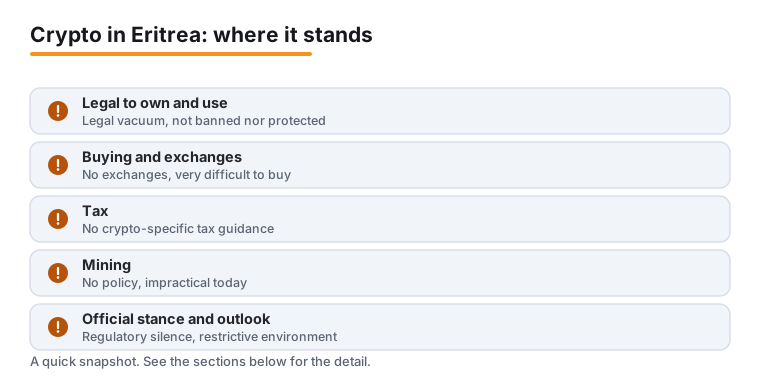
- Legal: No specific law, not recognised or banned, legal vacuum
- Tax: No crypto tax guidance, diaspora income tax cited at 2 percent
- Buying: Very hard, no licensed exchanges, P2P or funds held abroad
Eritrea is one of the most financially closed countries in the world, and that context shapes everything about how Bitcoin and other cryptocurrencies function there. The state controls the banking sector, the national currency (the nakfa, ISO code ERN) is not freely convertible, and strict exchange controls limit how residents can hold or move money. Against this backdrop, Eritrea has no dedicated law that legalises, regulates, or formally bans cryptocurrency. Crypto sits in a legal grey zone: not recognised as money, not licensed, not clearly protected, and operating well outside the official financial system.
This guide explains what is known about the legal status of crypto in Eritrea as of 2026, the relevant authorities, how currency and tax rules may apply, and the practical realities of buying, mining, and sending crypto in and out of the country. Where reliable public information is scarce, the guide says so and points you to the official source. This article is general information as of 2026 and is not legal, tax, or financial advice; verify any specific point with the Bank of Eritrea or a qualified Eritrean lawyer before acting. For wider context see our overview of crypto regulation.
On this page: Legal status · Who regulates it · Taxes · How to buy · Mining
Legal status: is Bitcoin and crypto legal in Eritrea?
There is no Eritrean statute that explicitly makes owning or using Bitcoin a criminal offence, and none that recognises it as legal tender or a regulated financial asset. In practice, cryptocurrency exists in a legal vacuum: it is neither expressly banned nor sanctioned and protected. Holding Bitcoin in a personal wallet is not specifically outlawed, but anyone using crypto has none of the consumer protections, dispute mechanisms, or legal recourse that regulated financial products would offer.
The more important issue is how crypto interacts with Eritrea's tight controls on foreign currency and cross-border transfers. It is generally unlawful for Eritrean citizens to hold or exchange foreign currency without permission, the nakfa is not convertible, and moving funds in or out of the country requires official approval. Because converting between crypto and foreign currency or the nakfa touches these rules, exchange-related crypto activity can attract scrutiny even where merely holding a coin does not. No global exchange operates a licensed onshore service in Eritrea, and many international platforms restrict or decline Eritrean users outright. Treat the environment as closed rather than merely unregulated, since the ESAAMLG mutual evaluation of Eritrea adopted in July 2025 found that virtual asset service providers are not recognized in terms of Article 5 of the Commercial Code of Eritrea and that there is no legal provision for licensing or registering them, and confirm the current position with a qualified local lawyer.
Who regulates crypto: the Bank of Eritrea
The central monetary authority is the Bank of Eritrea (BoE), based in Asmara. It is the sole issuer of the nakfa and is responsible for monetary policy, the banking system, and foreign-exchange control. There is no separate securities commission or dedicated digital-asset regulator in Eritrea, so any official position on crypto would come from the Bank of Eritrea and the Ministry of Finance rather than a specialist agency.
The Bank's legal mandate to license, regulate, and supervise financial institutions derives from the Bank of Eritrea Proclamation No. 93/1997, enacted alongside a Financial Institutions Proclamation the same year. Banking is dominated by state-owned institutions, foreign banks cannot open branches, and there is effectively no independent commercial-banking sector that would build regulated crypto services. The Bank of Eritrea's website (boe.gov.er) is frequently unreachable, so for verifiable text of the law many readers rely on the U.S. Library of Congress and other archives rather than a live official portal. As of 2026 the Bank of Eritrea has not published any crypto-specific licence, registration scheme, or public guidance on virtual assets.
Key laws and frameworks
Eritrea has no framework dedicated to digital assets. The rules that touch crypto are general financial, currency, and anti-money-laundering laws:
- Bank of Eritrea Proclamation No. 93/1997 and the 1997 Financial Institutions Proclamation establish the central bank and its power to license and supervise the banking system.
- Foreign-exchange and currency-control rules (including measures on foreign-currency accounts, settlement of domestic transactions, and remittance, such as the 2005 regulations) restrict holding foreign currency and moving money across borders. These are the rules most likely to apply to crypto conversions.
- Anti-Money-Laundering and Combating the Financing of Terrorism Proclamation No. 175/2014 is Eritrea's main AML/CFT law. It does not address virtual assets by name, but its financial-crime expectations could be read to cover anyone facilitating value transfers.
With no crypto-specific guidance published, gaps are likely to be interpreted conservatively by authorities. Keep clear records, and verify obligations with Eritrean counsel because published sources are limited and may not reflect informal practice. See our general primer on how crypto regulation works.
Licensing and registration of exchanges (VASPs)
Eritrea has no licensing or registration regime for crypto exchanges or virtual asset service providers (VASPs). There is no application process, no register of authorised providers, and no supervisory body assigned to oversee crypto firms. This is not a permissive environment: the absence of a licence pathway, combined with strict banking and exchange controls, means a compliant onshore exchange business effectively cannot be established.
The practical consequence is that no global exchange runs a regulated local operation, and there is no domestic platform a resident could use with legal certainty. Reports over the years have described authorities treating organised Bitcoin trading with suspicion. Anyone considering offering crypto services connected to Eritrea should assume there is no clear legal route and obtain local legal advice first. This differs sharply from jurisdictions that have built formal VASP registers; Eritrea simply has not created one.
It is worth noting that the earlier United Nations sanctions on Eritrea were lifted in November 2018 by Security Council Resolution 2444, and there are no UN or EU country-wide sanctions in force today. Even so, many international exchanges continue to restrict or decline Eritrean users through geolocation and identity checks, reflecting the country's high-risk profile and the difficulty of verifying customers there rather than a specific crypto ban.
Crypto taxation in Eritrea
Eritrea has not issued public tax guidance addressing cryptocurrency. There is no confirmed capital-gains treatment for crypto disposals, no stated rule for mining income, and no reporting form for digital-asset holdings. That silence is not the same as a tax exemption: general income-tax and business-tax rules are the only basis on which a crypto gain could be assessed, and the body that would assess it is the Inland Revenue Department under the Ministry of Finance and National Development, which holds the tax investigation mandate and whose Legal Division handles criminal cases affecting tax assessment and collection.
One feature of Eritrea's tax system is unusual and relevant to the diaspora: Eritrea levies a tax on the income of citizens living abroad, commonly described as a 2 percent rate. This levy, formally the Recovery and Rehabilitation Tax introduced by proclamation in 1995, is charged on the worldwide income of Eritrean citizens abroad. It is an income obligation linked to citizenship, not a crypto rule, but anyone in the diaspora considering crypto-based remittances should know that personal tax duties to Eritrea can exist independently of how funds are moved. This guide avoids quoting specific crypto tax rates or thresholds because none are reliably published for digital assets. Anyone with a potential liability should consult a qualified Eritrean tax professional and check official sources. For general concepts, see our guide to crypto taxes. This is not tax advice.
AML and KYC rules
Eritrea's principal anti-money-laundering law is the Anti-Money-Laundering and Combating the Financing of Terrorism Proclamation No. 175/2014. It does not mention virtual assets specifically, so there are no crypto-tailored KYC, travel-rule, or suspicious-transaction reporting obligations on exchanges (there are no licensed exchanges to bind in any case). General AML expectations apply through Proclamation No. 175/2014 as amended by Proclamation No. 181/2018, supplemented by AML/CFT Regulation Legal Notice No. 130/2018, and the money laundering offence at Article 31 reaches anyone facilitating transfers of value whatever form that value takes, carrying five to ten years rigorous imprisonment and a fine of up to fifty thousand nakfa.
Eritrea is a member of the Eastern and Southern Africa Anti-Money Laundering Group (ESAAMLG), the regional FATF-style body, but it is not itself a member of the Financial Action Task Force (FATF). International assessments have repeatedly described Eritrea's banking, legal, and regulatory systems as underdeveloped and opaque, and Eritrean officials have at times been reluctant to engage with international AML experts. The global trend is to bring crypto on-ramps and off-ramps within AML reporting, so even in the absence of local crypto rules, anyone moving value across borders should expect scrutiny to tighten as Eritrea works through the ESAAMLG follow-up process triggered by its July 2025 mutual evaluation, which rated all eleven effectiveness outcomes Low and returned 18 Non-Compliant ratings across the 40 FATF Recommendations, with none rated Compliant.
Buying and using crypto in practice
Buying crypto in Eritrea is hard for structural reasons rather than because of a single prohibition. International exchanges require bank cards, transfers, or supported local payment rails plus identity checks tied to a recognised banking system. Eritrea's banking sector is state-run, narrow, and largely disconnected from international card networks, the nakfa is not convertible, and many global platforms restrict Eritrean users. Reported per-person monthly bank withdrawal limits and an inability to freely withdraw foreign currency add further friction.
Internet access is also a binding constraint. Eritrea has one of the lowest connectivity rates in the world. Internet penetration was around 20 percent of the population at the start of 2025, meaning roughly four in five people were offline, which limits the realistic user base for any crypto activity. Mobile data is scarce, the country has no submarine cable landing station and relies on satellite and neighbouring-country links, and Starlink was still not available to Eritrean users as of 2026 because regulatory approval had not been granted. As a result, crypto access tends to depend on peer-to-peer arrangements, cash deals, or funds held abroad, often via family in the diaspora. These informal routes carry elevated counterparty and fraud risk and may run into the currency-control rules. If you transact at all, deal only with people or services you can verify, confirm wallet addresses carefully, and never assume the protections of a regulated exchange.
Mining crypto in Eritrea
Eritrea is sometimes described as having long-term potential for crypto mining because of strong solar and wind resources and a Red Sea geography suited to renewable generation. In theory, cheap clean energy is attractive for the power-hungry process of Bitcoin mining. In practice, there is no mining-specific permit, tax treatment, or policy, and the obstacles are substantial.
- Electricity supply: The national grid is limited and unreliable, with constrained capacity and frequent shortages. Stable, abundant, low-cost power is the single most important input for mining and is not readily available.
- Infrastructure and hardware: Mining needs specialised equipment, cooling, expertise, and the ability to import hardware. Import constraints, limited connectivity, and a shallow local tech base all work against this.
- Legal and currency uncertainty: Operators would face the same exchange-control and approval issues when converting any mined coins into usable funds.
So while the renewable-energy story is real as a future possibility, reliable mining is not practical today. Any claim of significant mining operations in Eritrea should be verified carefully.
Recent developments (2025 to 2026)
Eritrea still has no crypto-specific law, but the position is now documented rather than simply unknown. ESAAMLG adopted the first Mutual Evaluation Report of Eritrea in July 2025 and posted it on 28 August 2025, and it rates Eritrea Non-Compliant with FATF Recommendation 15, the standard covering virtual assets and virtual asset service providers. See our blockchain guide for the underlying technology. Eritrea has not announced a digital-asset law, a VASP licensing regime, or a central bank digital currency (CBDC), and the Bank of Eritrea has issued no public crypto guidance. The financial system remains closed and state-controlled, the nakfa stays non-convertible, and exchange controls are unchanged. The main practical changes affecting crypto access are about connectivity rather than law: internet penetration was 20.0 percent in October 2025, covering 726,000 users after a rise of 15,000 over the year, with 2.90 million people in Eritrea offline, and Starlink had not been approved for service in Eritrea as of 2026, so the on-ramp problem for residents remains as severe as before.
Regional context is shifting around Eritrea, which is worth watching but does not change Eritrean law. Neighbouring Ethiopia, for example, has pursued large-scale Bitcoin mining using surplus hydropower while its central bank has acted against peer-to-peer crypto trading. These developments are Ethiopian, not Eritrean, and should not be read as evidence of any change in Eritrea. For Eritrea specifically, note that there is no legislative pipeline to watch. The mutual evaluation records that the Constitution and Parliament have been suspended since 1998 and that the President assumes the powers of the National Assembly for law-making, so any crypto rule would arrive as a proclamation or presidential decree rather than as a bill with readable stages. The only external process that could prompt one is the ESAAMLG follow-up cycle triggered by the July 2025 report, and as of August 2026 ESAAMLG had published no follow-up report for Eritrea. Treat any claim that an Eritrean crypto bill is at a particular stage as unsourced until a proclamation number exists.
Consumer risks and protection
The risks of using crypto in Eritrea are unusually high. Because there is no recognition or licensing, there is no consumer protection, no deposit guarantee, and no official body to complain to if a platform fails or a counterparty disappears. Exchange and capital controls complicate conversions; reliance on informal peer-to-peer networks exposes users to fraud and theft; connectivity and electricity are unreliable; and ordinary crypto price volatility still applies. The lack of recourse means losses are often permanent.
Scams that target people with few financial options are a particular concern. Treat any service advertised as a Bitcoin ATM, local exchange, or guaranteed-return scheme in Eritrea with strong caution and verify it independently. There is no reliable evidence of public Bitcoin ATMs operating in the country. Only commit money you can afford to lose, use reputable self-custody wallets with strong authentication and offline backups, and never assume you can convert holdings on demand. See our broader regulation hub for how other jurisdictions handle consumer protection.
Official sources and how to verify
Because Eritrea publishes little online and the central bank's own site is often unreachable, cross-check any claim against authoritative records before relying on it. Useful starting points include:
- U.S. Library of Congress: Bank of Eritrea Proclamation No. 93/1997, the law establishing the central bank and its supervisory powers.
- FATF country profile for Eritrea, for the anti-money-laundering assessment context.
- ESAAMLG, the regional AML body Eritrea belongs to.
- U.S. State Department 2025 Investment Climate Statement: Eritrea, which describes the banking sector and currency controls.
The Bank of Eritrea (boe.gov.er) is the nominal official source for monetary and banking rules, but expect it to be intermittently offline; treat the archives above as practical alternatives. This guide is general information as of 2026 and is not legal advice. For any specific decision, verify the current position with the Bank of Eritrea or a qualified Eritrean lawyer.
What is changing: the position in August 2026
The short answer has not changed. Eritrea has no crypto-specific law, no licensing regime for exchanges, no central bank digital currency and no published Bank of Eritrea guidance on virtual assets. What has changed is that this is now recorded in a primary source with a date and a rating attached, rather than being an absence of information.
The Eastern and Southern Africa Anti-Money Laundering Group, of which Eritrea has been a full member since September 2021 and is one of 22 member countries, carried out an on-site assessment in Asmara from 16 July to 2 August 2024. The resulting Mutual Evaluation Report of Eritrea was adopted by the ESAAMLG Council of Ministers in July 2025 through a round robin process and posted on the ESAAMLG site on 28 August 2025. Eritrea had never been assessed before, so this is its first mutual evaluation.
Four findings in it answer questions this page could previously only hedge:
- Eritrea is rated Non-Compliant with FATF Recommendation 15, the standard covering new technologies, virtual assets and virtual asset service providers. Criterion 15.1 is marked not applicable and criteria 15.2 through 15.11 are each recorded as Not Met.
- Virtual asset service providers are not recognized in terms of Article 5 of the Commercial Code of Eritrea, and the report states there is no legal provision for licensing or registering them.
- There is no securities sector in Eritrea, so there is no capital markets regulator that could take on crypto oversight.
- The Financial Intelligence Unit is not yet operational. The Bank of Eritrea and the FIU are the named AML and CFT supervisors for financial institutions, but at the time of the on-site visit the FIU had five staff against a requirement of ten and no dedicated budget.
One piece of context in the report explains why no crypto bill is pending and why none is likely to appear through a parliamentary process. The report records that since 1998 Eritrea has been in a state of emergency with the Constitution and Parliament suspended, and that the President assumes the powers of the National Assembly for law-making and treaty ratification, with the country applying presidential decrees. Any Eritrean crypto rule would therefore arrive as a proclamation or decree rather than as a bill working through a legislature.
Nothing in the report suggests Eritrea has moved toward permitting or regulating crypto. The assessors found no evidence of virtual asset transactions or VASPs in the country at all.
What the July 2025 mutual evaluation found on virtual assets
The relevant findings, quoted or closely paraphrased from the ESAAMLG Mutual Evaluation Report of Eritrea, July 2025.
| Question | What the report says |
|---|---|
| Are there any crypto businesses in Eritrea? | "There is no evidence of virtual asset transactions and VASPs in Eritrea." The financial sector is described as closed to the outside world, with no financial system infrastructure to facilitate such activities. |
| Could one be set up legally? | No. VASPs are not recognized in terms of Article 5 of the Commercial Code of Eritrea, and the report states there is no legal provision for licensing or registering VASPs. |
| Is there a crypto supervisor? | No. "There is no designated AML/CFT supervisor for VASPs (no presence in Eritrea)." The Bank of Eritrea and the FIU supervise financial institutions, and the FIU is not yet operational. |
| Is there a securities or capital markets angle? | No. "There is no securities sector in Eritrea." |
| How is Eritrea rated on the virtual asset standard? | Non-Compliant with Recommendation 15. Criterion 15.1 is not applicable and criteria 15.2 to 15.11 are each Not Met. |
| How does that sit against the rest of the system? | All eleven immediate outcomes are rated Low effectiveness. Of the 40 FATF Recommendations, 18 are Non-Compliant, 16 Partially Compliant, 4 Largely Compliant and 2 not applicable. None is rated Compliant. |
| What does the financial sector consist of? | Two commercial banks with 29 branches, one insurance company, and one foreign exchange bureau and money transfer operator under a single company, plus a development bank and a microfinance programme run by the Ministry of Finance and National Development. There are no automatic teller machines, debit or credit cards, or internet banking. |
| Can money be sent out of the country? | Outward remittances are prohibited by law. The two commercial banks conduct them only in exceptional circumstances, such as paying for medical treatment abroad, which require government approval. The money transfer operator handles inbound transactions only. |
The named rules that actually apply
There is no crypto law, so these are the instruments that would govern anything a reader does with crypto in or from Eritrea. All are identified in the July 2025 mutual evaluation.
| Instrument | What it does | Why it matters for crypto |
|---|---|---|
| Bank of Eritrea Proclamation No. 93/1997, Article 5(2)(d), read with Financial Institutions Proclamation No. 94/1997, Articles 3(2)(e), 6(3), 11 and 12(2) | The Bank of Eritrea licenses financial institutions and money or value transfer services and prescribes the licensing requirements. Article 11 makes it an offence to conduct a financial activity without a licence, punishable under Article 12(2). | There is no virtual asset licence category to apply for, and running an unlicensed transfer or exchange service is a criminal offence rather than merely an unregulated activity. |
| AML/CFT Proclamation No. 175/2014, as amended by Proclamation No. 181/2018 | Article 31 criminalises money laundering, punishable by five to ten years rigorous imprisonment and a fine of up to fifty thousand nakfa, given in the report as 3,350 US dollars. Article 6(3)(b) requires customer due diligence on occasional transactions above USD 10,000. | The money laundering offence does not depend on what form the value takes. Designated non-financial businesses owe only suspicious transaction reporting and the tipping-off prohibition. |
| AML/CFT Regulation Legal Notice No. 130/2018 and Directive 1/2018 | Additional AML and CFT requirements for financial institutions, a prohibition on shell banks at Article 6, and a USD 10,000 de minimis threshold for cross-border wire transfers at Article 16(10). Directive 1/2018 sets the structure of the Financial Intelligence Unit. | The assessors flag the USD 10,000 wire threshold as ten times the FATF standard of USD 1,000, so transfers below it carry no originator information obligation. This is the reporting plumbing, and the FIU that would receive reports is not yet operational. |
| Proclamation No. 173/2013, Articles 6 and 7 | Written declaration to Customs required for travellers carrying currency above 10,000 US dollars or equivalent, with civil and penal sanctions for non-declaration and a fine of up to fifty thousand nakfa alongside confiscation. | The practical rule for anyone moving cash across the border to fund or cash out a position. Bearer negotiable instruments are not covered, and there is no sanction for a false declaration. |
| Bank of Eritrea Directive of 2015 (Currency Conversion Policy) | Cash withdrawals capped at 5,000 nakfa a month for individuals and 20,000 nakfa a month for companies. Transfers above 5,000 nakfa must go by cheque deposit or through a bank. | The binding constraint on peer-to-peer buying. The report converts these to roughly 350 US dollars and 1,340 US dollars a month, and anything larger passes through state-owned banks. |
| Business Licensing System Control and Business Licensing Office Establishment Proclamation No. 72/2000 | Makes the Ministry of Trade and Industry responsible for issuing business licences. Article 20 empowers the Bank of Eritrea to set the requirements for becoming a financial institution and to inspect and supervise licensed institutions. | The Business Licensing Office registers commercial businesses under the Commercial Code, and tax clearance from the Inland Revenue office is needed first. This is the route a crypto business would have to use, and the point at which Article 5 of the Commercial Code stops it. |
On tax, there is still no crypto-specific rule, rate or reporting form. The authority that would assess a gain is the Inland Revenue Department under the Ministry of Finance and National Development, which holds the tax investigation mandate and whose Legal Division handles criminal cases affecting tax assessment and collection.
What is coming next, and what cannot be dated
No crypto bill is before any Eritrean body, and the mutual evaluation records none. That absence is meaningful: under ESAAMLG procedure, assessors may refer to relevant bills and proposals to amend the system where these are made available, and the Eritrea report refers to no virtual asset bill, draft or consultation of any kind.
There is also no legislature for one to sit in. The report states that Eritrea has been in a state of emergency since 1998 with the Constitution and Parliament suspended, and that the President assumes the powers of the National Assembly for law-making. Any crypto rule would arrive as a presidential proclamation or decree, which can appear without a public pipeline and without notice. Readers should treat any claim that an Eritrean crypto bill is at a particular stage as unsourced until a proclamation number exists.
The only external process that could prompt a virtual asset rule is the ESAAMLG follow-up cycle. Recommendation 15 is named among the preventive measures deficiencies Eritrea is told to rectify, alongside Recommendations 1, 6, 10, 12, 16, 19 and 22 to 23. Eritrea's published ratings also meet the criteria for enhanced follow-up under the second round procedures, which place a country in enhanced follow-up if any one of four triggers applies: 8 or more Non-Compliant or Partially Compliant technical ratings, a Non-Compliant or Partially Compliant rating on any of Recommendations 3, 5, 10, 11 or 20, low or moderate effectiveness on 7 or more of the 11 outcomes, or low effectiveness on 4 or more of them. Eritrea meets all four.
Three cautions on timing, which is where this subject attracts invented specifics.
- ESAAMLG has published no follow-up report for Eritrea. Under the second round procedures a country in enhanced follow-up presents its first report at the first Task Force meeting six months after adoption, which for a July 2025 adoption would have fallen in about January 2026. That point has passed and nothing for Eritrea has appeared on the ESAAMLG news listing, where the most recent follow-up reports, posted on 14 May 2026, cover Angola, Malawi, Mozambique, Seychelles and Uganda.
- It is not published which procedures govern Eritrea's follow-up. Eritrea was assessed under the 2013 methodology, but ESAAMLG also issued third round procedures in June 2025, a month before Eritrea's report was adopted, and those set different enhanced follow-up triggers and a different timetable built around a roadmap of key recommended actions. Eritrea would qualify for enhanced follow-up under either document, but the reporting dates differ between them.
- Virtual assets are not a priority. None of the ten priority actions at the front of the report mentions virtual assets. They concern risk assessment, the money laundering offence, targeted financial sanctions, customer due diligence, suspicious transaction reporting, beneficial ownership, standing up the FIU, asset recovery, law enforcement capacity and mutual legal assistance.
Frequently asked questions
Is Bitcoin legal in Eritrea?
There is no published Eritrean law that specifically legalises or bans Bitcoin. Owning crypto is not named as a crime, but it is also not recognised or protected, and any activity that converts or transfers foreign currency can run into Eritrea's strict exchange controls. Treat the position as restrictive and unsettled, and confirm with the Bank of Eritrea or local legal counsel. This is general information, not legal advice.
Who regulates cryptocurrency in Eritrea?
The Bank of Eritrea is the central monetary and banking authority, acting under the Bank of Eritrea Proclamation No. 93/1997. There is no separate crypto or securities regulator, and the Bank has not issued any crypto-specific licence, registration scheme, or public guidance as of 2026. Its website (boe.gov.er) is frequently unreachable, so verifiable legal text is often found through archives such as the U.S. Library of Congress.
Can I legally buy Bitcoin from inside Eritrea?
It is very difficult. The banking system is state-run and largely disconnected from international card networks, the nakfa is not convertible, internet access is among the lowest in the world, and many global exchanges restrict Eritrean users. In practice, access relies on peer-to-peer deals or funds held abroad, which carry significant fraud and counterparty risk and may engage currency-control rules. Always check a platform's current acceptance policy first.
How is crypto taxed in Eritrea?
Eritrea has not published crypto-specific tax rules, so there are no confirmed rates or thresholds for digital assets. General income and business tax principles could still apply. Separately, Eritreans living abroad are subject to a diaspora income tax commonly cited at 2 percent, which is unrelated to crypto but can apply to remittances. Consult a qualified Eritrean tax professional and rely on official sources. This is not tax advice.
Does Eritrea have crypto AML or KYC rules?
Eritrea's main AML law is the Anti-Money-Laundering and Combating the Financing of Terrorism Proclamation No. 175/2014, which does not mention virtual assets and imposes no crypto-specific KYC obligations. Eritrea is a member of the regional body ESAAMLG but not of FATF. Anyone moving value across borders should still expect scrutiny, since global standards increasingly bring crypto on-ramps and off-ramps under AML reporting.
Are there Bitcoin ATMs or licensed exchanges in Eritrea?
No. There is no reliable evidence of public Bitcoin ATMs, and Eritrea has no licensing regime for crypto exchanges or VASPs, so no platform operates onshore with legal certainty. Even conventional cash ATMs are scarce, with withdrawals often made over the counter under monthly limits. Treat any service advertised as a crypto ATM or local exchange with caution and verify it independently.
Is Eritrea under sanctions that block crypto?
The earlier United Nations sanctions on Eritrea were lifted in November 2018 by Security Council Resolution 2444, and there are no UN or EU country-wide sanctions in force today. Despite this, many international exchanges still restrict or decline Eritrean users through geolocation and identity checks, because of the country's high-risk profile and the difficulty of verifying customers, not because of a specific crypto sanction. Always check a platform's current acceptance policy.
Why is it so hard to get online for crypto in Eritrea?
Eritrea has one of the lowest connectivity rates in the world, with internet penetration around 20 percent at the start of 2025, meaning roughly four in five people were offline. The country has no submarine cable landing station and depends on satellite and neighbouring-country links, mobile data is scarce, and Starlink had not been approved for service as of 2026. Poor connectivity is one of the main practical barriers to any crypto use.
Has Eritrea passed a crypto law yet?
No. As of August 2026 there is no crypto-specific law, no licensing regime for exchanges and no central bank digital currency in Eritrea, and no bill is known to be before any Eritrean body. The nearest thing to an official position is the ESAAMLG Mutual Evaluation Report of Eritrea, adopted in July 2025 and posted on 28 August 2025, which rates Eritrea Non-Compliant with FATF Recommendation 15, the standard covering virtual assets.
Is an Eritrean crypto law expected soon?
There is no basis for putting a date on it. Eritrea has been in a state of emergency since 1998 with the Constitution and Parliament suspended, and the President assumes the powers of the National Assembly for law-making, so there is no bill pipeline to track. A crypto rule would appear as a proclamation or presidential decree, without public stages. The July 2025 mutual evaluation records no virtual asset bill, draft or consultation, and virtual assets do not appear among the ten priority actions the report sets for Eritrea. Treat any claim that a specific Eritrean crypto bill is coming by a given date as unsourced unless it carries a proclamation number.
Why can I not open a crypto exchange or brokerage in Eritrea?
Because the activity is not a recognised category of business. The July 2025 ESAAMLG mutual evaluation records that virtual asset service providers are not recognized in terms of Article 5 of the Commercial Code of Eritrea, and that there is no legal provision for licensing or registering them. The Ministry of Trade and Industry issues business licences and the Business Licensing Office registers commercial businesses under the Commercial Code, but there is no VASP category to register and no Bank of Eritrea licence class that fits. Conducting a financial activity without a licence is itself an offence under Article 11 of the Financial Institutions Proclamation No. 94/1997.
Which regulator would deal with crypto in Eritrea?
The Bank of Eritrea, by default. It licenses financial institutions under the Financial Institutions Proclamation No. 94/1997 and money or value transfer services under Article 5(2)(d) of the Bank of Eritrea Proclamation No. 93/1997. There is no capital markets alternative, because the July 2025 mutual evaluation states there is no securities sector in Eritrea. The Financial Intelligence Unit is the other named AML supervisor, but the report found it not yet operational, with five staff against a requirement of ten and no dedicated budget.
What practical limits stop me buying crypto peer to peer in Eritrea?
Cash, card rails and connectivity. A Bank of Eritrea directive introduced in 2015 caps cash withdrawals at 5,000 nakfa a month for individuals, given in the report as about 350 US dollars, and 20,000 nakfa a month for companies, with transfers above 5,000 nakfa going by cheque deposit or through a bank. The mutual evaluation also records that Eritrea has no automatic teller machines, no debit or credit cards and no internet banking, and that outward remittances are prohibited by law except in exceptional cases such as medical treatment abroad, which need government approval. On connectivity, internet penetration was 20.0 percent in October 2025, meaning 2.90 million people in Eritrea were offline.
Do I have to declare crypto when crossing the Eritrean border?
There is no crypto declaration rule. Proclamation No. 173/2013 requires a written declaration to Eritrean Customs from travellers carrying currency above 10,000 US dollars or the equivalent in other convertible currencies, with civil and penal sanctions for failing to declare. The ESAAMLG assessment notes this requirement does not extend to bearer negotiable instruments, that there is no sanction for a false declaration, and there is no separate provision for virtual assets.
Facts reviewed: 13 August 2026. Page updated: 13 August 2026.