How to Spot a Fake Crypto Exchange
Fake crypto exchanges and cloned trading apps are one of the most common ways people lose money in this space. They do not break encryption or steal your keys with clever code. They simply build something that looks like a real platform, get you to deposit, and then either block your withdrawals or vanish. The good news is that almost every fake follows the same handful of patterns, and a few minutes of checking before you deposit will catch the large majority of them. This guide walks through the concrete red flags, the two scams that trap most victims (the withdrawal block and the deposit bonus), how cloned app-store listings work, and exactly how to verify a platform against official regulators and registers before you send a single dollar. This is educational information, not financial advice.
What a fake exchange actually is
A fake exchange is a website or app designed to look like a legitimate trading platform so that you deposit funds you can never get back. There are a few distinct flavors, and knowing which one you are looking at helps you spot it.
- Clone sites: a near-perfect copy of a real exchange, often on a slightly different domain (for example a hyphen, an extra word, or a different country code added to a well-known brand name).
- Invented platforms: a brand new name with a slick site, fake trading dashboard, and made-up volume figures. Common in romance and "investment mentor" scams.
- Fake apps: an app uploaded to a store, or sent as a direct download link, that imitates a known brand or invents a new one.
The shared goal is always the same. Your account balance on screen is just a number they control. It does not represent real coins held anywhere, so when you try to withdraw, the money is not actually there.
The classic red flags
No single sign proves a scam, but the more of these you see, the higher the risk. Treat several together as a hard stop.
- Guaranteed or fixed returns. Promises like "earn 2% per day" or "daily profit guaranteed" are not how real markets work. Real trading carries real loss.
- You were recruited, not searching. If a stranger from a dating app, WhatsApp group, Telegram channel, or social media DM introduced you to the platform, the platform itself is suspect.
- Pressure to deposit fast. "This bonus ends today" or "the price window is closing" exists to stop you from checking.
- Deposits only in crypto, or to a personal wallet. Real exchanges have audited corporate banking. Being told to send USDT to a single wallet address is a giant warning.
- No real company details. No registered company name, no verifiable address, no named executives, a domain registered weeks ago.
- Poor or scripted support that pushes you to deposit more, especially when you ask about withdrawals.
- Spelling and design slips, broken links, or a "live chat" that only ever talks about adding funds.
The withdrawal-block scam, step by step
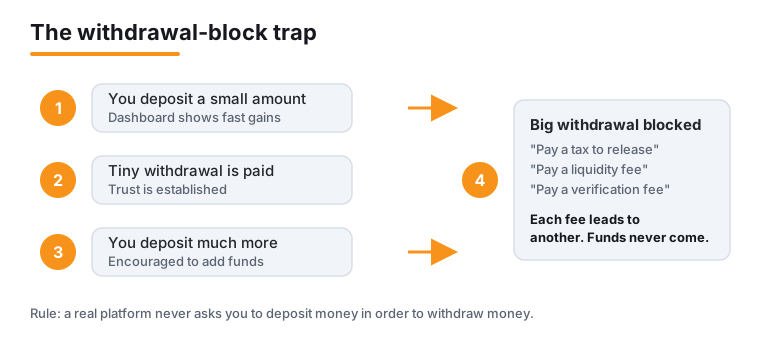
This is the single most common trap, and it is worth understanding in detail because the early stages feel completely normal. The platform lets you in, shows you profits, and even processes one small withdrawal to build trust. The block only appears once you try to take out a meaningful amount.
- You deposit a modest sum and watch the dashboard show steady gains.
- You request a small withdrawal. It is paid quickly. Your trust grows.
- You deposit much more, often after being encouraged to.
- You request a large withdrawal. Suddenly there is a problem.
- You are told you must pay a "tax," "liquidity fee," "verification deposit," or "anti-money-laundering release fee" before funds can move.
- Each fee you pay leads to another fee. No withdrawal ever arrives.
The rule that protects you: a legitimate platform never asks you to deposit more money in order to withdraw your own money. Taxes are paid to your government after you receive funds, never to the exchange as a precondition for release. If you are asked to pay a fee to unlock a withdrawal, you are in a scam, and paying more will not help. For background on how investment fraud is reported, the US FTC publishes guidance at ftc.gov and the FBI takes reports at ic3.gov.
The deposit-bonus and "matched funds" scam
This trap dresses a deposit demand up as a reward. You are offered a bonus that sounds generous: "deposit 1,000 and we will match it with 1,000 in trading credit," or "VIP tier unlocks at a 5,000 deposit." The catch is buried in the terms.
- The bonus inflates the number you must clear before withdrawing. Accepting it means you must trade a huge multiple of the combined balance before any funds can be taken out, which is mathematically designed to be impossible.
- The bonus is fake leverage. A few bad "trades" wipe out your real deposit while the bonus credit, which never existed, simply disappears.
- It is bait for a bigger deposit. The whole point is to get more of your real money in, since none of it will ever come out.
Real, regulated exchanges occasionally run small promotions, but they do not require you to lock up your principal behind enormous trading volume just to withdraw, and they never pair a bonus with pressure from a personal "account manager." If a bonus is the reason you are being urged to deposit more, treat the platform as hostile.
Fake app-store listings and cloned apps
Scammers know that an app on the official App Store or Google Play feels trustworthy, so they try hard to get listings up, and they also push people to install apps from outside the stores entirely. Watch for these patterns.
- Sideloaded or "TestFlight" links. If someone sends you a direct .apk file, a configuration profile to install, or a TestFlight invite for a trading app, stop. Most legitimate exchanges distribute through the official app stores, and a few, Binance for example, also publish an Android APK on their own website. The warning sign is not the file type, it is the source: only install from a download page you reached by typing the exchange's address yourself, never from a link or file someone sent you.
- Look-alike names and icons. A famous brand name with an extra word, a slightly wrong logo color, or a developer name that is not the real company.
- Brand-new listings with few, vague reviews, or a flood of five-star reviews that all read the same and arrived in the same week.
- Mismatched developer. Tap the developer name and check it links to the company's other known apps and official website.
How to check a listing
- Find the link from the official website, not from a message. Go to the exchange's real homepage (typed in yourself) and use its download button.
- Verify the developer account on the store page matches the company, and read recent, detailed reviews, not just the star average.
- Cross-check the app name against the company's own "download our app" page.
Apple and Google both document how to recognize and report fraudulent or impersonating apps. See Apple's App Store guidance at apple.com and Google Play's policies at play.google.com. Being in a store is reassuring, but it is not proof: bad listings do slip through and are removed later, so still verify the platform itself.
How to verify a platform against regulators and registers
This is the step that catches platforms a glossy website cannot fake. Before depositing, spend ten minutes confirming the platform is who it claims to be and is allowed to operate. Most countries publish free registers and scam warning lists.
- United States: check the SEC at sec.gov and the CFTC at cftc.gov, which both run investor alerts and fraud advisories. For brokers, FINRA's BrokerCheck is the standard tool.
- United Kingdom: search the FCA's register and its Warning List of unauthorized firms at fca.org.uk. A firm on the Warning List should be avoided outright.
- European Union: since the MiCA transitional period ended on 1 July 2026, a firm serving EU clients must hold authorisation as a crypto-asset service provider. Check ESMA's register of authorised providers at esma.europa.eu, and also read the warnings published by ESMA and your national regulator.
- Other countries: search "[your country] financial regulator warning list crypto" to find the official body.
A quick verification routine
- Search the exact platform name plus the word "scam" and plus "review." Read what real users and journalists say, not just the platform's own pages.
- Look it up on the regulator's register and warning list for your country, using the links above.
- Check the company behind it: a registered legal entity, a verifiable address, and named people. No company details is a stop sign.
- Check the domain age with a free WHOIS lookup. A site claiming years of history on a domain registered last month is lying.
- Confirm the website address character by character. Type it yourself rather than clicking a link, and watch for look-alike letters and extra words.
If the platform is not on any recognized register, claims to be regulated by a body you cannot find, or appears on a warning list, do not deposit. Being unregulated is not always proof of fraud, but combined with any other red flag here it is reason enough to walk away.
Before you deposit: a final checklist
Run through this short list every time, even when a platform looks established. It takes minutes and it is your strongest single defense.
- Did I find this myself, or was I recruited by a stranger or a "mentor"? Recruitment is a major warning.
- Am I being rushed by a deadline, a bonus, or pressure to add more? Slow down.
- Did I type the web address myself and confirm every character?
- Did I check the regulator's register and warning list for my country?
- Does a real company stand behind this, with an address and named people?
- Am I ever asked to pay a fee to withdraw? If yes, it is a scam, full stop.
- Did I install the app from the official store via the official site, not a sideload link?
Start with a small test amount and a small test withdrawal on any platform that is new to you, and keep your funds on platforms only as long as you are actively using them. Self-custody hardware wallets such as those documented at ledger.com remove the exchange from the equation entirely for long-term holdings, since the platform never controls your coins.
Frequently asked questions
An exchange paid my first small withdrawal. Doesn't that prove it is real?
No. Paying a small withdrawal is a deliberate trust-building tactic used in the withdrawal-block scam. The cost of paying you back a tiny amount is nothing compared to the larger deposit they are trying to lure out of you next. A successful small withdrawal is not evidence the platform is legitimate, and you should still verify it against your regulator's register before adding more.
The platform says I must pay tax before I can withdraw. Is that normal?
No. Taxes on investment gains are paid to your government, after you have received your funds, through your normal tax filing. No legitimate exchange collects "withdrawal tax," "liquidity fees," or "release fees" as a precondition for sending you your own money. Any such demand is a scam, and paying it will only lead to more demands.
I found the app on the official App Store or Google Play. Is it safe?
Being in an official store is reassuring but not proof. Fraudulent and impersonating apps do get through review and are removed later. Always check that the developer account matches the real company, read recent detailed reviews rather than just the star rating, and confirm the app from the company's own official website. Never install a trading app from a direct download link, .apk file, configuration profile, or TestFlight invite sent to you.
How do I check if an exchange is regulated?
Search your national financial regulator's online register and its warning or alert list. In the US that is the SEC at sec.gov and the CFTC at cftc.gov; in the UK it is the FCA at fca.org.uk, which also publishes a Warning List of unauthorized firms. If the platform is not findable on a recognized register, claims oversight from a body you cannot locate, or appears on a warning list, do not deposit.
I think I already deposited into a fake exchange. What should I do?
Stop sending money immediately, including any "fee" you are told will release your funds, since that is part of the scam. Take screenshots of the dashboard, wallet addresses, chats, and the website. Report it to your national authorities: in the US to the FTC at ftc.gov and the FBI's IC3 at ic3.gov, and to your bank or card provider if traditional payment was involved. Be wary of "recovery" services that contact you afterward, as recovery scams specifically target people who have already lost money.
Are decentralized or self-custody options safer than exchanges?
They remove a different risk. With a self-custody wallet you hold your own keys, so no exchange can block your withdrawal or disappear with your funds. That does not make you immune to scams: fake wallet apps, phishing sites, and malicious token approvals are real threats, and self-custody means you alone are responsible for backups and security. For long-term holdings, reputable hardware wallets reduce platform risk, but you still verify every site and app you connect to.